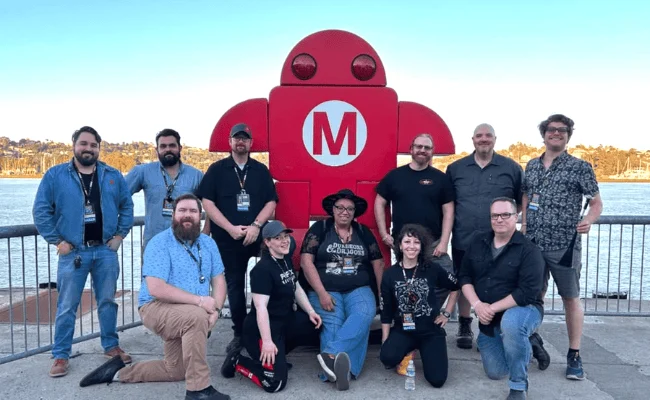
In an era increasingly dominated by digital visual effects, the enduring appeal of tangible artistry continues to captivate audiences worldwide. This sentiment was vividly brought to life at the highly anticipated Maker Faire Bay Area 2025, where animatronics designer Jesse Velez, founder of Raptor House FX, offered an unprecedented look into the creation of one of recent television’s most memorable and beloved sci-fi props: the fully wireless, real-time animatronic "Thing" from Netflix’s hit series Wednesday. Velez’s presentation, titled "Thing Lives!", not only pulled back the curtain on the intricate engineering and creative hacking involved but also celebrated the powerful resurgence of practical effects in major productions, demonstrating how dedicated craftsmanship can forge a deeper, more visceral connection with fans.
The Enduring Allure of "Thing" and the Wednesday Phenomenon
The character of "Thing T. Thing," a disembodied, sentient hand, has been an integral and iconic member of the Addams Family since its inception in Charles Addams’ cartoons. Across various adaptations, from the classic 1960s television series to the Barry Sonnenfeld films of the 1990s, "Thing" has consistently provided both comedic relief and crucial assistance to the eccentric family. When Netflix announced its spin-off series Wednesday, focusing on Wednesday Addams’ formative years at Nevermore Academy, expectations were high for how this beloved character would be reimagined. The creative team, including visionary director Tim Burton, made a deliberate choice that would profoundly impact the series’ authenticity and fan engagement: they opted for a practical, animatronic "Thing" rather than relying solely on computer-generated imagery (CGI).
This decision proved to be a stroke of genius. Wednesday, which premiered in November 2022, quickly shattered Netflix viewing records, becoming the most-watched English-language series in its first week. A significant part of its charm and success was attributed to the tactile, expressive presence of "Thing." Unlike its predecessors, this iteration of "Thing" was designed for extensive, unassisted interaction, performing alongside the cast in numerous scenes and, crucially, engaging with the public at a series of high-profile global promotional events. It was this latter requirement that posed a unique challenge, one that Jesse Velez and his team at Raptor House FX were uniquely positioned to solve.
From Concept to Global Premiere: The Journey of an Animatronic Icon
The journey of the Wednesday "Thing" from a conceptual prop to a global sensation is a testament to Velez’s innovative approach to animatronics. As he detailed at Maker Faire, the project began, as many great innovations do, with a simple yet ambitious prototype: a walking hand. The initial brief was clear – create a prop that could not only move convincingly but also interact spontaneously, mirroring human movements in real-time without cumbersome wires or visible human operators. This demanded a level of portability, wireless functionality, and expressive control that pushed the boundaries of traditional animatronic design.
The development timeline for "Thing" was rigorous, reflecting the fast-paced nature of television production and the ambitious global marketing strategy for Wednesday. Following the series’ production, Velez’s team faced the task of refining the on-set prop into a robust, travel-ready performer. The critical phase involved transforming the initial walking hand prototype into a fully autonomous, portable unit capable of traversing diverse environments and interacting seamlessly with A-list talent and adoring fans. This evolution required meticulous attention to miniaturization, power management, and real-time control systems.
Once perfected, the animatronic "Thing" embarked on an extraordinary global tour, accompanying the Wednesday cast to red carpet premieres and promotional events in major cities including Los Angeles, New York, Seoul, Istanbul, and London. In each location, "Thing" became an instant star, charming audiences and generating significant social media buzz. Its ability to "shake hands," "wave," and even "sign autographs" (with a pen held in its fingers) in real-time, often improvising reactions to the surrounding environment and the cast’s playful interactions, underscored the profound impact of practical effects in creating genuinely memorable experiences. This global exposure cemented "Thing’s" status not just as a prop, but as a living, breathing character in its own right, directly engaging with millions of fans across different cultures.
The Technical Alchemy: Hacking, Engineering, and Artistry
Velez’s presentation delved into the technical "magic" behind "Thing," revealing a philosophy that champions creative hacking, resourcefulness, and the seamless integration of diverse components. Rather than relying on purely bespoke, high-cost solutions for every element, Velez’s approach, as he articulated, involves a judicious blend of readily available, off-the-shelf components with purpose-built parts, all meticulously engineered to work in harmony. This methodology is a hallmark of the "maker" movement, emphasizing ingenuity and practical problem-solving.
While Velez did not provide an exhaustive list of every screw and circuit, he highlighted the key "ingredients" that brought "Thing" to life:
- Miniaturized Robotics and Servos: At the core of "Thing’s" movement are high-precision, miniature servo motors. These small, powerful actuators control the intricate articulation of each finger and the palm, allowing for a wide range of expressive gestures. The challenge was to integrate enough servos to achieve realistic movement while keeping the overall size and weight minimal.
- Wireless Communication Systems: The most critical innovation for the global tour version was its fully wireless operation. This involved robust, low-latency wireless transceivers to transmit control signals from the off-screen performer to the animatronic hand. Ensuring stable communication across various international venues, often crowded with other wireless signals, required sophisticated frequency management and error correction protocols.
- Real-Time Control Interface: The magic of "Thing’s" spontaneity comes from its real-time control. This typically involves a "puppeteer" or performer wearing a specialized glove or haptic feedback suit that translates their hand movements into commands for the animatronic. Advanced sensor technology within this interface captures the performer’s finger movements, wrist rotations, and overall hand posture, sending this data instantly to the animatronic unit.
- Microcontroller and Custom Software: A compact, powerful microcontroller serves as the brain of "Thing," receiving wireless commands and translating them into precise movements for each servo. Custom firmware and software were undoubtedly developed to handle the inverse kinematics (calculating the required joint angles to achieve a desired end-effector position), ensure smooth transitions, and manage power consumption efficiently.
- Power Management: Given its portable and wireless nature, "Thing" relied on a compact, high-density battery system. Optimizing battery life while maintaining performance was crucial for extended appearances at events. This would have involved careful selection of energy-efficient components and intelligent power management algorithms.
- Durable and Lightweight Materials: The exterior of "Thing" had to be both visually convincing and robust enough to withstand extensive travel and repeated public interactions. This likely involved lightweight but durable materials for the skeletal structure, possibly 3D-printed components for intricate parts, and a skin-like covering that could withstand wear and tear while maintaining a realistic appearance.
- Aesthetic Integration: Beyond the technical prowess, the artistry of "Thing" lies in its seamless integration. The visible mechanisms had to be minimized, and the surface texture, coloration, and subtle details had to perfectly match the character’s grotesque yet endearing aesthetic established in the series.
Velez’s mastery lies not just in selecting these components but in "making it all work and feel seamless." This involves countless hours of calibration, programming, and iterative refinement to ensure that the mechanical movements appear organic and imbued with character, blurring the line between machine and living entity.
The Resurgence of Practical Effects in a CGI World

Jesse Velez’s work on "Thing" is more than just an impressive technical achievement; it is a powerful statement about the evolving landscape of film and television production. For decades, the industry has leaned heavily on CGI for everything from fantastical creatures to mundane background elements, driven by advancements in computing power and the perceived cost-effectiveness and flexibility of digital manipulation. However, a growing sentiment, both among creators and audiences, suggests a longing for the tangible, the "real."
Practical effects, which encompass animatronics, prosthetics, miniatures, and in-camera illusions, offer a unique advantage: they exist in physical space. This means they interact with real light, cast real shadows, and often evoke a more visceral reaction from both actors on set and viewers watching the final product. Actors often report that working with a physical prop or creature, like "Thing," enhances their performance, allowing for more authentic reactions and interactions compared to acting opposite a green screen marker.
The success of "Thing" underscores a broader trend. Recent productions like The Mandalorian (which extensively uses puppetry and animatronics for Grogu), Dune (employing practical sets and creature effects), and even older classics like Jurassic Park (pioneering animatronics alongside early CGI) demonstrate that when practical effects are executed well, they can create an unparalleled sense of presence and authenticity. This isn’t to say CGI is obsolete; rather, it suggests a more balanced approach where practical effects are utilized when they offer a superior emotional or visual impact, with CGI augmenting or filling in the gaps. Velez’s presentation at Maker Faire implicitly advocates for this symbiotic relationship, highlighting how practical solutions can anchor fantastical elements in reality, making them more believable and impactful.
Fan Engagement and the Power of the Tangible
The global tour of "Thing" offered an invaluable case study in fan engagement. In an age where fan interaction often occurs primarily through digital platforms, the opportunity for a physical, albeit brief, encounter with a beloved character is extraordinarily powerful. Fans at the Wednesday premieres were not just watching a show; they were experiencing a piece of its magic firsthand. The sight of "Thing" scuttling across a red carpet, interacting with Jenna Ortega or other cast members, and even "posing" for selfies created indelible memories and generated authentic, enthusiastic social media content that money cannot buy.
This "Future is Tactile" philosophy, as Velez describes it, extends beyond entertainment. It speaks to a fundamental human desire for tangible experiences in an increasingly digital world. Whether it’s the thrill of a live concert, the tactile pleasure of a handcrafted item, or the awe inspired by a complex animatronic, there is an intrinsic value in interacting with something real, something that occupies physical space and responds to its environment. For the "maker" community, this resonates deeply. It champions the act of creation, the joy of building, and the satisfaction of seeing an idea manifest in the physical world.
Jesse Velez: A Visionary Maker

Jesse Velez embodies the spirit of the modern maker. His work with Raptor House FX is not just about technical proficiency but about artistic vision and a relentless drive to bring imaginative concepts to life. His approach of creatively hacking together off-the-shelf and purpose-built components, then meticulously refining them, is a perfect illustration of the maker ethos: innovative problem-solving, hands-on experimentation, and a commitment to craft. His presentation at Maker Faire Bay Area 2025 served as both an inspiration and an educational insight for aspiring animatronics designers, engineers, and creators.
Velez’s contribution to Wednesday highlights how independent studios and talented individual makers are increasingly playing crucial roles in high-profile productions, demonstrating that groundbreaking practical effects don’t always require massive, in-house studio departments. The accessibility of tools, components, and knowledge through communities like Maker Faire empowers creators like Velez to deliver Hollywood-quality results with ingenuity and passion.
Looking Ahead: The Continued Evolution of Practical Effects
The success of "Thing" and the insights shared by Jesse Velez at Maker Faire Bay Area 2025 signal a promising future for practical effects. As technology continues to advance, the line between practical and digital will likely blur further, with each informing and enhancing the other. We can anticipate even more sophisticated animatronics, enhanced by AI and machine learning, offering greater autonomy and responsiveness. The integration of augmented reality with physical props could create hybrid experiences that further immerse audiences.
Ultimately, Velez’s work on "Thing" serves as a powerful reminder that while digital tools offer limitless possibilities, there remains an irreplaceable magic in the tangible, the physical, and the handcrafted. In an age of digital overload, the visceral thrill of seeing something real, complex, and "alive" right in front of you—whether on screen or on a red carpet—is a testament to the enduring power of human ingenuity, one servo and line of code at a time. The enthusiasm generated by "Thing" and Velez’s presentation affirms that the future of storytelling will always benefit from a healthy dose of the wonderfully, tangibly real.