The Foundational Principles of Electric Motors: A Categorical Overview
To appreciate the distinctiveness of transverse flux motors, it is essential to first understand the established classifications within the electric motor universe. Electric motors, fundamentally, convert electrical energy into mechanical energy through the interaction of magnetic fields. The primary means of categorizing these machines often revolves around the orientation of their magnetic flux relative to the motor’s axis of rotation.
Radial Flux Motors: The Industry Standard
By far the most prevalent type of motor found across countless industrial, commercial, and domestic applications is the radial flux design. In these motors, the magnetic flux path is predominantly perpendicular to the axis of rotation. This configuration is intuitive and forms the basis for a vast array of motors, including common AC synchronous motors, induction motors, and various DC motor designs. Picture a conventional motor shaft (part of the rotor) sitting concentrically within a stationary housing (the stator); the magnetic field lines typically traverse the air gap between the rotor and stator in a radial direction, hence the name. Their robust design, mature manufacturing processes, and well-understood performance characteristics have cemented their status as the workhorse of electrification. However, in applications demanding extremely high torque at low speeds or compact form factors, radial flux motors can sometimes become bulky or necessitate complex gearing systems, leading to efficiency losses and increased maintenance.
Axial Flux Motors: Embracing Compactness
A less common but increasingly vital category is the axial flux motor. These motors are engineered such that the magnetic flux travels parallel to the axis of rotation. This distinct magnetic path often results in a flatter, thinner profile, earning them the descriptive moniker "pancake-style" motors. Their inherent compactness makes them highly desirable for applications where axial space is restricted, such as in-wheel motors for electric vehicles, specialized aerospace actuators, and certain robotics applications where slim profiles are advantageous. While they offer superior form factors in specific scenarios, axial flux motors also present their own set of design and manufacturing challenges, particularly concerning thermal management and structural integrity due to their disc-like construction.
Transverse Flux Motors: A Departure from Orthodoxy
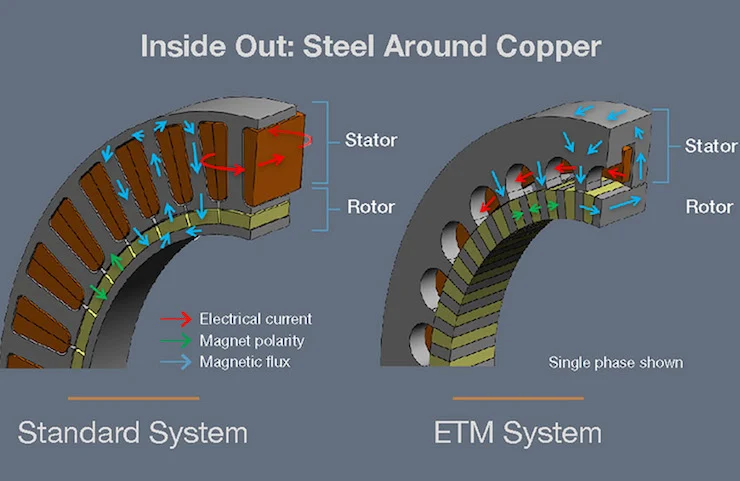
In stark contrast to both radial and axial flux architectures, the transverse flux motor (TFM) features a magnetic flux path that is transverse to the axis of rotation. This means the magnetic flux flows across the axis, creating a fundamentally different interaction between the stator and rotor. Practically, TFMs are often constructed with a unique stator arrangement where a single winding for each phase is wound circumferentially around the stator, enveloping the axis of rotation. This innovative winding strategy allows the magnetic flux to propagate along multiple, often complex, paths – including axially across the stator, along the circumference of the rotor, and radially through the air gap between these components. This multi-dimensional flux path is a cornerstone of the TFM’s exceptional performance characteristics.
The Engineering Marvel: Decoupling and Torque Density
The distinctive winding architecture of transverse flux motors is not merely an aesthetic choice; it underpins their most significant advantage: the ability to decouple the number of machine poles from the physical size of the windings themselves. In conventional radial or axial flux motors, increasing the number of poles typically necessitates reducing the space available for windings or making the windings more intricate, which can limit current capacity and increase resistance, thereby impacting efficiency and heat dissipation.
By allowing the magnetic flux to flow in a transverse manner and wrapping a single, large winding circumferentially, TFMs overcome this inherent limitation. This decoupling allows for a significantly higher number of poles to be integrated into the motor design without compromising winding space. More poles mean more magnetic interactions per revolution, which directly translates to a dramatically higher torque density. This enhanced torque density, measured in Newton-meters per kilogram (Nm/kg) or Newton-meters per cubic meter (Nm/m³), is a game-changer for applications requiring substantial power in a compact package.
Beyond torque density, TFMs also boast superior efficiency, particularly in direct-drive applications. Direct drive systems eliminate the need for mechanical gearboxes, which are typically used to multiply torque from conventional motors but introduce efficiency losses, backlash, noise, and maintenance requirements. By generating high torque directly, TFMs enable simpler, more robust, and more efficient mechanical systems, leading to reduced energy consumption and lower operational costs over the motor’s lifespan.
Recent Advancements and Industry Adoption: The ETM Robotics Initiative
The theoretical advantages of transverse flux motors have long been recognized in academic and research circles, but their practical implementation has historically been challenging. However, recent breakthroughs in materials science, manufacturing techniques, and computational modeling are paving the way for their commercial viability. A significant milestone in this journey was recently announced by ETM, a company that has successfully introduced transverse flux motors into the demanding robotics market.
ETM’s innovation centers on a patented architecture that explicitly addresses the longstanding trade-off between efficiency and size in electric motors. By effectively decoupling the magnetic flux from the electrical windings, ETM claims its motor technology can achieve the high torque density typically associated with high-ratio geared systems, but with the superior efficiency and thermal reliability characteristic of low-ratio or direct-drive systems. Specifically, the company has stated that its transverse flux motor technology provides up to 10 times greater torque density compared to conventional motors of similar size and weight.
This claim, if substantiated across a range of real-world applications, represents a profound leap forward for the robotics industry. Traditional robotic joints often rely on complex and heavy harmonic drives or cycloidal gearboxes to achieve the necessary torque and precision. These gearboxes add weight, introduce compliance, generate heat, and require regular maintenance. The ability to replace these components with a direct-drive TFM could dramatically improve robot performance metrics.
Implications for Robotics and Industrial Automation
The integration of TFMs, as exemplified by ETM’s foray into the market, carries substantial implications for the future of robotics and industrial automation:
- Increased Payload Capacity and Reach: Lighter, more powerful joints mean robots can carry heavier loads or extend their reach without compromising structural integrity. This is particularly beneficial for collaborative robots (cobots) that work alongside humans, where safety and dexterity are paramount.
- Enhanced Dynamic Performance: Direct-drive motors offer superior control bandwidth and responsiveness due to the elimination of gearbox compliance and friction. This translates to faster acceleration, more precise movements, and better trajectory tracking, crucial for high-speed pick-and-place operations or delicate manipulation tasks.
- Improved Energy Efficiency: The removal of gearboxes directly contributes to higher overall system efficiency. This is vital for battery-powered mobile robots and AGVs (Automated Guided Vehicles), extending their operational duration between charges.
- Reduced Maintenance and Downtime: Fewer mechanical components inherently lead to fewer points of failure. The elimination of gearboxes, which are often subject to wear and tear, significantly reduces maintenance requirements and increases the operational uptime of robotic systems.
- Compact and Sleek Designs: The high torque density allows for smaller, more integrated motor designs, enabling the creation of more compact and aesthetically pleasing robots that can operate in confined spaces or blend seamlessly into various environments.
Industry analysts suggest that the introduction of such advanced motor technologies will accelerate the adoption of robotics in sectors previously constrained by performance or cost. The potential for lighter, stronger, and more agile robots could unlock new applications in logistics, healthcare, agriculture, and service industries, expanding the global robotics market significantly.
Challenges and Overcoming Hurdles
Despite their compelling advantages, transverse flux motors are not without their complexities and drawbacks, which have historically limited their widespread adoption. Addressing these challenges is critical for their continued market penetration:
- Cogging and Ripple Torque: TFMs are often cited for issues related to cogging torque and ripple torque. Cogging torque is an undesirable torque pulsation that occurs even when the motor is unenergized, caused by the magnetic attraction between the permanent magnets (if present) and the stator teeth. Ripple torque, on the other hand, refers to unwanted torque variations that occur during operation. Both phenomena can lead to vibrations, noise, and reduced precision, especially at low speeds. Research efforts are focused on optimizing stator and rotor geometries, magnet arrangements, and employing advanced control algorithms to mitigate these effects.
- Complex Mechanical Design and Manufacturing: The unique, often three-dimensional magnetic flux path of TFMs typically necessitates a more intricate mechanical design compared to conventional motors. This complexity can translate into higher manufacturing costs, requiring specialized tooling, assembly techniques, and quality control processes. The precision required for aligning multiple flux paths and ensuring robust construction adds to the overall design and production expense.
- Non-Linear Dynamics: The intricate magnetic circuit of TFMs often exhibits highly non-linear dynamics. This characteristic complicates the accurate modeling and simulation of motor behavior, making it more challenging to design precise control systems. Advanced computational tools, such as finite element analysis (FEA), are indispensable for understanding and predicting their performance, but these require significant expertise and computational resources.
- Low Power Factor: Some transverse flux motor designs can suffer from a relatively low power factor. A low power factor means that the motor draws more apparent power (kVA) from the supply for a given amount of real power (kW) it produces. This can lead to larger current requirements, necessitating thicker cables and potentially oversized power electronics (inverters), which adds to the system cost and complexity. Engineers are exploring strategies to improve the power factor through optimized magnetic designs and advanced power electronic topologies.
The Road Ahead: Research, Development, and Future Prospects
The journey for transverse flux motors from a theoretical concept to a commercially viable technology is a testament to ongoing innovation in electrical engineering. Research and development efforts globally are concentrated on overcoming the aforementioned drawbacks. This includes:
- Materials Science: Exploring new magnetic materials with higher saturation flux densities and lower losses, as well as advanced composite materials for structural components to reduce weight and improve thermal performance.
- Advanced Manufacturing: Developing novel additive manufacturing techniques (3D printing) and automated assembly processes to reduce the complexity and cost associated with TFM production.
- Control Algorithms: Designing sophisticated control strategies that can compensate for cogging and ripple torque, manage non-linear dynamics, and optimize efficiency across varying operating conditions.
- Integrated Design: Focusing on holistic system design where the motor, power electronics, and control unit are co-designed to maximize performance and minimize inefficiencies.
The potential applications for transverse flux motors extend far beyond robotics. Their high torque density and efficiency make them attractive for:
- Electric Vehicles (EVs): As traction motors, potentially enabling direct-drive wheel hubs or more compact powertrain solutions, enhancing range and performance.
- Renewable Energy: As direct-drive generators in wind turbines, eliminating gearboxes and increasing reliability and efficiency in harsh environments.
- Heavy Industrial Machinery: In applications like excavators, conveyors, and presses, where high torque at low speeds is critical, reducing hydraulic system complexity and improving energy efficiency.
- Aerospace and Defense: For actuators and propulsion systems where weight and volume are premium considerations.
Conclusion
Transverse flux motors represent a compelling frontier in electric motor technology. By fundamentally rethinking the path of magnetic flux and decoupling critical design parameters, these motors offer unprecedented torque density and efficiency, particularly beneficial for direct-drive applications. While challenges related to design complexity, manufacturing cost, and dynamic performance persist, continuous innovation, as evidenced by companies like ETM, is steadily bringing TFMs closer to widespread commercial adoption. As the global demand for energy-efficient, powerful, and compact electromechanical systems grows, transverse flux motors are poised to play a transformative role, reshaping industries from robotics and automation to electric transportation and renewable energy, solidifying their position as a high-torque revolution in motion.






