In a landmark achievement for material science and industrial sustainability, a collaborative team of international researchers has announced the development of a groundbreaking filtration technology that could redefine how global industries manage separation processes. This new class of highly precise filtration membranes, dubbed "POMbranes," is the result of a multi-institutional effort involving the CSIR-Central Salt and Marine Chemicals Research Institute (CSMCRI) in Bhavnagar, the Indian Institute of Technology Gandhinagar (IITGN), Nanyang Technological University (NTU) in Singapore, and the S N Bose National Centre for Basic Sciences in Kolkata. The study, which details the molecular engineering and performance of these membranes, was recently published in the prestigious Journal of the American Chemical Society (JACS), signaling a major shift toward more energy-efficient and precise industrial manufacturing.
The Global Challenge of Industrial Separation
The significance of this development is rooted in a critical but often overlooked aspect of modern manufacturing: the separation of substances. Whether it is purifying life-saving drugs, treating wastewater from textile factories, or refining food products, separation processes are the backbone of industrial production. However, these processes come at a staggering environmental and economic cost. Currently, industrial separations account for approximately 40% to 50% of total global industrial energy consumption. This is largely because most facilities still rely on traditional thermal-based methods such as distillation and evaporation.
While distillation is effective, it requires heating large volumes of liquid to their boiling points, a process that is inherently energy-intensive and responsible for a massive carbon footprint. Membrane-based filtration has long been proposed as a "cold" and cleaner alternative, but the technology has historically faced significant hurdles. Conventional polymer membranes, while flexible and relatively cheap to produce, often suffer from uneven pore sizes. Over time, these organic polymers can swell, degrade, or lose their structural integrity when exposed to harsh chemicals or high pressures, leading to a loss in filtration precision and a shortened operational lifespan.
Engineering the POMbrane: A Nature-Inspired Solution
To overcome the limitations of traditional plastic filters, the research team turned to nature for inspiration. Biological systems, such as the aquaporin channels found in living cells, are capable of transporting water molecules with near-perfect efficiency while blocking other ions and solutes. These natural channels utilize precisely sized, molecularly rigid pores to achieve their selectivity.
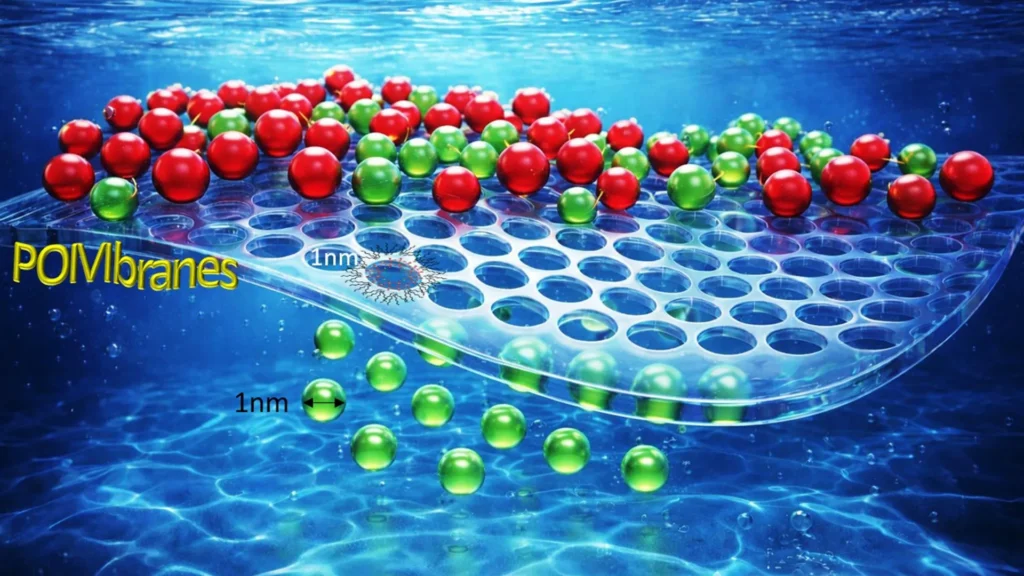
The researchers replicated this principle by utilizing polyoxometalate (POM) clusters. POMs are inorganic, metal-oxygen clusters that possess a unique advantage: they are crystalline and inherently rigid. Dr. Shilpi Kushwaha, a Senior Scientist at CSMCRI and one of the lead researchers on the project, explained that the team engineered these "POMbranes" to contain pores exactly one nanometer wide—roughly 100,000 times thinner than a human hair.
"To address the limitations of conventional membranes, we engineered a new class of ultra-selective, crystalline membranes," Dr. Kushwaha stated. Unlike polymer pores, which are formed by the random gaps between tangled plastic chains, the pores in POMbranes are built into the very structure of the metal clusters themselves. These "crown-shaped" clusters have a permanent, perfect hole in their center that does not change shape or degrade, providing a level of stability that was previously unattainable in flexible membrane technology.
Technical Breakthrough: From Clusters to Continuous Films
One of the primary challenges in moving from a laboratory discovery to a practical industrial tool is scalability. While individual POM clusters are highly effective, creating a large-scale, defect-free membrane required arranging billions of these tiny ring-like structures into a continuous layer.
The research team, including co-first authors Ms. Priyanka Dobariya (CSMCRI) and Mr. Vinay Thakur (IITGN), developed a sophisticated chemical strategy to achieve this. They attached flexible chemical chains to the rigid POM clusters, effectively creating a hybrid material that combines the precision of inorganic crystals with the processability of organic polymers. When these modified clusters were introduced to a water surface, they naturally self-assembled into an ultrathin, large-area film.
Dr. Raghavan Ranganathan, an Associate Professor at IITGN’s Department of Materials Engineering, noted that the team could control the density of the membrane by adjusting the length of the attached chemical chains. This level of control ensures that molecules attempting to pass through the membrane are forced through the one-nanometer holes of the clusters, rather than leaking through gaps between them. To verify this mechanism, Dr. Ranganathan and Mr. Thakur conducted extensive molecular-level simulations, which provided a "digital twin" of the filtration process, confirming that the POM clusters act as a high-tech molecular sieve.
Unprecedented Precision: Measuring the Performance Gap
The results of the performance testing were stark. The POMbranes demonstrated a capability to distinguish between molecules based on a difference of only 100 to 200 Daltons (a unit of molecular mass). This level of "molecular weight cut-off" is incredibly difficult for standard membranes to achieve consistently.
According to Dr. Ketan Patel, Principal Scientist at CSMCRI, the POMbranes showed nearly ten times better separation performance compared to existing commercial technologies. Furthermore, the membranes maintained their integrity across a wide range of acidity levels (pH ranges) and remained stable under the mechanical stresses typical of industrial filtration. This combination of high selectivity, chemical durability, and physical flexibility makes them a prime candidate for wide-scale industrial adoption.
Economic Significance: Transforming India’s Industrial Landscape
The introduction of POMbrane technology comes at a pivotal time for India’s economy, particularly for the textile and pharmaceutical sectors. India’s textile and apparel industry is a cornerstone of the national economy, contributing over 2.3% to the GDP and accounting for 13% of industrial production. With the domestic market projected to reach $350 billion by 2030, the environmental impact of this growth is a major concern.
Textile dyeing and finishing are notoriously water-intensive and produce large volumes of effluent contaminated with complex dye molecules. Traditional treatment methods often struggle to remove these dyes efficiently enough to allow for water recycling. POMbranes offer a solution by selectively sieving out dye molecules while allowing clean water to pass through. This could significantly reduce the industry’s freshwater demand and help factories comply with increasingly stringent "Zero Liquid Discharge" (ZLD) regulations.
In the pharmaceutical sector, where India is often referred to as the "pharmacy of the world," the implications are equally profound. Drug purification and solvent recovery are critical steps that determine both the quality and the cost of medication. Mr. Vinay Thakur emphasized that the high selectivity of POMbranes can lower energy use in these processes while maintaining the rigorous purity standards required by global health regulators.
Chronology of Development and Future Outlook
The development of POMbranes followed a rigorous multi-year timeline:
- Conceptual Design: Researchers identified POM clusters as ideal candidates for stable, nanometer-sized pores.
- Molecular Modification: The team successfully synthesized hybrid clusters by grafting flexible chains onto the POM cores.
- Self-Assembly Optimization: Experiments at the air-water interface led to the discovery of the optimal conditions for forming continuous, defect-free ultrathin films.
- Computational Validation: Molecular dynamics simulations at IITGN confirmed the sieving mechanism at a molecular scale.
- Performance Testing: The membranes were tested against a variety of dyes, salts, and pharmaceutical precursors to establish their 10x performance advantage.
As the global manufacturing sector moves toward "Industry 4.0" and "Green Chemistry," technologies like POMbranes are expected to play a central role. The research team describes the new membrane as a "platform technology," meaning it can be adapted for various uses beyond water treatment and drug purification, including lithium extraction, hydrogen purification, and carbon capture.
Sustainability and the Path to Net-Zero
The broader impact of this research lies in its contribution to global sustainability goals. By reducing the energy required for industrial separations by up to 50%, POMbranes could directly contribute to a significant reduction in industrial CO2 emissions. Furthermore, the ability to facilitate high-efficiency water reuse addresses the growing global crisis of water scarcity.
As industries look for ways to decouple economic growth from environmental degradation, the marriage of biological principles with advanced materials science—as seen in the POMbrane project—provides a clear roadmap. The next phase for the research team involves scaling the production of these membranes for industrial-scale pilots, bringing this nature-inspired "molecular sieve" from the laboratory to the factory floor. By applying precise control at the molecular scale and adapting it into a scalable material technology, the researchers from India and Singapore have demonstrated a viable path toward a more efficient and sustainable industrial future.