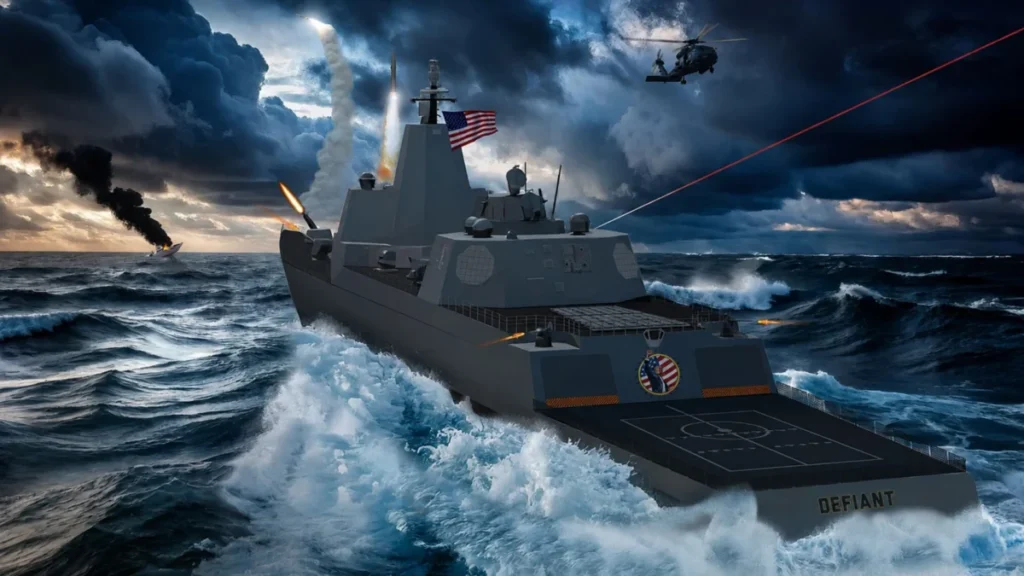
According to a comprehensive report by the Congressional Budget Office (CBO), the acquisition of 15 of these next-generation warships, tentatively dubbed "Trump-class" in some discussions, is projected to incur an astronomical cost of approximately $275 billion. This monumental investment signals a significant strategic pivot for the U.S. Navy, aiming to bolster its capabilities in an increasingly complex and contested global maritime environment. The CBO report, specifically requested by Senator Jeff Merkley, serves to provide a transparent evaluation of how this new platform is expected to impact long-term military spending and the Navy’s budgetary trajectory.
Unprecedented Investment and Budgetary Shifts
The sheer financial commitment required for this fleet is staggering. The lead vessel in this new class is estimated to cost around $23 billion alone, reflecting the extensive research, development, and pioneering manufacturing processes involved in its initial construction. As full-scale production is anticipated to ramp up, subsequent ships in the series are projected to average about $18 billion each over their extensive operational lifetimes, encompassing not just procurement but also sustainment, maintenance, and potential modernization cycles.
Should these plans come to fruition, the financial landscape of the Navy’s surface warship acquisition budget will undergo a dramatic transformation. Annual spending in this critical sector is forecast to more than double, rocketing from the current baseline of $6.9 billion to an unprecedented $15.2 billion. This surge in expenditure is part of a broader, long-term defense strategy. Between the years 2027 and 2056, defense planners intend to procure a total of 72 major warships. This comprehensive acquisition plan includes the 15 new nuclear-powered battleships, alongside 57 Arleigh Burke-class destroyers, which have long served as the backbone of the U.S. Navy’s surface fleet. The inclusion of a large number of these proven destroyers alongside the cutting-edge battleships indicates a strategy of maintaining numerical strength while integrating advanced, high-end capabilities.
Historical Context and Strategic Imperatives
The concept of a "battleship" for the U.S. Navy evokes images of the formidable Iowa-class vessels, the last operational battleships in the American fleet, which served through World War II, Korea, Vietnam, and even saw action in the Gulf War before their final decommissioning. These behemoths were symbols of naval power projection, armed with massive guns. However, the proposed BBGN (Battleship, Guided Missile, Nuclear) represents a radical departure from these historical predecessors. It is designed not for direct gun-to-gun engagements, but for a new era of distributed lethality, long-range precision strike, and energy-based defensive systems, responding to evolving threats and geopolitical realities.
The strategic rationale behind such an expensive and technologically ambitious program is rooted in the intensifying "Great Power Competition," particularly with China and Russia. Both nations have significantly modernized and expanded their naval capabilities, introducing advanced anti-access/area denial (A2/AD) strategies, sophisticated anti-ship missiles, and hypersonic weapons. The U.S. Navy’s decision to pursue these nuclear-powered battleships can be interpreted as a response to these challenges, aiming to ensure sustained forward presence, enhance power projection capabilities in contested environments, and maintain a decisive technological edge. The new class is envisioned to provide unparalleled endurance, firepower, and energy reserves necessary to operate effectively in these future high-intensity conflicts.
A Massive Hull for Massive Power
The proposed warship, officially designated BBGN, is designed to be an engineering marvel. Reports indicate that it will possess a fully loaded displacement of between 35,000 and 41,000 tons. This makes it the largest surface combatant designed for the U.S. Navy since the mighty battleships of World War II, dwarfing contemporary vessels in size and displacement.
To contextualize its colossal scale, the BBGN will boast more than double the mass of the Zumwalt-class destroyer, a vessel already noted for its significant size and stealth characteristics. Furthermore, it will be approximately 3.5 times larger than the Navy’s current workhorse, the Arleigh Burke-class destroyer, which typically displaces around 9,000-10,000 tons. This immense hull is not merely for show; it is a critical engineering requirement to accommodate the vast power generation and distribution systems needed for its advanced capabilities.
Naval engineers require a hull of this magnitude primarily to supply raw power. Modern radar systems, which demand increasing energy for enhanced range and resolution, coupled with advanced laser weapons and sophisticated computing networks, require an immense and continuous supply of electricity. A massive hull provides the necessary physical space and structural integrity for multiple nuclear reactors, heavy cooling units essential for managing the heat generated by these systems, and the complex high-voltage power networks required to distribute that energy throughout the ship. This design philosophy underscores a shift towards "power-dense" naval platforms, where energy generation is as crucial as traditional propulsion.
Arsenal of the Future: Heavy Weapons and Directed Energy
The design philosophy of the BBGN places a heavy emphasis on long-range strike capability and cutting-edge energy-based defense systems. For conventional missile operations, the warship is slated to feature an impressive array of 128 Mark 41 vertical launch system (VLS) cells. These versatile cells are capable of firing a wide range of munitions, including anti-air missiles (such as the SM-2, SM-3, and SM-6 variants), and land-attack cruise missiles like the Tomahawk. The Mark 41 VLS is a ubiquitous system across the U.S. Navy, ensuring commonality and logistical efficiency, but 128 cells on a single surface combatant represents an enormous magazine depth.
These conventional VLS cells will be supplemented by four large-diameter launch tubes specifically dedicated to the Conventional Prompt Strike (CPS) hypersonic missiles. The integration of hypersonic weapons is a critical component of the Navy’s push for rapid global strike capabilities, allowing for the engagement of time-sensitive, high-value targets with unprecedented speed and precision, significantly reducing reaction times for adversaries.
Beyond conventional and hypersonic missiles, the CBO report explicitly states, "The Navy has stated that the ship would be equipped to carry the nuclear-armed sea-launched cruise missile, or SLCM-N." This particular armament adds a significant layer to the ship’s strategic profile, placing it in a unique category. With the potential to carry SLCM-N, coupled with its extensive conventional arsenal, the BBGN would possess more firepower than any other American vessel, with the sole exception of the Ohio-class ballistic missile submarines, which are purpose-built for strategic nuclear deterrence. The potential inclusion of SLCM-N has, however, been a subject of ongoing debate within arms control circles and Congress, raising questions about its necessity for deterrence and potential implications for strategic stability.
The BBGN’s future-forward design extends to incorporating advanced directed energy weapons. The report further notes, "Other elements would include large lasers, a rail gun, and a variety of defensive systems such as guns, smaller missiles, decoys, and optical dazzlers intended to counter and disrupt unmanned aerial systems." The integration of "large lasers" points towards high-energy laser weapons capable of intercepting incoming missiles, drones, and small boats with high precision and at a low cost per shot, offering a "deep magazine" concept unlike traditional missile interceptors. Railguns, while still in advanced development, promise the ability to launch projectiles at extreme velocities using electromagnetic forces, providing long-range, high-impact kinetic strike capabilities. The comprehensive suite of defensive systems, including smaller missiles, electronic warfare capabilities, and optical dazzlers, underscores the necessity for layered defense against increasingly sophisticated threats like swarming drones and advanced anti-ship cruise missiles.
Nuclear Propulsion: The Heart of Endurance and Power
The choice of propulsion system is central to the BBGN’s innovative design and operational philosophy. While a conventional gas-turbine engine would initially lower construction costs by approximately 13 percent, the long-term benefits of nuclear propulsion far outweigh this initial saving.
A nuclear reactor dramatically reduces long-term operational costs by eliminating the need for periodic refueling, which is a costly and time-consuming logistical exercise for conventionally powered ships. Nuclear propulsion allows the ship to operate indefinitely without returning to port for fuel, constrained only by provisions for its crew and maintenance cycles. This unparalleled endurance significantly enhances its ability to maintain a sustained forward presence in distant theaters, critical for power projection and deterrence. Crucially, nuclear reactors provide the constant, immense electricity required by the futuristic radar, laser weapons, and advanced computing systems that define the BBGN. This reliable and abundant power source is a fundamental enabler for the ship’s most advanced capabilities, allowing for continuous operation of energy-intensive systems without compromising propulsion.
Manufacturing and Industrial Base Considerations
The manufacturing process for these colossal warships is envisioned to rely on a shared industrial network, a strategy aimed at leveraging the national shipbuilding infrastructure and distributing economic benefits. Different shipyards across the country will be tasked with fabricating individual sections of the hull and various components. These massive sections will then be transported to HII Newport News Shipbuilding, a facility renowned for its expertise in nuclear-powered vessel construction, where final assembly will take place in Drydock 12. This specific drydock is notable for its capacity, having previously been utilized for the construction of Ford-class aircraft carriers, underscoring the scale and complexity of the BBGN project.
This distributed manufacturing approach seeks to mitigate risks associated with single-point failures in the supply chain and to foster a robust shipbuilding industrial base. However, it also presents challenges in terms of logistics, coordination, and ensuring consistent quality control across multiple sites. The specialized nature of nuclear shipbuilding also necessitates a highly skilled workforce, and investments in training and workforce development will be crucial to meet the demands of this ambitious program.
Timeline and Future Outlook
The Pentagon has formally requested $1 billion in early funding for the BBGN program in fiscal year 2027. This initial investment is intended to cover preparatory work, long-lead time components, and detailed design finalization, paving the way for the official order of the first battleship in 2028. Given the complexity and scale of such a project, the construction of the lead ship is expected to take many years, with commissioning likely in the late 2030s or early 2040s. The full fleet of 15 ships would then be rolled out over several decades, fundamentally reshaping the U.S. Navy’s capabilities well into the latter half of the 21st century.
This program, while promising unparalleled naval power, also comes with inherent risks. The history of large-scale defense acquisition programs is replete with examples of cost overruns, schedule delays, and technological integration challenges. The Zumwalt-class destroyer program, for instance, faced significant cost increases and a reduction in planned ships from 32 to just three, offering a cautionary tale of ambitious naval designs. Maintaining strict budgetary discipline and rigorous oversight will be paramount to prevent similar issues with the BBGN program.
The development and deployment of these nuclear-powered battleships represent a strategic gamble by the U.S. Navy. It is a bet on the future of naval warfare, where sustained power, advanced weapon systems, and long-range endurance are seen as critical determinants of maritime dominance. The outcome of this ambitious endeavor will undoubtedly shape the balance of global power and the nature of naval operations for generations to come.