In a landmark study published in the journal Nature, a research team led by the Massachusetts Institute of Technology (MIT) has revealed that ordinary graphite, the same material found in common pencil lead, possesses a far more complex electronic life than previously understood. At the microscopic level, specifically within a configuration known as rhombohedral graphene, researchers have identified multiple distinct superconducting states. This discovery is particularly significant because while superconductivity—the ability of electrons to flow through a material with zero electrical resistance—has been observed in thousands of materials, it is exceptionally rare for a single material to host several different forms of this state.
The research, led by Long Ju, the Lawrence C. and Sarah W. Biedenharn Associate Professor of Physics at MIT, demonstrates that rhombohedral graphene is not merely a "boring carbon material," but a highly tunable platform for exotic physics. By manipulating experimental "knobs" such as electrical voltages and magnetic fields, the team was able to coax the material into showing behaviors that defy conventional physical expectations, including superconducting states that actually strengthen when exposed to high-intensity magnetic fields.
The Architectural Complexity of Rhombohedral Graphene
To understand the breakthrough, one must first look at the structure of carbon at the atomic scale. Graphene is a single layer of carbon atoms arranged in a hexagonal, honeycomb-like lattice. While single-layer graphene has its own suite of remarkable properties, physicists have spent the last decade exploring what happens when these layers are stacked.
Most graphite found in nature or used in industrial applications consists of graphene layers stacked in an "ABA" pattern, where the third layer aligns perfectly with the first. However, a smaller percentage of natural graphite forms in a "rhombohedral" or "ABC" configuration. In this version, each layer is slightly offset from the one below it, creating a structure reminiscent of a staircase. This specific stacking order is critical because it alters the electronic band structure of the material, creating "flat bands" where electrons slow down and interact with one another more intensely.
For years, the scientific community focused on "magic-angle" twisted bilayer graphene—a process where two sheets of graphene are manually stacked and rotated at a specific angle of 1.1 degrees to induce superconductivity. The MIT team’s approach differs by looking at naturally occurring rhombohedral structures. This eliminates the need for precise manual twisting and allows researchers to study the intrinsic properties of the carbon stack itself. To isolate these samples, the researchers used the "Scotch tape method"—a technique pioneered by Nobel laureates Andre Geim and Konstantin Novoselov—to exfoliate thin flakes from bulk graphite, searching for the specific rhombohedral signatures under a microscope.
Experimental Methodology and the Role of Electron Density
The study involved isolating flakes of rhombohedral graphene consisting of four or five layers. Once isolated, the team placed these samples in a specialized refrigerator capable of reaching temperatures near absolute zero (millikelvin range). In collaboration with Dominik Zumbühl’s group at the University of Basel in Switzerland, the researchers utilized high-precision equipment to measure the material’s resistance under extreme conditions.
The core of the experiment involved "doping" the material—adjusting the concentration of charge carriers. In previous studies, the team had added electrons to the graphene (n-doping) and observed superconductivity. In this latest effort, they decided to explore the opposite: removing electrons to create "holes" (p-doping). By meticulously lowering the electron density and applying an external electric current, they monitored the voltage. When the voltage dropped to zero, it signaled that the material had entered a superconducting state.
The researchers discovered that as they tuned the density of these holes, four distinct superconducting states emerged at different intervals. This multi-state phenomenon suggests that rhombohedral graphene possesses a highly versatile electronic landscape, where the way electrons pair up can change fundamentally based on the environment provided by the researchers.
Defying Magnetic Interference
Perhaps the most startling aspect of the discovery is how these superconducting states reacted to magnetic fields. In conventional superconductors, magnetic fields are the "enemy." Superconductivity typically relies on "Cooper pairs"—pairs of electrons with opposite spins (one up, one down) that cancel each other’s magnetic moment. When a magnetic field is applied, it exerts force on these spins, attempting to align them both in the same direction. This "spin-flip" usually breaks the Cooper pair, destroying the superconducting state.
However, the MIT team observed that three of the four superconducting states in rhombohedral graphene persisted even when subjected to a magnetic field of up to 9 tesla. To put this in perspective, 9 tesla is approximately 180,000 times stronger than the Earth’s magnetic field.
Furthermore, when the magnetic field was applied perpendicular to the graphene plane, the researchers witnessed a phenomenon that Long Ju described as "exotic." Instead of the magnetic field suppressing the superconductivity, it actually enhanced it. The critical temperature—the point above which superconductivity vanishes—increased from 55 millikelvin to roughly 90 millikelvin. Additionally, the material was able to carry 50 to 60 percent more current before the superconducting state collapsed.
Theoretical Implications: Aligned Spins and Triplet Pairing
The persistence and enhancement of superconductivity in high magnetic fields suggest that the electrons in rhombohedral graphene may not be forming conventional Cooper pairs. The researchers propose that the material might be hosting "triplet" superconductivity.
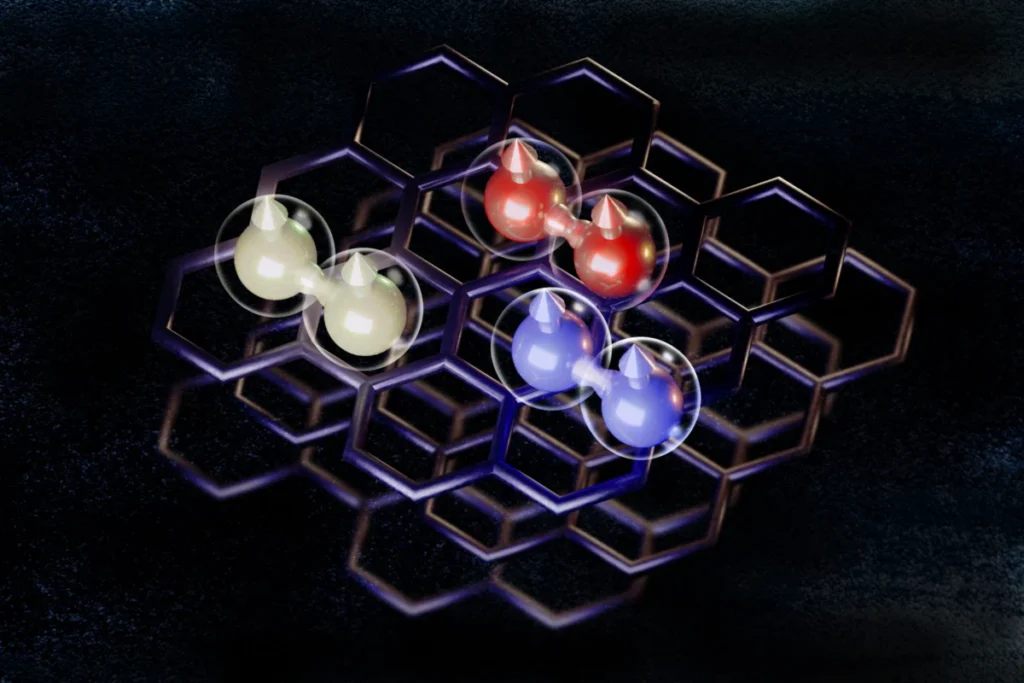
In a triplet state, the electrons in a pair have spins that are aligned in the same direction rather than being opposed. Because their spins are already aligned, an external magnetic field does not force a "spin-flip" that would break the pair. Instead, the field may stabilize the alignment, explaining why the superconductivity not only survives but thrives under magnetic pressure.
While this remains a hypothesis that requires further theoretical and experimental validation, the discovery of a potential triplet superconductor is a "holy grail" in condensed matter physics. Triplet superconductors are incredibly rare and are highly sought after for their potential applications in topological quantum computing, where they could be used to create more stable qubits that are less prone to environmental interference.
Chronology of Graphene Research at MIT
The latest findings are part of a broader timeline of breakthroughs coming out of MIT’s Department of Physics.
- 2004: Graphene is first isolated by researchers in Manchester, sparking a global interest in 2D materials.
- 2018: MIT’s Pablo Jarillo-Herrero discovers "magic-angle" superconductivity in twisted bilayer graphene, launching the field of "twistronics."
- 2021-2023: Long Ju’s group begins focusing on rhombohedral graphene, discovering that it can host a "chiral" form of superconductivity and fractional electron charges without the need for twisting.
- 2024: The current study identifies four distinct states and the magnetic-field-resilient properties of p-doped rhombohedral graphene.
This progression shows a shift in the field from manufacturing complex artificial structures to discovering that the same, and sometimes even more complex, physics can be found in the natural stacking orders of carbon if the measurement tools are sensitive enough.
Broader Impact and Future Directions
The implications of this study extend beyond the walls of the laboratory. From a fundamental physics standpoint, rhombohedral graphene has proven to be a "clean" system. Because it is a single-element material (carbon) with a naturally occurring structure, it lacks the impurities or structural "strain" often found in complex chemical superconductors or manually twisted graphene stacks. This makes it an ideal "model system" for theorists to test new ideas about how electrons interact in 2D spaces.
In terms of practical technology, the ability to control superconductivity via "knobs" like voltage and magnetic fields is a cornerstone of future electronics. If the enhancement of superconductivity by magnetic fields can be understood and eventually replicated at higher temperatures, it could lead to the development of new types of sensors, high-field magnets for medical imaging (MRI), or even components for particle accelerators.
"We’re not only dealing with what nature gives us," says lead author Junseok Seo, a graduate student in Ju’s group. "We’re applying additional controls to change it to something that nature does not give us, but that can exist in the same material."
The research was a massive collaborative effort, involving co-first authors Junseok Seo and Shenyong Ye, alongside a dozen other MIT researchers and international partners from the University of Basel, Florida State University, and the National Institute for Materials Science in Japan. The work was supported in part by the U.S. Office of Naval Research, signaling the strategic importance of these materials for future defense and sensing technologies.
As the team continues to probe the "staircase" of rhombohedral graphene, the scientific community is left to reconsider the humble pencil lead. What was once seen as a simple lubricant or writing tool is now at the forefront of the quantum revolution, proving that the most profound secrets of the universe can sometimes be found in the most common materials. The next phase of research will likely focus on pushing these superconducting states to higher temperatures and exploring the potential for "topological" properties that could redefine the future of information technology.