In a landmark study that bridges 17th-century physics with 21st-century cosmology, an international team of researchers has confirmed that the laws of gravity established by Isaac Newton and Albert Einstein remain remarkably accurate even when measured across the gargantuan distances of the deep universe. The findings, derived from data collected by the Atacama Cosmology Telescope (ACT) in Chile, provide some of the most compelling evidence to date that the "missing mass" observed in galaxies is likely the result of invisible dark matter rather than a fundamental misunderstanding of how gravity functions.
The study, led by researchers from the University of Pennsylvania and published in the prestigious journal Physical Review Letters, addresses a discrepancy that has puzzled the scientific community for nearly a century. By analyzing the movement of galaxy clusters separated by hundreds of millions of light-years, the team demonstrated that the strength of gravity diminishes with distance exactly as predicted by the inverse-square law—a principle first articulated by Newton in 1687 and later integrated into Einstein’s General Theory of Relativity.
The Central Paradox: Why Galaxies Defy Visible Logic
For decades, the field of astrophysics has grappled with what University of Pennsylvania researcher Patricio A. Gallardo describes as a "massive discrepancy in the cosmic ledger." When astronomers observe the rotation of stars within a galaxy or the movement of galaxies within a cluster, the math does not add up. Based on the amount of visible matter—stars, gas, and dust—these celestial bodies should be moving much slower than they actually are.
Under the standard Newtonian framework, the gravitational pull exerted by a galaxy’s center should weaken as one moves toward its outer edges. Consequently, stars at the periphery should orbit at lower velocities. However, observations conducted since the mid-20th century show that these outer stars move just as fast as those near the core. This suggests that either there is a vast amount of "dark matter" providing extra gravitational glue, or our understanding of gravity itself is flawed when applied to cosmic scales.
"That is the central puzzle," Gallardo explains. "Either gravity behaves differently on very large scales, or the universe contains additional matter that we cannot directly see." This study sought to settle this debate by testing the very foundations of gravitational theory on a scale previously thought impossible to measure with such precision.
Chronology of Gravitational Thought and the "Missing Mass" Problem
To understand the significance of the ACT findings, one must look at the timeline of gravitational discovery and the subsequent challenges that emerged:
- 1687 – The Newtonian Era: Isaac Newton publishes Philosophiae Naturalis Principia Mathematica, introducing the Universal Law of Gravitation. He proposes that every mass attracts every other mass with a force that is inversely proportional to the square of the distance between them.
- 1915 – The Einsteinian Revolution: Albert Einstein presents General Relativity, reimagining gravity not just as a force, but as a curvature of spacetime caused by mass and energy. Einstein’s equations encompass Newton’s laws but provide more accuracy for high-mass and high-velocity systems.
- 1933 – The First Clue: Astronomer Fritz Zwicky observes the Coma Cluster and realizes the galaxies are moving far too fast to stay bound together by visible mass alone. He coins the term "dunkle Materie" (dark matter).
- 1970s – The Rotation Curve Evidence: Vera Rubin and Kent Ford provide definitive evidence that stars in the outer reaches of spiral galaxies orbit at the same speed as stars closer to the center, reinforcing the dark matter hypothesis.
- 1983 – The Rise of MOND: Physicist Mordehai Milgrom proposes Modified Newtonian Dynamics (MOND), suggesting that at very low accelerations—such as those found at the edges of galaxies—gravity does not follow the inverse-square law but instead becomes stronger.
- 2024 – The ACT Validation: The University of Pennsylvania team uses the Cosmic Microwave Background (CMB) to prove that gravity does, in fact, follow the inverse-square law across hundreds of millions of light-years, dealing a significant blow to MOND-like theories.
Methodology: Using Ancient Light as a Cosmic Yardstick
The research team utilized data from the Atacama Cosmology Telescope, a six-meter-diameter instrument located high in the Chilean Andes. The ACT is designed to map the Cosmic Microwave Background (CMB), the "afterglow" of the Big Bang that has been traveling through space for approximately 13.8 billion years.
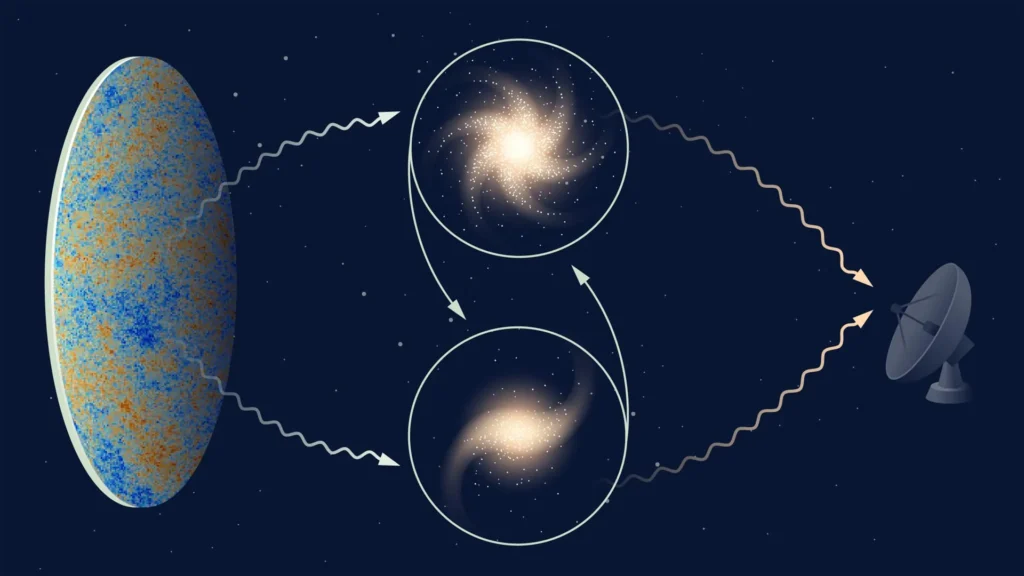
As this ancient light travels toward Earth, it passes through massive structures like galaxy clusters. The gravitational field of these clusters, combined with their internal motions, leaves a subtle imprint on the CMB. By analyzing these tiny fluctuations in light across hundreds of thousands of galaxy clusters, the researchers were able to measure the gravitational interactions occurring at distances of tens of millions to hundreds of millions of light-years.
"It is remarkable that the law of the inverse of the squares is still holding its ground in the 21st century," says Gallardo. If gravity had behaved according to modified theories like MOND, the ACT data would have shown a more gradual decline in gravitational strength over distance. Instead, the results aligned almost perfectly with the predictions of Newton and Einstein.
Supporting Data and Technical Analysis
The study involved a collaboration of over 40 researchers from institutions across the globe. By aggregating data from a massive sample size of galaxy clusters, the team achieved a level of statistical certainty that previous, smaller-scale studies lacked.
Key data points from the research include:
- Scale of Testing: Gravity was tested across distances ranging from small galactic scales to massive inter-cluster voids spanning hundreds of millions of light-years.
- Consistency: The measurements fell within the predicted range for General Relativity with a high degree of confidence, leaving little room for the "extra" gravity predicted by MOND without the presence of dark matter.
- CMB Signatures: The researchers focused on the movement-induced changes in the CMB light, which allowed them to isolate the effects of gravity from other electromagnetic forces.
This confirmation reinforces the "Standard Model of Cosmology," also known as the Lambda-CDM model. In this model, the universe is composed of roughly 5% ordinary matter, 27% dark matter, and 68% dark energy. By proving that gravity remains constant in its behavior, the study effectively narrows the search for answers: if the gravity law isn’t broken, the "missing" mass must be real, albeit invisible.
Reactions and Implications for the Scientific Community
The broader scientific community has viewed the results as a pivotal moment for theoretical physics. While MOND and other alternative gravity theories gained traction because they elegantly explained galaxy rotation curves without needing to invent a new particle, the ACT results suggest these theories cannot account for the behavior of the universe on its largest scales.
Mark Devlin, a lead researcher at Penn who oversaw the development of the ACT, noted that the telescope’s precision was key to this breakthrough. The ACT project, supported by the U.S. National Science Foundation and various international agencies, was designed specifically to probe these types of fundamental questions.
However, the validation of standard gravity brings back an old problem: what is dark matter? "This study strengthens the evidence that the universe contains a component of dark matter," Gallardo admits, "but we still do not know what that component is made of." The scientific community remains divided on whether dark matter consists of Weakly Interacting Massive Particles (WIMPs), axions, or perhaps primordial black holes.
Future Outlook: The Next Frontier of Gravitational Research
While the ACT study has provided a definitive check on the inverse-square law, the investigation into the nature of the universe is far from over. The ACT has recently concluded its primary observations, handing the baton to the next generation of observatories.
The Simons Observatory, also located in the Atacama Desert, is expected to provide even higher-resolution maps of the CMB. Combined with upcoming data from the European Space Agency’s Euclid mission and NASA’s Nancy Grace Roman Space Telescope, physicists hope to map the distribution of dark matter with unprecedented detail.
Furthermore, the study of gravity is moving into the realm of gravitational waves. By observing the "ripples" in spacetime caused by colliding black holes, scientists can test Einstein’s theories in the "strong-field" regime—where gravity is at its most intense.
The University of Pennsylvania’s findings serve as a reminder of the enduring power of classical scientific principles. As Gallardo notes with a smile, gravity remains a "naturally attractive field." For now, Newton’s 300-year-old insights and Einstein’s century-old refinements remain the bedrock of our understanding of the cosmos, guiding us as we attempt to unmask the invisible matter that holds the universe together.