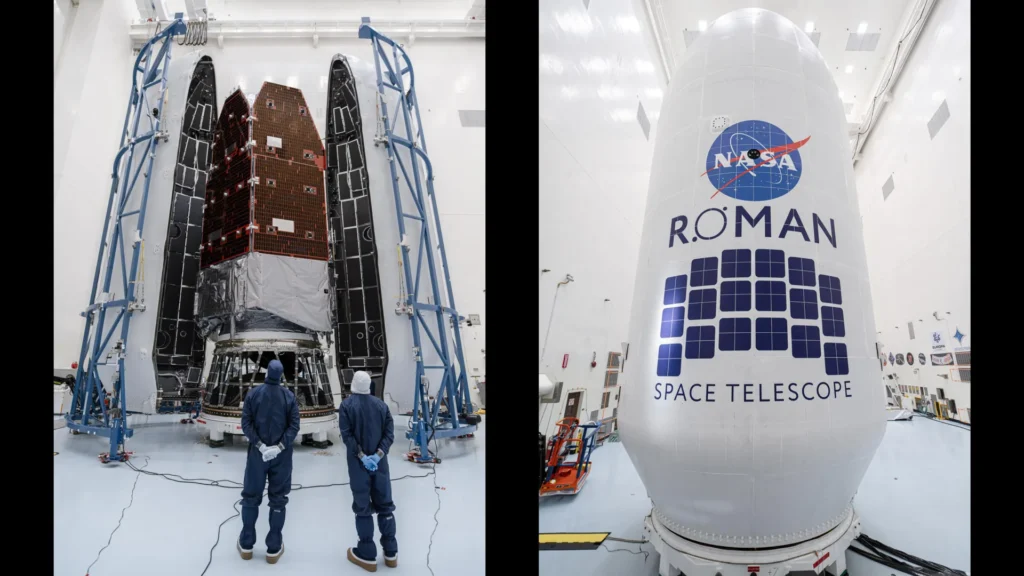
The Nancy Grace Roman Space Telescope, NASA’s ambitious observatory poised to revolutionize our understanding of the cosmos, has taken a significant stride toward its eventual deployment. On August 21, at NASA’s Kennedy Space Center in Florida, dedicated teams meticulously enclosed the sophisticated observatory within the protective fairing of its powerful SpaceX Falcon Heavy rocket. This critical encapsulation took place at the Payload Hazardous Servicing Facility, marking a pivotal moment in the telescope’s journey from terrestrial preparation to the vast expanse of space.
The fairing, a colossal shell measuring 43 feet in height, serves as an indispensable shield for the Roman Space Telescope. Its primary role is to safeguard the delicate observatory during its terrestrial handling and, more crucially, throughout the tempestuous initial ascent through Earth’s atmosphere. This protective embrace, coupled with specialized ground support equipment, ensures that the telescope remains within a meticulously controlled environment, preserving its integrity as it is maneuvered between various facilities in the lead-up to launch.
A Shield Against the Fury of Ascent
The launch of any spacecraft is an event fraught with extreme environmental challenges. As the Falcon Heavy rocket ignites its engines and surges skyward, the Roman Space Telescope will be subjected to a gauntlet of forces. These include immense sound waves generated by the rocket’s propulsion systems, crushing aerodynamic pressure as it pierces the atmosphere, and significant thermal stresses due to atmospheric friction. The robust design of the fairing is specifically engineered to absorb and deflect these potentially damaging stresses, acting as a resilient barrier between the sensitive scientific instruments and the violent forces of launch.
This protective shell, however, is a temporary necessity. Once the Falcon Heavy rocket achieves sufficient altitude, where the surrounding atmosphere no longer poses a threat, the fairing’s protective function ceases. Approximately a few minutes after liftoff, in a precisely orchestrated maneuver, the two halves of the fairing will elegantly separate and detach, gracefully falling back towards Earth. This separation allows the Roman Space Telescope to emerge, unimpeded, to continue its solitary voyage towards its distant cosmic destination. In a testament to SpaceX’s commitment to sustainability and reusability, the company intends to recover both sections of the fairing after their descent, a practice that significantly reduces the cost and environmental impact of space launches.
Destination: A Cosmic Balancing Act at L2
Following its successful launch and the jettisoning of its fairing, the Roman Space Telescope will embark on a journey of approximately one million miles. Its ultimate destination is the Sun-Earth Lagrange point 2 (L2), a gravitationally stable region in space. At this unique location, the combined gravitational forces of the Sun and Earth create a point where a spacecraft can maintain a relatively fixed position with minimal fuel expenditure. This orbital perch is particularly advantageous for powerful space observatories like Roman. It provides an exceptionally stable environment, free from the thermal fluctuations and light interference associated with orbiting closer to Earth, thereby enabling continuous and unhindered observation of the universe. L2 is already home to other prominent space observatories, including the James Webb Space Telescope, further highlighting its suitability for cutting-edge astronomical research.
The Final Countdown: Integration with the Falcon Heavy
Before the momentous liftoff, the encapsulated Roman observatory will undergo further critical preparations. Teams will meticulously transport the sealed payload from the Payload Hazardous Servicing Facility to SpaceX’s hangar located at Launch Pad 39A. Within this hangar, the payload will be carefully integrated and attached to the colossal Falcon Heavy rocket. This intricate process requires precision engineering and rigorous safety protocols to ensure the secure mating of the telescope and its launch vehicle.
Following the successful integration, the fully assembled launch system – the Falcon Heavy rocket adorned with the Roman Space Telescope – will be slowly and deliberately transported to the launch pad at Launch Complex 39A. NASA and SpaceX are currently targeting Sunday, August 30, with a launch window opening no earlier than 7:26 a.m. EDT, for this historic event. This precise timing is crucial and subject to a multitude of factors, including weather conditions, rocket readiness, and the orbital mechanics required for the mission’s trajectory.
Unveiling Thousands of New Worlds and Cosmic Mysteries
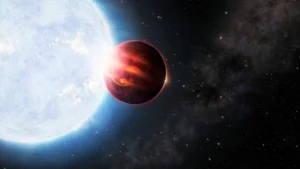
The scientific potential of the Nancy Grace Roman Space Telescope is immense, promising to reshape our understanding of exoplanets and the fundamental nature of the universe. Once Roman commences its science operations, researchers anticipate a prolific discovery rate, expecting to identify thousands of exoplanets – planets orbiting stars beyond our own solar system. The sheer volume of these discoveries will provide astronomers with an unprecedented statistical sample, enabling them to determine the prevalence of different types of planetary systems and to identify distant worlds that may bear a striking resemblance to our own terrestrial home. This vast catalog of exoplanets will be invaluable for refining theories of planet formation and for assessing the potential for habitability beyond Earth.
Beyond the realm of exoplanetary science, Roman is poised to tackle two of the most profound enigmas in modern cosmology: dark matter and dark energy. Dark matter, a substance that eludes direct detection through electromagnetic radiation, exerts a significant gravitational influence on the universe. Its presence is inferred from its role in shaping the structure of galaxies and the large-scale cosmic web. Dark energy, on the other hand, represents the mysterious force driving the accelerating expansion of the universe. Understanding the nature and behavior of these two elusive phenomena is paramount to comprehending the ultimate fate and evolution of the cosmos.
Through its ambitious survey capabilities, Roman will meticulously map vast swathes of the sky, charting the distribution of matter and galaxies across cosmic distances. This detailed cosmic census will provide astronomers with invaluable data to probe the properties of dark matter and dark energy, offering new insights into their interactions and their influence on the universe’s expansion. The observations gathered by Roman have the potential to significantly advance our knowledge of how the universe evolved from its earliest moments to its present state and to unravel the underlying causes of its accelerating expansion. This mission is not merely about observing; it is about fundamentally deciphering the universe’s grand narrative.
A Legacy of Exploration: Building on Past Successes
The development and impending launch of the Nancy Grace Roman Space Telescope represent the culmination of decades of scientific inquiry and technological innovation. Named in honor of Nancy Grace Roman, a pioneering astrophysicist often referred to as the "mother of Hubble," the telescope embodies a continuation of her legacy in pushing the boundaries of astronomical observation. Roman was instrumental in the early planning and development of NASA’s space telescope programs, advocating for their scientific importance and guiding their implementation. Her vision has directly paved the way for the groundbreaking capabilities that Roman will bring to the field.
The Roman Space Telescope is designed to be a flagship mission, building upon the successes and lessons learned from previous observatories. While the Hubble Space Telescope has provided iconic images and transformative data, and the James Webb Space Telescope is delving into the infrared universe with unparalleled sensitivity, Roman is conceived to excel in specific areas, particularly in its ability to conduct large-scale surveys. Its wide field of view, significantly larger than that of Hubble, will enable it to image vast portions of the sky much more efficiently. This efficiency is crucial for its primary scientific objectives, such as the Roman Exoplanet WFIRST (Wide Field Infrared Survey Telescope) mission, which aims to conduct a comprehensive survey of exoplanets and investigate dark energy. The cost of the Roman Space Telescope mission is estimated to be around $3.2 billion, a significant investment reflecting the ambitious scope and scientific return anticipated from this endeavor. This figure includes development, launch, and initial operational costs.
A Collaborative Endeavor: NASA and SpaceX Partnership
The successful encapsulation of the Roman Space Telescope within the Falcon Heavy fairing underscores the vital partnership between NASA and SpaceX. This collaboration exemplifies the evolving landscape of space exploration, where government agencies and private aerospace companies work in tandem to achieve ambitious goals. SpaceX’s innovative launch vehicle technology, particularly the Falcon Heavy, provides NASA with a powerful and cost-effective means of delivering large and complex payloads to space. The Falcon Heavy, known for its lifting capacity and reusability, is well-suited to accommodate the substantial mass and volume of the Roman Space Telescope.
This partnership not only facilitates the launch of crucial scientific instruments but also contributes to the broader economic and technological advancements within the space sector. The efficient development and execution of missions like Roman demonstrate the synergistic potential of public-private collaborations in driving scientific discovery and expanding humanity’s presence in space. The ability of SpaceX to recover and reuse its rocket components also contributes to a more sustainable approach to spaceflight, a growing imperative as the frequency of launches increases.
Looking Ahead: A New Era of Cosmic Discovery
The successful encapsulation of the Nancy Grace Roman Space Telescope represents a pivotal moment, transitioning the observatory from its extensive ground-based preparations to its final integration with its ride to space. The coming weeks and months will be filled with the meticulous work of attaching Roman to the Falcon Heavy rocket, conducting final system checks, and preparing for the launch window. The anticipation within the scientific community is palpable, as researchers eagerly await the commencement of Roman’s operations.
The insights gained from the Roman Space Telescope are expected to resonate for decades, offering profound answers to some of humanity’s most fundamental questions about our place in the universe. From the abundance and diversity of worlds beyond our solar system to the enigmatic nature of dark matter and dark energy, Roman promises to usher in a new era of cosmic discovery, expanding our comprehension of the vast and intricate tapestry of the cosmos. Its launch will be a testament to human ingenuity, scientific curiosity, and the enduring quest to understand the universe we inhabit.