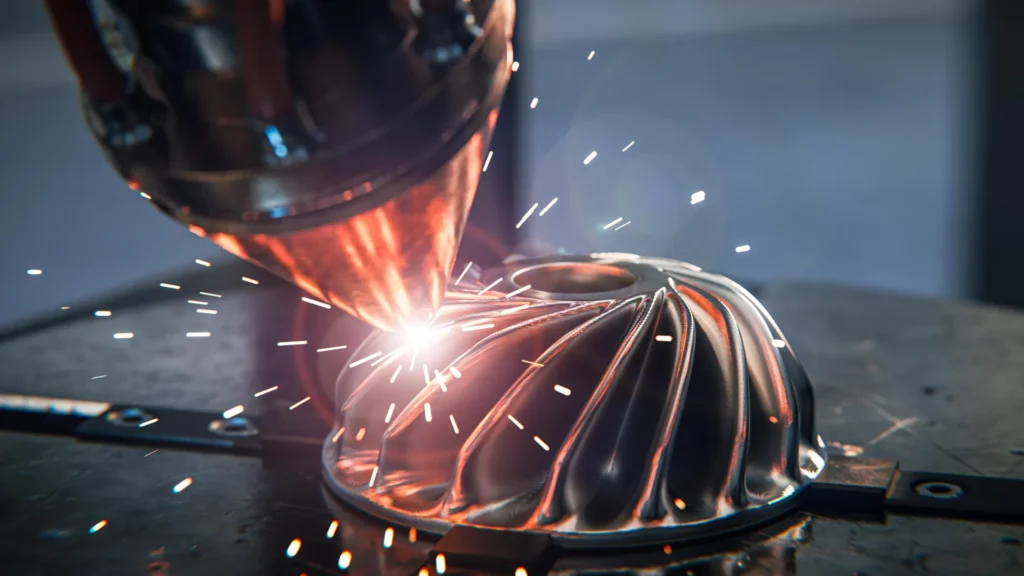
Researchers at Washington State University have successfully integrated artificial intelligence into the additive manufacturing process to unlock a faster, more cost-effective method for 3D printing a specialized high-performance metal alloy. By leveraging advanced machine learning algorithms, the interdisciplinary team from WSU’s School of Electrical Engineering and Computer Science and the School of Mechanical and Materials Engineering bypassed the traditional, prohibitively expensive trial-and-error method that would have required testing more than 100 million possible printing configurations. This breakthrough not only streamlines the production of GRCop-42, a NASA-developed alloy essential for aerospace technology, but also establishes a scalable framework for applying AI to complex scientific challenges such as drug discovery and advanced materials synthesis.
The Challenge of Printing GRCop-42
GRCop-42 is a high-strength, high-conductivity copper-based alloy infused with chromium and niobium. Developed by NASA’s Glenn Research Center in Cleveland, Ohio, the material was specifically engineered to meet the brutal demands of liquid rocket engine components. Its primary value lies in its ability to maintain structural integrity at extreme temperatures while facilitating rapid heat transfer—a combination that is vital for combustion chambers and nozzles. However, the very properties that make GRCop-42 desirable also make it notoriously difficult to manufacture.
In the realm of additive manufacturing, or 3D printing, copper alloys present a unique set of obstacles. Copper is highly reflective, meaning it often bounces laser energy away rather than absorbing it to melt the metal powder. Consequently, successfully printing GRCop-42 has traditionally required high-powered, specialized industrial printers capable of generating immense laser energy. Currently, approximately 90% of commercial 3D printers lack the wattage necessary to process this alloy using standard settings.
Before the WSU study, efforts to use lower-wattage, more common commercial printers resulted in failure. The material would either fail to fuse properly or, conversely, overheat and melt into a formless mass. Finding the "sweet spot"—the perfect combination of laser power, scanning speed, hatch spacing, and other variables—is a mathematical nightmare. With dozens of variables to adjust, the search space exceeds 100 million possible configurations.
A Strategic Shift: From Trial-and-Error to AI Optimization
The traditional scientific method for optimizing manufacturing parameters involves "one-variable-at-a-time" testing. In the case of GRCop-42, this approach is economically unfeasible. A single test print can cost hundreds of dollars in raw material alone, and the post-print analysis—which involves checking for porosity, tensile strength, and thermal conductivity—can take several days of lab work.
To solve this, the WSU team, led by Jana Doppa, the Huie-Rogers Endowed Chair Professor of Computer Science, and Berry Distinguished Professor in Engineering, turned to an AI strategy known as Bayesian optimization. This method is particularly effective for "black-box" problems where each experiment is expensive and the underlying relationship between inputs and outputs is unknown.
The researchers began their work by looking at the "debris" of past failures. They utilized data from 37 previous printing attempts conducted by the School of Mechanical and Materials Engineering that had failed to produce viable results. While these failed experiments were previously seen as dead ends, the AI viewed them as essential data points that defined the boundaries of what would not work.
"Every result improved our AI model," noted Azza Fadhel, a PhD student in computer science and the paper’s first author. "Even the failures provided critical information about the search space."
The Chronology of Discovery
The research unfolded over a condensed three-month period, a timeline that would have been impossible using conventional methods. The process followed a rigorous four-stage cycle:
- Data Seeding: The AI was fed the initial 37 failed configurations to establish a baseline.
- Model Recommendation: The AI model analyzed the data to estimate the probability of success for untested configurations. It then selected a small "batch" of new settings to test.
- Experimental Validation: The engineering team, including experts Nathaniel Zuckschwerdt, Susmita Bose, and Amit Bandyopadhyay, attempted to print the alloy using the AI’s specific recommendations on a 500-watt laser system—a power level previously thought insufficient for GRCop-42.
- Feedback Loop: The results of these prints—whether successful or not—were fed back into the AI. This allowed the model to refine its understanding of the "feasible region" within the 100-million-option search space.
The AI’s selection strategy was dual-pronged. It utilized "exploitation," focusing on areas that seemed most likely to yield success based on current data, and "exploration," where it intentionally chose uncertain areas of the search space to gather more information. This balanced approach ensured the model didn’t get stuck in a "local optimum" but instead searched the entire landscape of possibilities.
By the end of the three-month window, having conducted only 40 new experiments, the team identified six successful printing configurations. For the first time, they proved that GRCop-42 could be printed with high quality using only 500 watts of laser power.
Technical Implications and Data Analysis
The success of the 500-watt prints represents a significant technical milestone. By optimizing the interplay between the laser’s travel speed and the thickness of the powder layers, the AI found a way to achieve sufficient energy density without the need for the 1,000-watt or higher lasers typically found in elite aerospace manufacturing facilities.
Data from the successful prints showed that the AI-guided parameters resulted in:
- High Density: Minimal porosity in the final metal structure, ensuring it can withstand the high-pressure environments of rocket engines.
- Thermal Retention: Preservation of the alloy’s signature thermal conductivity.
- Resource Efficiency: A 99% reduction in the number of physical experiments required compared to traditional statistical sampling methods.
This efficiency is transformative for the industry. In a standard laboratory setting, testing 100 million configurations is a task that would span decades. The WSU team achieved a viable result in 40 tries.
Institutional Recognition and Broader Impact
The significance of this work was recognized by the global AI community. The research was published in the Proceedings of the AAAI Conference on Artificial Intelligence, one of the most prestigious venues for machine learning research. Furthermore, the project received the "Innovative Deployed Application Award" at the AAAI annual conference, an honor reserved for AI applications that solve real-world problems with high impact.
The implications of this breakthrough extend far beyond the aerospace sector. Professor Jana Doppa emphasized that the methodology is "domain-agnostic." The same AI-guided approach could be used in:
- Pharmaceuticals: Accelerating drug discovery by narrowing down billions of chemical combinations to find those most likely to treat specific diseases.
- Green Energy: Developing new catalysts for hydrogen production or more efficient battery chemistries.
- Advanced Manufacturing: Optimizing the production of other difficult-to-process materials, such as refractory metals or high-entropy alloys.
Democratizing the Future of Space Exploration
Perhaps the most significant outcome of the WSU research is the "democratization" of high-performance manufacturing. By proving that NASA-grade alloys can be printed on standard commercial equipment, the researchers have lowered the barrier to entry for smaller aerospace startups, university laboratories, and medium-sized manufacturing firms.
"Ninety percent of commercial printers cannot print this metal alloy," Doppa explained. "By finding these feasible process parameters, we are essentially democratizing the printing of this alloy."
In the current era of "New Space," where private companies like SpaceX and Blue Origin are rapidly iterating on rocket designs, the ability to rapidly prototype and manufacture combustion components using more accessible hardware could significantly lower the cost of space flight. It allows for a more decentralized supply chain, where critical components do not have to be sourced from a handful of facilities with million-dollar laser systems.
Conclusion: A New Era of AI-Human Collaboration
The WSU study serves as a powerful case study for the future of scientific inquiry. It highlights a shift where AI does not replace the scientist or engineer but acts as a high-speed navigator through the vast "haystack" of data.
As the team moves forward, they plan to apply this AI framework to even more complex materials and multi-material 3D printing, where different metals are fused together in a single part. The success with GRCop-42 has proven that even in high-stakes environments where material and time costs are immense, AI can provide a reliable path to discovery.
"There’s always uncertainty when you are deploying something where real people, materials, and physical costs are involved," Doppa reflected. "We didn’t know whether we would succeed or not… I was very surprised that we were able to do this so well."
The success at Washington State University marks a pivotal moment in the intersection of computer science and materials engineering, suggesting that the next generation of technological breakthroughs will not be found through sheer force of labor, but through the intelligent optimization of human expertise and machine learning.