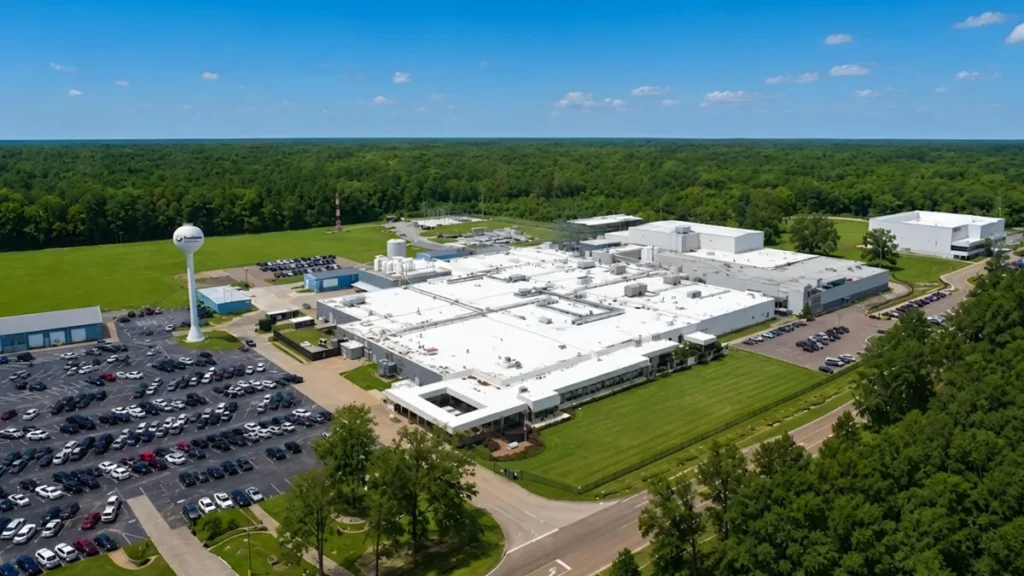
Raytheon, a business of RTX, has completed a significant $50 million expansion of its advanced manufacturing facility in Forest, Mississippi, adding a crucial 17,000 square feet of operational space. This strategic investment is specifically designed to substantially increase the production capabilities for critical electronic warfare (EW) and radar systems, addressing growing demands from both domestic and international defense clients. The expansion is projected to create 100 high-skill jobs by 2028, reinforcing the facility’s role as a vital hub for sophisticated defense electronics manufacturing and bolstering the local economy.
The newly expanded facility now encompasses a formidable 445,000 square feet of total manufacturing space, dedicated to the intricate processes of production, testing, and integration. A primary focus of this increased capacity will be the Next Generation Jammer Mid-Band (NGJ-MB) pods, essential components being supplied to the U.S. Navy and the Australian government. Beyond NGJ-MB, the facility will also support a range of other airborne radar programs, underscoring its multifaceted contribution to modern aerial combat and surveillance capabilities. This enhancement reflects a broader strategic imperative within the defense sector to scale up production of advanced systems that are critical for operating in increasingly contested electromagnetic environments.
The Strategic Imperative: Mastering the Electromagnetic Spectrum
Electronic warfare systems are at the forefront of modern military strategy, designed to provide a decisive advantage by disrupting, degrading, or deceiving enemy radar and communications systems. The NGJ-MB, in particular, represents a generational leap in this domain. Developed by Raytheon Intelligence & Space (now part of Raytheon, an RTX business), the NGJ-MB is a sophisticated external jamming pod system that operates within the mid-band frequency range. It is primarily designed to fly on the U.S. Navy’s EA-18G Growler aircraft, a specialized electronic attack variant of the F/A-18 Super Hornet. Its mission is to deny, degrade, and disrupt enemy air defense and communications systems, thereby ensuring the safe passage and operational effectiveness of friendly forces.
The demand for such advanced EW capabilities has surged amidst evolving geopolitical landscapes, characterized by the proliferation of sophisticated integrated air defense systems (IADS) by potential adversaries. Militaries globally are recognizing the critical need to control the electromagnetic spectrum, moving beyond traditional kinetic engagements to achieve dominance through non-kinetic means. According to recent market analyses, the global electronic warfare systems market is projected to grow significantly, driven by increasing defense budgets, modernization programs, and the continuous development of advanced radar and communication technologies by potential adversaries. This expansion positions Raytheon to capture a larger share of this growing market, ensuring it can meet the escalating requirements of the U.S. and its allies.
A Decade of Strategic Growth: Raytheon’s Investment in Forest
The latest $50 million expansion is not an isolated event but rather the culmination of a sustained and substantial investment strategy by Raytheon in its Forest, Mississippi facility. Over the past decade, the company has poured approximately $280 million into this site through a series of significant capital projects, transforming it into one of Mississippi’s largest and most technologically advanced defense manufacturing plants.
The chronology of these expansions highlights a deliberate, phased approach to scaling capabilities:
- 2013 Expansion: An initial 20,000-square-foot addition marked the beginning of this intensive investment period, primarily aimed at increasing general manufacturing capacity.
- 2020 Expansion: A more substantial 50,000-square-foot facility dedicated to radar production and testing was completed, underscoring the growing importance of advanced radar systems in Raytheon’s portfolio and the strategic emphasis on airborne sensing capabilities.
- Current 202X Expansion: The latest 17,000-square-foot addition, costing $50 million, specifically targets enhanced capacity for the NGJ-MB and other complex defense electronics.
This continuous investment underscores Raytheon’s long-term commitment to the Forest facility and its strategic role within the company’s global manufacturing footprint. The expansions are not merely about increasing floor space but about providing the sophisticated infrastructure required for the production and integration of complex defense electronics. These systems demand extensive manufacturing precision, rigorous testing protocols, and highly specialized integration processes, all of which are facilitated by the dedicated, state-of-the-art facilities now available in Forest. The facility, which has supported Raytheon for over 40 years, has evolved from a general manufacturing site into a specialized center for critical national defense programs.
Boosting Capacity for National and Allied Defense
The expanded capacity at the Forest facility is directly tied to critical defense objectives, serving both U.S. and allied forces. The production of NGJ-MB pods for the U.S. Navy is paramount for maintaining the operational superiority of its carrier air wings. The ability of Growler aircraft to effectively jam enemy radar and communications is crucial for penetrating contested airspace, protecting strike packages, and ensuring freedom of maneuver in high-threat environments. This system plays a vital role in suppression of enemy air defenses (SEAD) missions, which are fundamental to modern air power projection.
The inclusion of the Australian government as a recipient of these NGJ-MB pods further highlights the international significance of this expansion. Australia, a key U.S. ally in the Indo-Pacific region, also operates the EA-18G Growler. By equipping its forces with the NGJ-MB, Australia enhances its own electronic warfare capabilities, strengthening regional security alliances and improving interoperability with the U.S. and other partner nations. This joint procurement strategy underscores a broader effort among allies to standardize and enhance advanced defense systems, ensuring a cohesive and formidable response to emerging threats.
Beyond electronic warfare, the facility’s support for airborne radar programs is equally critical. Radar systems provide the essential sensing capabilities needed to detect, track, and identify objects in the air, on the ground, and at sea. The combination of advanced radar and electronic warfare systems ensures that modern aircraft can not only find threats but also operate effectively when an adversary attempts to prevent detection or disrupt communications. This dual capability is foundational to achieving air superiority and maintaining situational awareness in complex, multi-domain battlefields.
Economic Impact and Workforce Development in Mississippi
Raytheon’s long-standing presence and continued investment in Forest, Mississippi, represent a significant economic anchor for the state. The commitment to create 100 new high-skill positions by 2028 is a direct boost to the local economy, providing well-paying jobs that require specialized technical expertise. These positions often include engineers, technicians, and skilled manufacturing professionals, contributing to a robust workforce development pipeline.
Mississippi state officials have consistently lauded Raytheon’s contributions. Governor Tate Reeves, or similar state economic development authorities, would likely emphasize the importance of such investments in driving economic growth and creating opportunities for Mississippi families. "Rebuilding the American Arsenal creates more opportunities and more jobs right here at home," a representative voice from state leadership would likely state, echoing sentiments of national security and economic prosperity. "Today, our partners at Raytheon are expanding their manufacturing capacity and bringing 100 new jobs to Forest, Mississippi. These are critical jobs modernizing our military and supporting our troops – work Mississippi families can be proud of." This sentiment reflects a statewide focus on attracting and retaining high-tech manufacturing, particularly in the defense sector, which provides stable, high-wage employment.
Barbara Borgonovi, president of Naval Power at Raytheon, underscored this commitment: "Completing this expansion underscores our long-term commitment to Forest and the state of Mississippi. Together with state and local partners, we’re building the workforce, infrastructure, and capabilities needed to boost production in support of critical national defense programs." Her statement highlights the collaborative effort between industry and government to cultivate a skilled workforce and robust infrastructure essential for meeting defense production goals. Such partnerships are crucial for sustaining the defense industrial base and ensuring national readiness.
Leadership Perspectives and Strategic Vision
The expansion reflects Raytheon’s proactive approach to aligning its manufacturing capabilities with evolving defense priorities. The global security environment has placed a renewed emphasis on technological superiority, and electronic warfare is a cornerstone of this strategy. Raytheon, as a major defense contractor, is keenly attuned to these shifts. The investment in Forest is a tangible manifestation of its commitment to supporting the U.S. military’s modernization efforts and strengthening its alliances.
The "Rebuilding the American Arsenal" narrative, often invoked by defense industry leaders and government officials, speaks to a broader national effort to replenish and upgrade military capabilities following periods of conflict and budget fluctuations. This includes not only increasing the quantity of existing systems but also advancing their technological sophistication. For Raytheon, this means investing in facilities and talent that can produce highly complex systems like the NGJ-MB, which demand cutting-edge engineering and manufacturing processes. The company’s strategic vision involves anticipating future warfare requirements and ensuring it has the capacity and innovation to deliver solutions that maintain a qualitative edge for the U.S. and its allies.
The Geopolitical Landscape Driving Demand
The imperative behind Raytheon’s expansion is deeply rooted in the current global geopolitical climate. Rising tensions in regions such as the Indo-Pacific, Eastern Europe, and the Middle East have spurred a significant increase in global defense spending and a renewed focus on advanced military capabilities. Peer competitors are rapidly developing and deploying sophisticated anti-access/area denial (A2/AD) strategies, which heavily rely on advanced radar and communication systems to deter or deny entry to contested zones.
In response, the U.S. and its allies are prioritizing investments in technologies that can counter these threats. Electronic warfare, particularly systems like the NGJ-MB, is critical for penetrating and operating within such A2/AD environments. The ability to jam enemy sensors and communications effectively provides a crucial advantage, allowing friendly forces to execute missions with reduced risk and increased effectiveness. The demand for these systems is therefore not just cyclical but structural, driven by a long-term strategic competition that necessitates continuous technological advancement and production capacity.
Future Outlook and Implications
The implications of Raytheon’s Forest expansion are far-reaching. For Raytheon itself, it solidifies its position as a leading provider of electronic warfare and radar systems, ensuring it can meet current and future contractual obligations and potentially expand its market share. This investment enhances its competitive advantage by demonstrating robust manufacturing capabilities and a commitment to technological leadership.
For the U.S. and allied militaries, the increased production capacity translates directly into improved operational readiness and enhanced capabilities. The deployment of more NGJ-MB pods means more EA-18G Growlers can be equipped to support critical missions, projecting power and deterring aggression more effectively. This directly contributes to national security objectives and strengthens the collective defense posture of allied nations.
For the broader defense industrial base, this project serves as an example of strengthening domestic manufacturing capacity for crucial defense technologies. It highlights the importance of industrial resilience and the ability to scale production rapidly in response to evolving threats. Furthermore, the expansion is likely to foster further innovation in electronic warfare systems. As manufacturing processes become more efficient and capacity grows, it creates opportunities for incorporating next-generation technologies, such as artificial intelligence and machine learning, into future iterations of these systems, pushing the boundaries of what EW can achieve.
In conclusion, Raytheon’s $50 million expansion in Forest, Mississippi, is more than just a facility upgrade; it is a strategic investment in the future of electronic warfare, national security, and economic growth. By enhancing its ability to produce critical systems like the NGJ-MB, Raytheon is not only creating high-skill jobs but also directly contributing to the modernization of military capabilities for the U.S. and its key allies, ensuring they remain prepared to operate and prevail in the complex and contested environments of tomorrow.