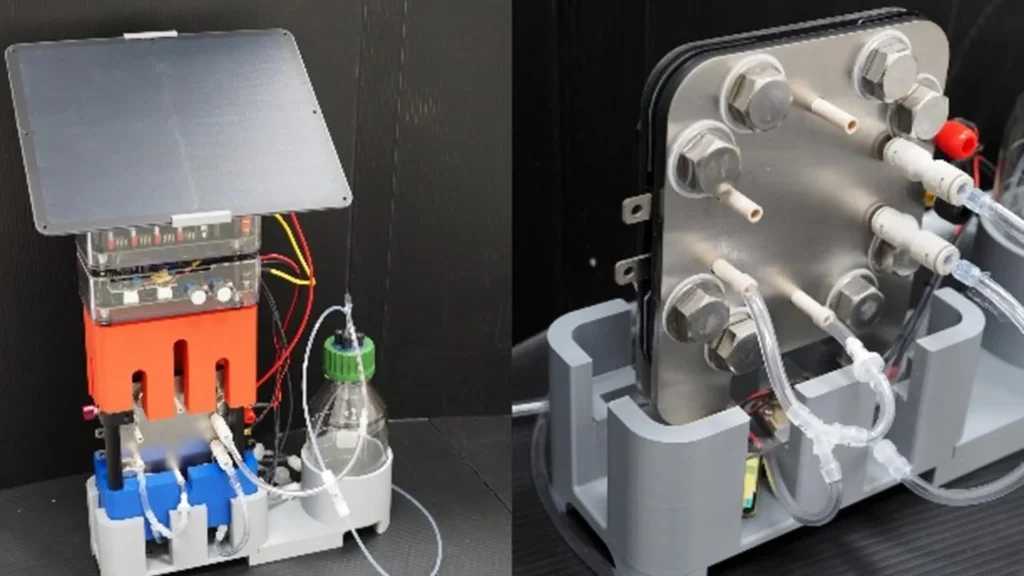
Researchers at Osaka Metropolitan University have engineered a groundbreaking artificial photosynthesis system capable of generating solar fuel with unprecedented consistency, fundamentally altering the landscape of renewable energy storage by directly integrating a self-regulating chemical component into the electrolyzer. This innovative design not only streamlines the system but also significantly reduces both its complexity and overall cost by eliminating the long-standing reliance on external battery-based control equipment for power management. The advance, spearheaded by the institution’s Research Center for Artificial Photosynthesis in collaboration with Iida Group Holdings Co., Ltd., marks a pivotal step towards making solar fuels a more practical and widespread reality, addressing critical challenges in the global transition to sustainable energy.
The Global Imperative for Sustainable Energy and Solar Fuels
The accelerating pace of climate change, coupled with growing global energy demand and geopolitical instability impacting fossil fuel markets, has intensified the urgent need for sustainable and reliable energy solutions. Solar energy, abundant and clean, stands at the forefront of this transition. However, its inherent intermittency—the fluctuation of sunlight throughout the day and across seasons—presents a significant challenge for grid stability and continuous power supply. This intermittency necessitates advanced energy storage solutions that can capture excess solar energy during peak production and release it when demand is high or sunlight is scarce.
While battery technologies like lithium-ion have seen remarkable advancements, they often come with limitations related to material scarcity, environmental impact from mining and disposal, safety concerns, and degradation over time. This has spurred intense research into "solar fuels," which aim to convert solar energy directly into chemical bonds, effectively storing sunlight in a dense, transportable, and long-lasting form. Artificial photosynthesis, inspired by the natural process that powers plant life, represents a highly promising pathway to produce such fuels. This process mimics nature’s ability to transform simple, abundant molecules like water and carbon dioxide into energy-rich compounds using sunlight as the sole energy input. The potential to close the carbon cycle by utilizing atmospheric CO2 as a feedstock further underscores its environmental appeal, offering a pathway not just to clean energy but also to carbon capture and utilization.
Understanding Artificial Photosynthesis and Its Challenges
At its core, artificial photosynthesis involves several key steps. Sunlight is first captured by light-absorbing materials, analogous to chlorophyll in plants. This captured energy is then used to drive chemical reactions, typically within an electrochemical cell known as an electrolyzer. In the context of solar fuel production, the electrolyzer uses the electricity generated from solar cells to split water molecules and/or convert carbon dioxide into chemical compounds. One of the most promising products of this process is formic acid (HCOOH), a versatile chemical that can serve multiple roles: as a direct fuel for certain types of fuel cells, a safe and efficient carrier for hydrogen, and a crucial chemical feedstock in various industrial applications. Its liquid state at room temperature and relatively high energy density make it an attractive candidate for energy storage and transportation compared to gaseous fuels like hydrogen, which require complex compression or liquefaction.
A major technical hurdle in the development of efficient and economically viable artificial photosynthesis systems has been maintaining stable operation under fluctuating solar irradiation. Solar cells exhibit varying power output depending on the intensity of sunlight, temperature, and other environmental factors. To maximize the energy harvested from solar panels and ensure a consistent input to the electrolyzer, systems typically employ Maximum Power Point Tracking (MPPT) technology. MPPT continuously adjusts the voltage and current supplied by the solar cells to ensure they operate at their "maximum power point," where they deliver the highest possible power output under prevailing conditions.
However, conventional MPPT setups introduce their own set of complexities and costs. They traditionally rely on sophisticated power electronics, including DC-DC converters, inverters, and often, battery banks to buffer energy fluctuations and smooth out the energy flow to the electrolyzer. While effective in optimizing power transfer, these additional components contribute significantly to the system’s capital expenditure (CAPEX) and operational expenditure (OPEX). They increase the overall system footprint, introduce multiple points of failure, require regular maintenance, and critically, the batteries themselves have a finite lifespan, necessitating eventual replacement and contributing to environmental waste. Industry estimates suggest that power electronics and battery storage can account for 20-40% of the total system cost in distributed renewable energy setups, a barrier to widespread adoption, particularly in cost-sensitive applications.
Osaka Metropolitan University’s Breakthrough: The Self-Regulating Electrolyzer
To overcome these inherent limitations, a pioneering team at Osaka Metropolitan University, led by Associate Professor Yasuo Matsubara and Professor Yutaka Amao at the Research Center for Artificial Photosynthesis, embarked on a novel approach. Rather than relying on external electronic or battery-based solutions for MPPT, their research focused on fundamentally redesigning the electrolyzer itself. In collaboration with Iida Group Holdings Co., Ltd., a company with a vested interest in sustainable technologies, they successfully integrated a specialized solid electrolyte directly into the device’s core structure.
This ingenious design imbues the electrolyzer with an intrinsic self-regulating capability, allowing it to automatically perform the MPPT function without any external electronic control systems or auxiliary batteries. The mechanism behind this self-regulation is rooted in the unique thermal and impedance properties of the specially engineered solid electrolyte. As Professor Amao elaborated, "As sunlight increases, the electrolyzer naturally heats up due to increased electrical activity and energy input. The system is meticulously designed so that this warming causes the electrical resistance of the solid electrolyte to drop. This reduction in resistance, in turn, allows electricity to flow more freely and efficiently through the device." This direct coupling of environmental conditions (sunlight intensity leading to heating) with the electrochemical properties of the electrolyzer means the system dynamically adjusts its electrical behavior in real-time, inherently optimizing power utilization. Essentially, the electrolyzer intelligently adapts to the incoming power fluctuations, drawing precisely the right amount of current and voltage to maintain optimal operation, much like a living organism adjusting to its environment. This represents a paradigm shift from active electronic control to passive, material-based self-regulation.
Engineering Simplicity and Cost Reduction: The Economic and Practical Advantages
The implications of this self-regulating design are profound, particularly for the economic viability and scalability of artificial photosynthesis. By removing the need for external electronics, converters, and costly battery banks, the Osaka Metropolitan University system promises substantial reductions in both CAPEX and OPEX. Initial analyses suggest that eliminating MPPT components and batteries could cut the initial system cost by an estimated 15-30% for smaller, distributed systems, making solar fuel production more accessible. Furthermore, the simplified architecture translates to fewer components, which inherently means increased reliability and reduced maintenance requirements. The absence of batteries, known for their finite cycle life and performance degradation over time, significantly extends the overall lifespan of the artificial photosynthesis system, enhancing its long-term economic attractiveness.
This reduced complexity is not merely an engineering elegance; it has tangible practical benefits. Simpler systems are easier to manufacture, deploy, and operate, lowering the barriers to entry for various applications, from industrial-scale chemical production to decentralized energy solutions for remote communities. The partnership with Iida Group Holdings Co., Ltd., a company with a broad portfolio including housing and construction, suggests a strategic intent to explore how this technology could be integrated into real-world applications, potentially even powering residential or commercial buildings. The reduced footprint and increased robustness of the system also open doors for deployment in challenging environments where conventional electronic systems might struggle due to temperature extremes or limited access for maintenance.
Rigorous Testing and Real-World Validation
The efficacy of this innovative system was not confined to laboratory simulations. The researchers subjected their technology to rigorous testing under actual outdoor conditions, where sunlight levels naturally fluctuate throughout the day due to cloud cover, time of day, and seasonal variations. The results were compelling: the system consistently produced formic acid from water and CO2, maintaining stable output even as ambient sunlight intensity varied. This real-world validation is crucial, demonstrating the technology’s readiness to perform reliably outside controlled environments.
A significant milestone in the technology’s journey was its showcase at the "Joint Pavilion Iida Group × Osaka Metropolitan University" exhibition, a preview event for the much-anticipated Osaka Kansai Expo 2025. Professor Matsubara reflected on this experience, stating, "We were confident that it would be successful, as we previously showcased this research at the ‘Joint Pavilion Iida Group × Osaka Metropolitan University’ exhibition as part of the Osaka Kansai Expo 2025. It successfully generated enough formic acid to power a miniature diorama in the pavilion, showing its potential as an efficient artificial photosynthesis system that could potentially be used to charge applications in our homes." This public demonstration served as a powerful proof-of-concept, translating complex scientific research into a tangible and relatable application, significantly boosting public and industry confidence in the technology’s potential. Powering a miniature diorama, while small-scale, vividly illustrated the practical application of solar fuel generated by the self-regulating system, hinting at its eventual capacity to power everyday devices and potentially contribute to home energy solutions.
Formic Acid: A Promising Solar Fuel
The choice of formic acid as the primary solar fuel product is strategic. Formic acid is a colorless liquid, biodegradable, and less corrosive than other potential chemical energy carriers. It offers several distinct advantages:
- Hydrogen Carrier: Formic acid can be easily decomposed to yield hydrogen and carbon dioxide (HCOOH → H2 + CO2). This makes it an excellent, safe, and compact carrier for hydrogen, overcoming the significant challenges associated with storing and transporting gaseous hydrogen.
- Direct Fuel: It can be directly used as a fuel in direct formic acid fuel cells (DFAFCs), which are simpler and often more efficient than hydrogen fuel cells, making it suitable for portable electronic devices and even automotive applications.
- Chemical Feedstock: Formic acid is a key industrial chemical used in various sectors, including textiles, leather, rubber, and agriculture. Producing it from CO2 and water using solar energy offers a sustainable and carbon-neutral pathway for its synthesis, reducing reliance on fossil-fuel-derived production methods.
- Energy Density: As a liquid, formic acid possesses a higher volumetric energy density compared to gaseous hydrogen, making it more practical for bulk energy storage and transportation.
The ability to consistently produce formic acid under real-world conditions, without the complexity of external control, enhances its appeal as a cornerstone of a future "formic acid economy," where this versatile compound could play a central role in sustainable energy and chemical industries.
Broader Implications for Energy Storage and Decarbonization
The innovation from Osaka Metropolitan University carries far-reaching implications for global energy strategies and decarbonization efforts. By providing a simpler, more robust, and cost-effective method for solar fuel production, it accelerates the integration of intermittent renewable energy sources into the existing energy infrastructure.
- Grid Stability: Solar fuels, like formic acid, can act as a long-duration energy storage solution, mitigating the intermittency of solar and wind power. This would significantly enhance grid stability, reduce reliance on fossil fuel "peaker plants," and facilitate higher penetration of renewables.
- Decentralized Energy: The simplified design is ideal for off-grid applications and remote communities, enabling energy independence without the need for complex grid connections or frequent battery replacements. This could empower developing regions with access to clean, affordable energy.
- Circular Carbon Economy: By utilizing CO2 as a feedstock, the system contributes directly to a circular carbon economy. Instead of emitting CO2, industries could capture it and convert it into valuable fuels and chemicals, effectively turning a waste product into a resource. This concept is vital for achieving net-zero emissions targets.
- Competitive Edge: This technology could provide a competitive advantage over other energy storage solutions. While batteries are excellent for short-term storage, solar fuels excel in long-term, high-density storage and transportation, filling a critical gap in the energy storage landscape. For instance, the energy density of liquid formic acid far surpasses that of lithium-ion batteries on a mass basis, making it more suitable for applications requiring extended energy reserves.
The Road Ahead: Challenges and Future Prospects
While the Osaka Metropolitan University team’s achievement is significant, the journey from lab to widespread commercialization involves further steps. Key areas for future research and development include:
- Scalability: Demonstrating the technology’s effectiveness at larger industrial scales will be crucial. This involves optimizing reactor design, material durability, and overall system integration for commercial production volumes.
- Efficiency Improvements: Continuous efforts to enhance the solar-to-fuel conversion efficiency are vital to make the process more economically competitive with fossil fuels and other renewable energy pathways. Current state-of-the-art artificial photosynthesis systems typically aim for efficiencies above 10%, with some experimental systems achieving higher. Further improvements will reduce the land area required for solar capture and the overall cost of fuel production.
- Long-Term Stability: Ensuring the long-term operational stability and durability of the self-regulating solid electrolyte under continuous use and varying environmental conditions is paramount for commercial viability.
- Diversification of Fuels: While formic acid is promising, exploring the self-regulating electrolyzer’s applicability to produce other solar fuels, such as methanol or synthesis gas, could broaden its impact and market potential.
- Policy and Infrastructure: Supportive government policies, research funding, and the development of infrastructure for solar fuel production, distribution, and utilization will be essential for successful deployment.
The findings, published in the esteemed journal EES Solar, solidify the scientific basis of this breakthrough. The collaboration between academic researchers and industrial partners like Iida Group Holdings Co., Ltd. exemplifies a powerful model for translating fundamental scientific discoveries into practical technologies. This innovation from Osaka Metropolitan University represents not just a technical improvement but a fundamental rethinking of how solar energy can be captured, stored, and utilized, paving a clearer path towards a truly sustainable and decarbonized future where sunlight powers our homes, industries, and transportation without compromise.