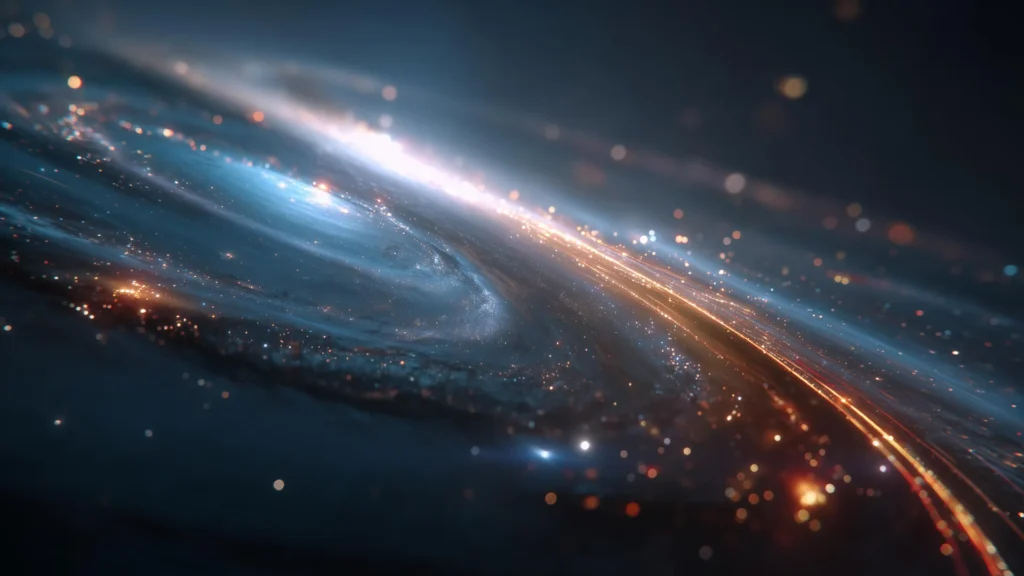
The fundamental understanding of the cosmos has been upheld by an international coalition of astrophysicists who have published a comprehensive study confirming that the universe continues to expand at an accelerating rate. This research, published in the Monthly Notices of the Royal Astronomical Society, serves as a direct rebuttal to a controversial study released last year which suggested that the growth of the universe might be decelerating. Led by researchers at the University of Southampton and featuring contributions from two Nobel Laureates, the team argues that the standard cosmological model remains the most accurate description of our reality, driven by the elusive and powerful force known as dark energy.
The debate centers on the interpretation of Type Ia supernovae, which have long served as the primary "yardsticks" for measuring cosmic distances. By analyzing these stellar explosions, the research team identified critical flaws in the methodology of the preceding study, which had claimed that the evidence for cosmic acceleration was weakening. According to the new findings, the perceived "slowdown" was not a reflection of physical reality but rather a result of a misunderstanding in how the ages of stars and the characteristics of their host galaxies were analyzed. This confirmation allows the scientific community to pivot away from questioning the existence of acceleration and back toward the more complex task of identifying the true nature of dark energy.
The Foundations of Cosmic Acceleration and the 1998 Breakthrough
To understand the weight of this new study, one must look back to the late 1990s, a period that fundamentally altered the trajectory of modern physics. Until that time, the prevailing scientific assumption was that the expansion of the universe, set in motion by the Big Bang, would eventually slow down due to the inward pull of gravity. Scientists debated whether the universe would eventually collapse in a "Big Crunch" or expand forever at a diminishing rate.
In 1998, two independent teams—the High-Z Supernova Search Team and the Supernova Cosmology Project—reached a conclusion that shocked the world. By observing distant Type Ia supernovae, they discovered that these objects were much fainter, and therefore much further away, than they should have been if the universe’s expansion were slowing down. The only logical conclusion was that the expansion of the universe was actually speeding up.
This discovery led to the 2011 Nobel Prize in Physics, awarded to Professor Adam Riess, Professor Brian Schmidt, and Professor Saul Perlmutter. It also necessitated the introduction of "dark energy" into the standard model of cosmology. Dark energy is hypothesized to be a property of space itself—a repulsive force that acts as a kind of "anti-gravity," pushing galaxies away from one another at ever-increasing velocities.
Challenging the Status Quo: The 2024 Controversy
The consensus surrounding dark energy remained largely unchallenged for over two decades until a study led by a team of researchers in South Korea was published. That research suggested that the luminosity of Type Ia supernovae might evolve over billions of years. If the brightness of these "standard candles" changed as the universe aged, the measurements used to prove acceleration would be compromised.
The South Korean team argued that the universe might have entered a period of decelerating expansion, suggesting that dark energy was perhaps a temporary phenomenon or was weakening over time. This claim sent ripples through the astrophysical community, as it threatened to dismantle the Lambda Cold Dark Matter (ΛCDM) model—the current "Standard Model" of cosmology. If the South Korean findings were correct, thousands of papers and decades of theoretical work would have required a total rewrite.
Identifying Methodological Flaws in the Slowdown Theory
The international team, led by Dr. Phil Wiseman of the University of Southampton, set out to scrutinize the claims of a cosmic slowdown. Their analysis revealed that the earlier study had overlooked several nuances in the astrophysics of supernovae and their environments.
One of the primary issues identified was the estimation of stellar ages. The Southampton-led team found that the previous study had conflated the age of an entire galaxy with the age of the specific star that exploded. Galaxies are composed of diverse populations of stars of varying ages; assuming a supernova comes from a star that is the same age as the galaxy’s average population can lead to significant statistical errors.
Furthermore, the new research highlighted a failure to account for "host galaxy mass." Modern cosmology recognizes that the environment in which a supernova occurs—specifically the mass and chemical composition of its host galaxy—affects the peak brightness of the explosion. By failing to apply standard corrections for these factors, the previous study produced skewed data that mimicked the appearance of a slowing expansion.
"Extraordinary claims require especially careful testing," noted Professor Adam Riess, a co-author of the new study. "What we find is that when we calibrate these supernovae, accounting for different host environments and populations, the evidence for cosmic acceleration remains remarkably consistent."
The Role of Type Ia Supernovae as Standard Candles
The reliability of Type Ia supernovae is central to this debate. These events occur in binary star systems where at least one star is a white dwarf—the dense remnant of a star that has exhausted its nuclear fuel. When the white dwarf accretes enough matter from its companion to reach a critical mass (known as the Chandrasekhar limit), it triggers a runaway nuclear fusion reaction, resulting in a supernova of predictable brightness.
Because their peak luminosity is relatively uniform, astronomers use them to calculate distances across the cosmos. By comparing the known brightness of the supernova to its observed brightness from Earth, scientists can determine how far away the galaxy hosting the supernova is. When combined with "redshift" data—the stretching of light waves as an object moves away—astronomists can map the expansion history of the universe.
The Southampton study reaffirmed that while there are subtle variations in supernova brightness based on the age and mass of the host galaxy, these variations are well-understood and can be corrected. Once these corrections are applied, the data aligns perfectly with a universe dominated by dark energy.
Scientific Reactions and the Robustness of the Standard Model
The resolution of this controversy has been met with relief and a renewed sense of focus within the astronomical community. Dr. Phil Wiseman emphasized that the "crisis" in cosmology regarding the potential slowdown has effectively been averted.
"The previous and well-accepted measurements were, in fact, fine and our current understanding of the fate of the universe remains robust," Wiseman stated. He added that the focus should now return to the "mystery about why the rate of expansion of the universe is still accelerating."
Professor Mark Sullivan, another co-author from the University of Southampton, noted that while the South Korean study’s conclusions were incorrect, the challenge was a healthy part of the scientific method. "This is how progress is made. Although this idea did not turn out to be correct, it has opened up new ways of thinking about how supernovae explode and how we can measure dark energy more accurately," Sullivan said.
The debate also forced researchers to refine their assumptions. Dr. Brodie Popovic, a co-author, explained that the team spent considerable time re-examining the astrophysics of the explosions themselves. This deep dive confirmed that the assumptions built into cosmological measurements over the last 25 years are sound and that the influence of host galaxy environments is being properly managed in modern calculations.
Implications for the Fate of the Universe
With the acceleration of the universe reaffirmed, the long-term outlook for the cosmos remains centered on the "Big Freeze" scenario. If dark energy continues to drive galaxies apart at an accelerating rate, the universe will eventually become so vast and the galaxies so distant that they will disappear from each other’s view.
Over trillions of years, stars will exhaust their fuel, and the universe will grow cold and dark. This "Heat Death" or "Big Freeze" is the direct consequence of a universe dominated by a cosmological constant—a form of dark energy that does not dilute as space expands.
The confirmation of acceleration also has significant implications for the "Hubble Tension," a current discrepancy in physics where different methods of measuring the expansion rate of the universe (the Hubble Constant) yield slightly different results. While the Southampton study does not solve the Hubble Tension, it eliminates one potential variable—the idea that the expansion rate was fundamentally slowing down—thereby narrowing the field of inquiry for other researchers.
Data Analysis and Future Prospects
The study utilized data from various supernova surveys, including the Dark Energy Survey (DES) and the Pan-STARRS project. These surveys provide high-cadence observations of thousands of supernovae, allowing for the statistical rigor necessary to debunk the slowdown hypothesis.
Looking forward, the scientific community is preparing for a new era of "precision cosmology." Upcoming missions and facilities are expected to provide even more definitive data on the nature of dark energy:
- The Vera C. Rubin Observatory: Located in Chile, its Legacy Survey of Space and Time (LSST) will discover millions of supernovae, providing a dataset orders of magnitude larger than what is currently available.
- The Euclid Space Telescope: Launched by the European Space Agency, Euclid is currently mapping the geometry of the dark universe, looking at how dark energy and dark matter influence the distribution of galaxies.
- The Nancy Grace Roman Space Telescope: NASA’s upcoming mission will specifically target Type Ia supernovae at high redshifts to measure the expansion history of the universe with unprecedented accuracy.
Conclusion
The international team’s findings serve as a powerful validation of the current cosmological paradigm. By identifying the errors in the 2024 slowdown claim, researchers have reinforced the reality of an accelerating universe driven by dark energy. While the "what" and "how" of acceleration are now more certain than ever, the "why" remains one of the greatest unsolved mysteries in science.
As Dr. Wiseman concluded, the goal now is to move past the question of whether acceleration exists and move toward understanding the fundamental physics of the vacuum itself. The universe continues its outward rush, and for now, the theories of the Nobel-winning pioneers of 1998 stand taller than ever, guiding the next generation of astronomers as they peer into the deep reaches of space and time.