For decades, the intricate process of analyzing the chemical composition of materials has been tethered to the confines of large, expensive laboratory instruments known as spectrometers. These essential systems, foundational to fields ranging from disease diagnosis and stringent food inspection to critical pollution monitoring, operate on the principle of dissecting light. Traditionally, this involves using optical components like prisms or gratings to split incoming light into its constituent wavelengths, subsequently measuring the intensity of each color. The inherent requirement for light to traverse a significant distance within these optical paths has rendered such instruments inherently bulky, posing a formidable challenge to any attempts at meaningful miniaturization. This constraint has limited their deployment in portable, real-time, and distributed sensing applications, creating a persistent demand for more compact and accessible analytical tools.
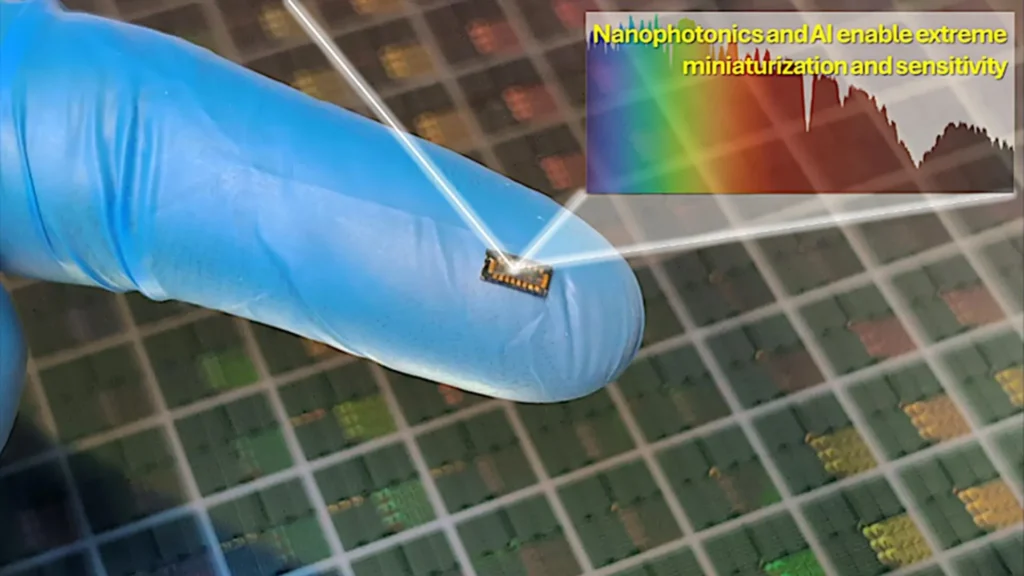
Now, a significant leap forward has been achieved by researchers at the University of California Davis (UC Davis). As detailed in their groundbreaking publication in Advanced Photonics, the team has successfully engineered a spectrometer-on-a-chip so minute it rivals the size of a single grain of sand. This innovative device eschews the conventional reliance on large optical components to physically separate light. Instead, it harnesses the power of artificial intelligence (AI) in conjunction with a compact array of specially engineered sensors to computationally reconstruct the light spectrum. This paradigm shift from optical to computational spectral analysis represents a fundamental re-imagining of how spectroscopy can be performed, promising to unlock unprecedented possibilities for pervasive sensing technologies.
The Miniaturization Imperative: A Historical Challenge in Spectroscopy
Spectroscopy, the study of the interaction between matter and electromagnetic radiation, dates back to the early 19th century with pioneers like Joseph von Fraunhofer and Gustav Kirchhoff laying its theoretical foundations. Its practical applications quickly became apparent, from identifying elements in distant stars to analyzing chemical compounds in laboratories. Over the centuries, spectrometers evolved from simple prism-based devices to sophisticated instruments employing diffraction gratings, Fourier transform interferometers, and array detectors. Each advancement brought greater resolution, sensitivity, and speed, but often at the cost of increased complexity and physical size.
The challenge of miniaturization has been a persistent one. Traditional spectrometers require a certain optical path length to effectively disperse light and resolve different wavelengths. Imagine a rainbow: to see distinct colors, the light needs to travel through a medium (like water droplets) and spread out. Similarly, in a spectrometer, the light needs space to be spread out by a prism or grating before it hits a detector. This fundamental physical requirement has historically dictated the minimum size of these instruments. While efforts in the past have led to smaller benchtop units and even some handheld devices, they often compromise on performance, resolution, or spectral range, or rely on complex micro-electromechanical systems (MEMS) that can be fragile or expensive to manufacture at scale. The aspiration has always been to integrate the power of a laboratory-grade spectrometer into a truly portable, even wearable, form factor, but the laws of physics seemed to stand in the way.
Deconstructing Light: The UC Davis Innovation
The UC Davis team, led by a multidisciplinary group of engineers and photonics experts, has circumvented these traditional physical limitations by adopting an entirely novel approach. At the heart of their breakthrough is a chip that completely abandons the standard method of spreading light into a rainbow using bulky components. Instead, it employs a meticulously designed array of 16 unique silicon detectors. Each detector in this array is not designed to isolate a single color directly, but rather to react subtly and distinctly to the incoming light across a broad spectrum. This differential response allows each detector to collect an "encoded signal" that, while not immediately interpretable as a specific wavelength, contains crucial hidden spectral information.
To draw an analogy, one can conceptualize this system as a panel of highly specialized "tasters" or sensors, each experiencing the same complex mixture (the incoming light) but perceiving and reporting on slightly different aspects of its composition. Individually, each detector only captures a partial, seemingly incomplete picture. However, when the collective output of all 16 detectors is brought together, it generates a rich tapestry of data—enough information for a sophisticated artificial intelligence algorithm to meticulously reconstruct the original, full light spectrum. This shift from direct optical measurement to indirect, computational inference is the cornerstone of the UC Davis innovation.
Beyond Prisms and Gratings: How AI Reconstructs Spectra
The second, equally critical component of this groundbreaking system is a fully connected neural network. This AI model has been rigorously trained on thousands upon thousands of examples, learning the intricate and often counter-intuitive relationship between the noisy, highly encoded signals generated by the 16 silicon detectors and the actual, precise spectrum of the incident light. The training process is akin to teaching the AI to understand a complex, multi-layered code where each detector’s output is a piece of the puzzle.
Researchers refer to this as solving an "inverse problem." In traditional spectroscopy, light goes in, is separated, and then measured directly. Here, the process is reversed: the system receives a composite, encoded signal and must infer the original spectral input. This is an inherently challenging computational task, but the neural network, through extensive training, learns to accurately disentangle these complex relationships. The result is a system capable of reproducing spectral data with an impressive accuracy, boasting a resolution of approximately 8 nanometers (nm), all without the need for any bulky optical hardware whatsoever. This computational prowess allows the device to achieve analytical capabilities previously reserved for much larger and more complex instruments. The resolution of 8 nm is particularly noteworthy for a device of this size, making it competitive with many portable spectrometers currently on the market, which often struggle to maintain such precision in a compact form factor.
Unlocking the Invisible: Near-Infrared Capabilities
A major technical breakthrough that significantly expands the utility of this spectrometer-on-a-chip lies in its ability to effectively detect near-infrared (NIR) light. Standard silicon photodiodes, while excellent for detecting visible light, typically struggle to capture NIR light, which encompasses wavelengths up to approximately 1100 nm. This limitation has historically restricted silicon-based sensors from numerous critical applications because NIR light possesses unique properties. For instance, in biomedical imaging, NIR light is invaluable because it can penetrate deeper into human tissue than visible light, allowing for non-invasive analysis of biological samples, blood oxygenation, and even tumor detection without causing harm. In agriculture, NIR spectroscopy is used for assessing crop health, ripeness, and soil composition, while in industrial settings, it’s crucial for material sorting and quality control.
The UC Davis team overcame this inherent limitation of silicon by ingeniously modifying the surface of standard silicon photodiodes with specialized photon-trapping surface textures (PTSTs). These engineered surfaces fundamentally alter how light behaves once it enters the chip. Instead of allowing NIR photons to simply pass straight through the relatively thin silicon layer – which they would typically do due to silicon’s lower absorption coefficient in this range – the textured surface scatters the light repeatedly within the silicon. This scattering significantly increases the optical path length of the NIR photons inside the silicon, dramatically enhancing the likelihood that the silicon material will absorb them. As a direct consequence of this clever surface engineering, the chip becomes sensitive across a much wider spectral range than conventional silicon sensors, extending its utility into the crucial near-infrared region and broadening its potential applications exponentially. This innovation effectively expands the "eyesight" of silicon, making it suitable for a vast array of new sensing tasks.
Capturing Fleeting Moments: Ultrafast Temporal Resolution
Beyond its spectral capabilities, the new architecture offers another profound advantage: the integration of high-speed sensors capable of measuring photon lifetime with extremely high temporal precision. This feature allows the device to detect and analyze ultrafast interactions between light and matter – phenomena that traditional spectrometers, often limited by their slower response times or integration periods, may entirely miss.
For example, many chemical reactions, biological processes, and material dynamics occur on picosecond or even femtosecond timescales. Understanding these rapid interactions can provide invaluable insights into fundamental science, material properties, and biological mechanisms. Traditionally, systems capable of such ultrafast temporal resolution are incredibly complex, requiring pulsed lasers, time-correlated single photon counting (TCSPC) setups, or streak cameras, all of which are large, expensive, and require specialized operators. The UC Davis chip’s ability to incorporate this high-speed temporal detection within such a minute footprint represents a significant technological leap. Researchers involved in the project emphasize that this capability could unlock advanced forms of sensing and imaging that previously demanded far larger, more costly, and often less accessible systems, democratizing access to high-temporal-resolution spectroscopy.
Tiny Footprint With Big Potential: Market Implications and Applications
The completed UC Davis system occupies an astonishingly small area of just 0.4 square millimeters. Despite its minuscule size, it maintains high sensitivity and demonstrates strong resistance to electrical noise, a persistent and significant challenge for the development of portable, low-cost electronics. Even when operating in electrically noisy environments, the AI-assisted design intelligently processes signals to preserve clear signal quality, ensuring reliable data acquisition in real-world scenarios.
This unique combination of miniaturization, AI-driven spectral reconstruction, extended NIR sensitivity, and ultrafast temporal resolution positions the technology for a transformative impact across numerous sectors. By combining advanced machine learning with enhanced silicon light detection, this innovation could pave the way for a new generation of compact, real-time hyperspectral sensing devices.
Potential Applications are Vast and Varied:
- Portable Medical Diagnostics and Wearable Health Monitors: Imagine a disposable patch that can continuously monitor blood glucose levels non-invasively, detect early signs of skin cancer, or analyze biomarkers in sweat for real-time health assessment. The small size and low cost could make advanced diagnostics accessible in remote areas or integrate them seamlessly into everyday wearables.
- Environmental Remote Sensing: Drones or miniature satellites equipped with these spectrometers could provide real-time, high-resolution data on air and water quality, pollutant detection, and greenhouse gas emissions over vast areas, far more efficiently and cost-effectively than current methods.
- Food Quality Analysis: From ensuring the freshness and ripeness of fruits and vegetables in supermarkets to detecting contaminants or adulteration in processed foods, these chips could provide instant, on-site quality control throughout the supply chain, reducing waste and enhancing consumer safety.
- Precision Agriculture: Farmers could use handheld devices or drone-mounted sensors to precisely monitor crop health, nutrient deficiencies, or pest infestations at a granular level, optimizing fertilizer and pesticide use and increasing yields.
- Industrial Process Control: Real-time spectral analysis on production lines could ensure consistent product quality, monitor chemical reactions, and detect manufacturing defects, leading to greater efficiency and reduced waste.
- Security and Defense: Compact spectrometers could aid in the rapid identification of hazardous materials, explosives, or chemical warfare agents in the field, enhancing safety for first responders and military personnel.
- Personalized Cosmetics and Skincare: Devices could analyze individual skin composition to recommend tailored products or monitor their effectiveness.
The Economic Landscape of Spectroscopy and Future Outlook
The global spectroscopy market, encompassing a wide array of instruments from atomic absorption to mass spectrometry, was valued at approximately $18-20 billion in 2023 and is projected to grow to over $30 billion by 2030, driven by increasing demand in life sciences, pharmaceuticals, environmental testing, and food & beverage industries. While high-end laboratory instruments dominate a significant portion of this market, the fastest growth is anticipated in the portable and handheld segments, precisely where the UC Davis innovation is poised to make its mark.
Current handheld spectrometers, while a step towards portability, often come with price tags ranging from thousands to tens of thousands of dollars, depending on their capabilities. The ability to produce a spectrometer on a silicon chip, leveraging established semiconductor manufacturing processes, suggests a potential for significantly lower per-unit costs at scale. This cost reduction, coupled with the miniaturization and enhanced capabilities, could disrupt existing market segments and, more importantly, create entirely new ones by enabling applications previously deemed impractical or too expensive.
While the research represents a major scientific breakthrough, the path to widespread commercialization will involve further engineering challenges. These include robust packaging, integration with user-friendly interfaces, further calibration for specific applications, and scaling up manufacturing processes. Nevertheless, the foundational technology appears robust.
Industry analysts, upon reviewing the Advanced Photonics publication, have expressed cautious optimism. Dr. Elena Petrova, a senior analyst in photonics technologies, remarked, "This UC Davis breakthrough is not merely an incremental improvement; it’s a fundamental re-architecture of spectroscopy. The combination of AI and novel silicon engineering to achieve high resolution and NIR sensitivity in such a tiny footprint is genuinely exciting. It addresses a long-standing bottleneck in point-of-care diagnostics and distributed environmental monitoring. The next few years will be critical to see how this translates from lab prototype to commercial product, but the potential is undeniable."
The UC Davis team’s work underscores a broader trend in scientific instrumentation: the convergence of advanced materials science, artificial intelligence, and microelectronics to create powerful, miniaturized tools. By pushing the boundaries of what is possible with silicon and leveraging the computational power of neural networks, these researchers have not only developed a dramatically smaller spectrometer but have also laid the groundwork for a future where sophisticated analytical capabilities are no longer confined to specialized laboratories but are instead seamlessly integrated into our daily lives, empowering individuals and industries with unprecedented insights into the world around them. This grain-of-sand sized device holds the promise of unlocking a new era of pervasive, intelligent sensing.