In the vast expanse of the cosmos, the "textbook" biography of a black hole has long been one of singular, violent collapse. For decades, the prevailing scientific consensus suggested that black holes primarily originate from the death of massive stars. When a star of sufficient magnitude exhausts its nuclear fuel, it undergoes a cataclysmic supernova explosion, shedding its outer layers while its core collapses into an infinitesimal point of infinite density. This traditional pathway creates what astrophysicists call "first-generation" black holes. However, a groundbreaking new analysis from the Massachusetts Institute of Technology (MIT) suggests that the universe’s black hole population is far more complex and interconnected than previously imagined.
According to a study published this week in the journal Physical Review Letters, a significant portion of the black holes detected by modern observatories are not the direct descendants of stars, but are instead "second-generation" entities born from the prior merger of two smaller black holes. By analyzing data from the global network of gravitational-wave detectors—including the Laser Interferometer Gravitational-Wave Observatory (LIGO) in the United States, Virgo in Italy, and KAGRA in Japan—the MIT team determined that approximately 14 percent of merging black holes may be the products of "hierarchical merging."
This finding challenges the simplicity of stellar evolution models and provides a robust explanation for the existence of "impossible" black holes—those with masses and spins that cannot be explained by the death of a single star.
The Mechanics of Hierarchical Merging
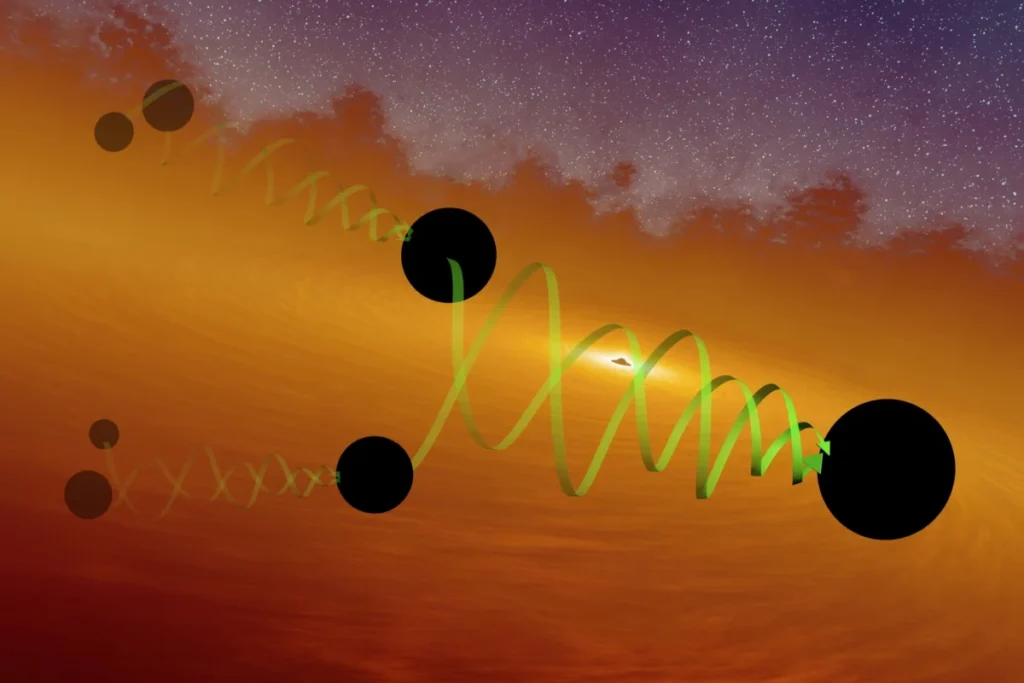
Hierarchical merging is a process akin to a cosmic family tree. In this scenario, two first-generation black holes, each formed from a supernova, find themselves locked in a gravitational dance. As they spiral toward each other, they emit gravitational waves—ripples in the fabric of spacetime—eventually colliding to form a single, more massive black hole. This new entity is a second-generation black hole. If this second-generation black hole subsequently finds another partner and merges again, it creates a third-generation black hole, and so on.
"We’re finding that, for some of these merging black holes, it’s not their first rodeo," explains Cailin Plunkett, the study’s lead author and a graduate student in MIT’s Department of Physics. "Overall in the universe, black holes are merging all the time. The question of how often they are repeatedly merging was pretty uncertain. Now we’re seeing a relatively consistent picture where there’s a decent percentage of black holes that are coming from this repeated pathway."
The research, co-authored by Salvatore Vitale, an associate professor of physics at MIT, alongside colleagues from Williams College, the Adler Planetarium, and Northwestern University, suggests that this hierarchical pathway is a fundamental mechanism for black hole growth in the universe.
Identifying the "Fingerprints" of Second-Generation Black Holes
To distinguish a second-generation black hole from a first-generation one, scientists look for two primary physical characteristics: mass and spin.
When a massive star collapses, it loses a tremendous amount of its angular momentum during the supernova phase. Consequently, the resulting first-generation black hole is expected to have very little spin. However, when two black holes merge, the orbital angular momentum of their dance is converted into the intrinsic spin of the resulting black hole. According to Salvatore Vitale, these second-generation black holes should be "spinning very fast, at about 70 percent of their maximum possible spin."
Mass is the second key indicator. Standard stellar evolution theory predicts a "mass gap" in the black hole population. Supernovae from extremely massive stars are believed to be so violent that they blow the entire star apart, leaving no remnant behind. This suggests that black holes formed directly from stars should rarely exceed roughly 45 times the mass of our sun (solar masses). Yet, gravitational-wave detectors have frequently observed black hole mergers involving components that far exceed this limit. Hierarchical merging provides a natural solution to this mystery: if two 25-solar-mass black holes merge, they create a 50-solar-mass entity, effectively bypassing the limits of stellar collapse.
The Role of Orbital "Wobble" and Precession
The MIT team’s analysis relied on a sophisticated model of orbital dynamics. When two black holes of different generations merge, the resulting pair is often "lopsided," featuring one partner with significantly higher mass and spin than the other.
As these unequal partners spiral toward one another, their mismatched spins cause the orbital plane to "wobble" or precess. If the spins are perfectly aligned perpendicularly to the plane of their orbit, the system remains steady. However, if one black hole—specifically a high-spin, second-generation one—has a spin that is tilted, it causes the entire orbital disk to tilt and shift. This precession leaves a distinct signature in the gravitational waves emitted by the system.
The MIT researchers developed an analytical model to capture this specific pattern of wobbling. They then applied this model to the LIGO-Virgo-KAGRA Gravitational Wave Transient Catalog 4.0 (GWTC-4.0), which contains data from 155 pairs of binary black holes.
"Rather than analyze each gravitational-wave signal one by one… Plunkett and Vitale searched for a characteristic pattern of hierarchical mergers across the data overall," the researchers noted. This population-level analysis allowed them to identify a recurring statistical signal of second-generation mergers that individual observations might have missed.
Chronology of Recent Discoveries
The momentum for this study was built on specific detections made in 2024. The gravitational-wave signals labeled GW241011 and GW241110 served as critical case studies. Both signals exhibited characteristics of highly lopsided mergers, where one component was spinning much faster than its partner.
- January – March 2024: Initial analysis of signals from the fourth observing run of the LIGO-Virgo-KAGRA collaboration identifies outliers with high mass and spin.
- Mid-2024: Detailed modeling of GW241011 and GW241110 suggests these are likely hierarchical merger events.
- Late 2024: The MIT team expands the scope of the research, applying their "wobble" model to the entire GWTC-4.0 catalog to determine the prevalence of these events across the known universe.
- November 2024: Publication of the findings in Physical Review Letters, confirming the 14 percent threshold.
Dense Stellar Environments: The Cosmic Breeding Grounds
For hierarchical merging to occur, the universe must provide a specific environment where black holes are "crowded" enough to find new partners after a merger. In the vacuum of relatively empty galactic space, the chances of two black holes meeting are slim. However, in dense stellar environments like globular clusters or active galactic nuclei, the density of stars and remnants is high enough to facilitate repeated collisions.
"You might have a ton of stars whizzing around each other, and if some are massive and explode, they become black holes," Plunkett explains. "The black holes continue to whizz around, and can capture each other and merge. This process can repeat potentially ad infinitum."
In these gravitational "beehives," the product of one merger remains trapped by the cluster’s gravity, allowing it to eventually pair up with another neighbor. This environment-driven evolution explains why second-generation black holes are concentrated in specific mass ranges, such as 40 solar masses and above, while first-generation black holes tend to cluster around 10 and 30 solar masses.
Implications for the Future of Astrophysics
The confirmation that hierarchical merging is a common pathway has profound implications for our understanding of cosmic history. It suggests that black holes are not just static remnants of dead stars, but active participants in a dynamic, ongoing process of growth and evolution.
This research also sets the stage for the next decade of astronomical observation. As gravitational-wave detectors become more sensitive, scientists expect to detect thousands of mergers per year, allowing them to map the "genealogy" of black holes across the entire observable universe.
Prof. Salvatore Vitale expressed optimism about the future of the field, noting that with upcoming technology and new observatories, "In ten years, we’ll go from seeing the first gravitational wave ever to seeing them irrespective of where they happen in the universe—which would, of course, be fantastic."
The ability to identify second-generation black holes also provides a new tool for studying the environments in which they form. By tracking the frequency of hierarchical mergers, scientists can infer the properties of distant, dense star clusters that are otherwise invisible to traditional telescopes.
As the study of gravitational waves continues to mature, the 14 percent figure identified by the MIT team may serve as a baseline for a new era of "galactic archaeology," where the spins and masses of black holes tell the story of multiple generations of stellar life and death, woven together through the relentless pull of gravity. This shift from a single-origin story to a complex, multi-generational narrative marks a significant milestone in our quest to understand the darkest and most mysterious objects in the cosmos.