The pedagogical landscape of computer science education is undergoing a significant transformation as researchers and practitioners seek more effective ways to transition novice learners from basic syntax comprehension to complex problem-solving. For experienced programmers and computing educators, the process of solving a programming challenge often occurs with a high degree of automaticity. Years of deliberate practice allow experts to subconsciously navigate decision-making frameworks, select appropriate algorithms, and anticipate potential edge cases before a single line of code is ever drafted. However, for the beginner, this same process is frequently perceived as an insurmountable wall of complexity. To address this cognitive disconnect, the Raspberry Pi Foundation has introduced a comprehensive guide on "subgoal labels," a scaffolding technique designed to externalize the mental models of experts for the benefit of learners.
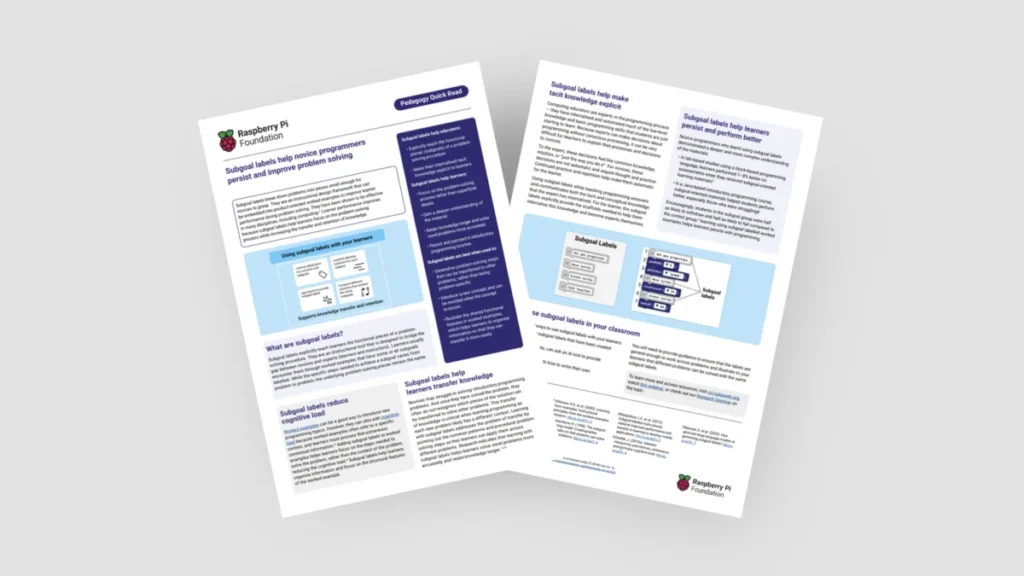
This approach acknowledges a fundamental principle of educational psychology: the "expert blind spot." When a skill becomes second nature, the expert often forgets the individual, granular steps required to perform that skill. By introducing subgoal labels into the curriculum, educators can effectively bridge this gap, providing a structured framework that guides students through the logical decomposition of programming tasks. The recent release of the Subgoal Labels Quick Read by the Raspberry Pi Foundation serves as a pivotal resource for teachers aiming to implement these evidence-based strategies in the classroom.
The Cognitive Science of Programming Education
To understand the efficacy of subgoal labels, one must look at Cognitive Load Theory (CLT), originally developed by John Sweller in the 1980s. CLT posits that the human working memory has a limited capacity. When students are presented with a complex programming problem, they often face "extraneous cognitive load"—mental effort that does not directly contribute to learning but is required to navigate poorly structured instructions.
Subgoal labels serve to reduce this extraneous load by breaking a larger problem into "chunks" or subgoals. By providing these labels, educators allow students to focus their limited cognitive resources on one manageable segment of the problem at a time. Research conducted by Dr. Lauren Margulieux and her colleagues has demonstrated that students who use subgoal labels are not only better at solving the specific problems they are taught but are also more capable of transferring those skills to new, unfamiliar programming challenges. This suggests that subgoal labels do more than just help students find the right answer; they help students build more robust mental schemas for how programming logic is structured.
Defining Subgoal Labels in a Technical Context
Subgoal labels are brief, descriptive headings or instructions integrated into instructional materials, particularly within "worked examples." A worked example is a step-by-step demonstration of how to solve a problem. While a standard worked example might simply show the final code, a version enhanced with subgoal labels explains the purpose of each section of the code.
For instance, consider a common introductory task: using a turtle graphics library to draw a blue square in a specific quadrant of the screen. A novice might look at a blank IDE and feel paralyzed by the multiple requirements (color, shape, position). Using subgoal labels, the task is decomposed as follows:
- Initialize the Environment: Import the necessary libraries and create the turtle object.
- Configure Appearance: Set the pen color to blue and define the fill properties.
- Position the Sprite: Move the turtle to the top right corner without drawing a line.
- Execute Geometry: Use a loop to draw the four sides and turns of the square.
- Finalize Output: Close the drawing path and update the display.
By categorizing the code into these five functional blocks, the student learns to see the program as a series of logical objectives rather than a monolithic string of syntax. This "signposting" technique ensures that the student understands why they are writing a specific line of code, rather than merely memorizing what to write.
Historical Evolution of Programming Pedagogy
The shift toward subgoal labels represents a broader evolution in how computer science is taught. In the 1980s and 1990s, programming education often focused on rote memorization of syntax in languages like BASIC, Pascal, or C++. The assumption was that if a student learned the rules of the language, the logic of problem-solving would naturally follow.
However, high failure rates in introductory computer science courses (CS1) globally led researchers to rethink this "syntax-first" approach. In the early 2000s, the rise of block-based languages like Scratch provided a visual way to handle syntax, but the challenge of "problem decomposition" remained. The current decade has seen a move toward "pedagogical content knowledge" (PCK), where the focus is on teaching the mental strategies of programming. Subgoal labels are a cornerstone of this movement, providing a bridge between the visual ease of block-based coding and the conceptual rigor of text-based languages like Python and Java.
Practical Strategies for Classroom Implementation
The Raspberry Pi Foundation’s latest guidance emphasizes that integrating subgoal labels does not require a total curriculum overhaul. Instead, they can be layered into existing teaching methods through several practical avenues:
1. Worked Examples and Completion Tasks
Educators can provide students with a fully functional piece of code where the subgoals are clearly marked as comments. Following this, a "completion task" can be given where the subgoal labels remain, but the code beneath them is missing. This forces the student to write the code that satisfies the specific objective described by the label, reinforcing the link between intent and implementation.
2. Parsons Problems with Subgoal Grouping
A Parsons Problem is a type of assessment where students are given lines of code in a jumbled order and must drag them into the correct sequence. To enrich this, educators can provide "distractor" subgoals or require students to group the jumbled lines under the correct subgoal headings. This adds a layer of conceptual categorization to the syntactic ordering task.
3. Peer Review and Code Documentation
Subgoal labels can be used as a tool for peer evaluation. Students can be asked to review a classmate’s code and identify whether the subgoals have been met. Furthermore, requiring students to write their own subgoal labels before they start coding acts as a form of "pseudocoding," which is a professional standard in software engineering.
Data and Evidence: The Impact on Learning Outcomes
Quantitative studies in computing education research (CER) have consistently highlighted the benefits of subgoal labeling. In a study involving undergraduate students learning Python, those provided with subgoal labels performed 20% better on transfer tasks—problems that required applying learned concepts to new scenarios—compared to a control group.
Furthermore, the use of subgoal labels has been shown to reduce "time-on-task" for beginners without sacrificing the depth of understanding. This is particularly important in K-12 environments where classroom time is limited. By reducing the time spent on "getting stuck," students can progress through more complex material within a single academic year.
Official Responses and Educational Implications
Leading figures in the computing education community have welcomed the Raspberry Pi Foundation’s focus on this area. While the foundation has not issued a formal press release, the sentiment among educational technologists is that these resources are vital for democratizing computer science.
"The challenge in modern CS education isn’t just access to hardware; it’s access to effective mental frameworks," says a consensus of educational researchers. "Subgoal labels are a low-cost, high-impact intervention that can be used in any environment, from high-tech labs to classrooms with limited resources."
The implications of this approach extend beyond the classroom. As the global economy becomes increasingly reliant on software development and data analysis, the ability to decompose complex problems is a highly transferable skill. By teaching students to use subgoal labels, educators are essentially teaching "Computational Thinking"—a problem-solving methodology that is applicable in mathematics, engineering, and even the humanities.
Broader Impact and Future Outlook
The introduction of the Subgoal Labels Quick Read is part of a larger trend toward evidence-based teaching in STEM (Science, Technology, Engineering, and Mathematics). As more schools integrate computer science into their core curricula, the demand for "scaffolded" learning materials will only increase.
One significant implication of this pedagogical shift is its potential impact on diversity and inclusion within the tech sector. Research indicates that students from underrepresented backgrounds are often more likely to be discouraged by the "sink or swim" nature of traditional programming instruction. By providing clear scaffolding like subgoal labels, educators can create a more inclusive environment that supports learners who may not have had prior exposure to computational concepts at home.
Looking ahead, the next frontier in this field may involve the integration of Artificial Intelligence (AI) in the classroom. AI-driven tutoring systems are already being developed to provide real-time subgoal suggestions to students as they code. However, the foundational research provided by organizations like the Raspberry Pi Foundation ensures that these technological advancements remain grounded in proven educational theory.
In conclusion, the strategic use of subgoal labels represents a sophisticated understanding of the human learning process. By breaking down the "automatic" actions of experts into visible, manageable steps, educators can empower the next generation of programmers to tackle increasingly complex global challenges. The resources provided by the Raspberry Pi Foundation offer a clear roadmap for teachers to transform their classrooms into environments where every student, regardless of their starting point, has the tools to succeed in the digital age.