DM3D, a pioneering contract manufacturer and metal additive manufacturing (AM) solutions provider, is making significant strides in the aerospace and space industries by leveraging its proprietary Direct Metal Deposition (DMD) technology. This innovative approach allows for the 3D printing of large, complex metal parts, drastically accelerating production timelines and reducing costs for high-profile clients such as NASA. The company’s patented laser-based DMD systems are not only enhancing its own manufacturing capabilities but are also being offered to other additive manufacturers, signaling a broader impact on the industry’s evolution.
From Automotive Roots to Aerospace Frontiers
Founded in 2013, DM3D’s journey began in Auburn Hills, Michigan, with a focus on tool and die building and refurbishment, primarily serving the automotive sector. However, the inherent challenges of one-off production, coupled with the growing trend of offshoring in the tool and die industry, alongside a burgeoning interest in the aerospace market, prompted a strategic pivot. Bhaskar Dutta, the company’s president, with over two decades of experience in additive manufacturing, recognized the immense potential of metal AM to address the demanding requirements of space and aerospace clients.
"The traditional tool and die business, while foundational, presented limitations in terms of scalability and customization," explained Dutta in a previous industry forum. "We saw a clear opportunity to apply our deep understanding of AM, particularly in metal deposition, to sectors that demand extreme precision, high performance, and rapid turnaround for complex components. The space industry, with its rigorous qualification processes and need for lightweight, robust parts, became a natural target."
This strategic shift involved significant investment in research and development. DM3D not only focused on scaling its in-house production capabilities but also on developing its own Direct Energy Deposition (DED) systems. The culmination of this effort is their patented Direct Metal Deposition (DMD) technology, specifically engineered for Large Format Additive Manufacturing (LFAM) production. These advanced systems are now also available for sale to other additive manufacturing companies, underscoring DM3D’s commitment to advancing the broader AM ecosystem.

The company’s Auburn Hills facility has evolved into a comprehensive hub for its operations. All packaging and shipping are managed internally, ensuring quality control throughout the supply chain. Furthermore, DM3D has integrated a robust post-processing infrastructure, featuring multiple in-house CNC and EDM machines. This vertical integration allows for a high degree of control over the final product quality, with only the largest, most exceptionally sized parts being outsourced for specialized finishing.
The Power of Direct Metal Deposition (DMD)
DM3D’s core technological advantage lies in its patented laser DMD process. This method is adept at working with a wide array of metals, including stainless steel, Inconel, and various alloys of aluminum, titanium, and copper. The versatility of the laser-based DMD technology is particularly crucial for handling diverse metal materials, each with its unique melting points and deposition characteristics.
The DMD process is meticulously designed for the production of complex geometries that are often prohibitively difficult or impossible to manufacture using conventional subtractive methods. It operates by utilizing a focused laser energy source to precisely melt and deposit metal powder or wire layer by layer. This additive approach allows for intricate internal structures, optimized designs for weight reduction and performance enhancement, and the consolidation of multiple components into a single, integrated part.
The fundamental steps of the DMD process involve:
- Material Feeding: Precisely controlled delivery of metal powder or wire into the deposition zone.
- Laser Melting: A high-power laser beam precisely melts the feedstock material and a thin layer of the substrate or previously deposited material.
- Deposition and Solidification: The molten metal is deposited onto the build platform or existing structure, where it rapidly solidifies, forming a strong metallurgical bond.
- Layer-by-Layer Construction: The deposition head moves in a controlled path, guided by a digital design file, building the part layer upon layer.
- Quality Control: Real-time monitoring of process parameters such as temperature, melt pool dynamics, and deposition rate to ensure part integrity.
This controlled and repeatable process allows DM3D to achieve high material utilization and produce parts with exceptional dimensional accuracy and mechanical properties. The ability to precisely control the energy input and material flow is critical for preventing defects such as porosity, lack of fusion, and residual stresses, which are common challenges in metal AM.

Addressing Low-Volume, High-Value Markets
The inherent advantages of additive manufacturing—reduced lead times and lower costs—are particularly impactful for industries that require low volumes of large, complex parts. This is precisely why DM3D initially targeted the space and aerospace sectors. These industries often involve intricate designs, stringent material specifications, and the need for highly customized components, making traditional manufacturing methods both time-consuming and expensive.
"The elimination of the tool and die making process alone offered a significant reduction in lead time," commented Dutta. "For low-volume production and prototyping, additive manufacturing is not just cost-effective; it’s a game-changer. It enables rapid iteration and allows us to deliver mission-critical components faster than ever before."
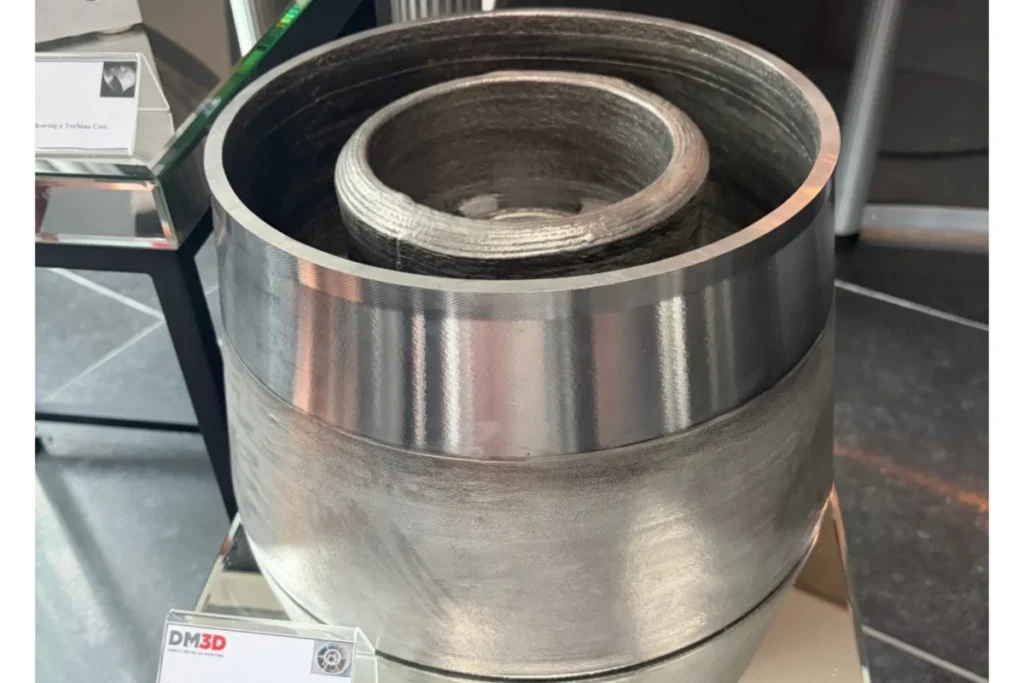
DM3D has demonstrably proven its capabilities by producing some of the largest additively manufactured metal components for rocket engines. A landmark achievement was the 3D printing of NASA’s RS-25 engine nozzle liner. This colossal component, measuring an impressive 111 inches in height with a 97-inch diameter base, was manufactured using a custom-designed, multi-nozzle DMD system. The development of this specialized system was a direct response to the unique requirements of such a large and complex part, showcasing DM3D’s adaptability and engineering prowess.
The process for the RS-25 nozzle liner involved a collaborative effort between DM3D and NASA. Following the initial design phase, advanced simulation software, such as ANSYS, was employed to meticulously analyze the part’s potential thermal stresses and distortions throughout the entire build process. This predictive modeling was crucial for optimizing the print parameters and ensuring the structural integrity of the final component. Once the simulations were complete, the liner was additively manufactured using DM3D’s DED technology. Post-production, the completed liner underwent a rigorous structured light geometric inspection scan to verify its dimensional accuracy and conformity to design specifications.
The impact of employing AM for the production of this critical component was substantial. DM3D reported a reduction of over 50% in lead time and a 25% decrease in cost compared to conventional manufacturing methods. The innovative multi-nozzle DMD system developed for this project was instrumental in achieving these efficiencies. By utilizing two simultaneously operating process heads, the system effectively doubled the throughput. Furthermore, the system was designed with scalability in mind, with the capability to incorporate two additional process heads if necessary, allowing for even greater production speed and flexibility for future projects.

A Trusted Partner for Advanced AM Solutions
DM3D has strategically positioned itself as a comprehensive, one-stop-shop for additive manufacturing services and solutions. This integrated approach caters to clients across a diverse range of industries, offering not just manufacturing capabilities but also access to cutting-edge AM technology. As a relatively small company, DM3D maintains a focused strategy, carefully selecting the applications it undertakes to ensure optimal resource allocation and the highest quality output.
Looking ahead, DM3D is actively pursuing expansion of its technological repertoire and market reach. A key near-term objective is to achieve qualification for wire-based DED technology. This will broaden the range of materials and part sizes that can be manufactured, offering greater flexibility and cost-effectiveness for certain applications. Additionally, the company is prioritizing the qualification of titanium parts for production. With titanium castings becoming increasingly difficult for manufacturers to source due to supply chain complexities and lead time challenges, DM3D’s ability to reliably produce titanium components through AM will address a significant market need and further expand its service offerings.
The company’s commitment to innovation, coupled with its strategic focus on high-demand, specialized markets, positions DM3D as a significant player in the ongoing evolution of additive manufacturing. Their advancements in large-format metal AM, particularly their patented DMD technology, are not only enabling critical missions for space exploration but are also setting new benchmarks for efficiency, cost-effectiveness, and design freedom in advanced manufacturing. The implications of these developments extend beyond individual projects, hinting at a future where complex, large-scale metal components can be produced more sustainably and accessibly, driving innovation across numerous high-technology sectors.