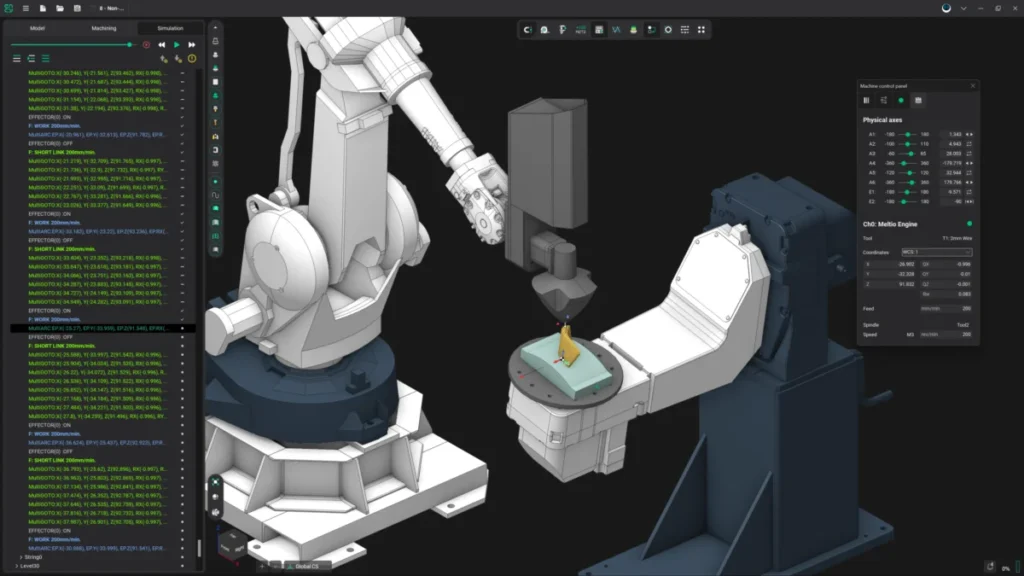
In a significant advancement for industrial automation, machine-tool provider CNC Solutions has unveiled a groundbreaking "Technology Package" that redefines how industrial robots tackle complex manufacturing tasks traditionally reserved for dedicated CNC machines. This integrated solution, leveraging offline programming software ENCY Robot, Beckhoff’s advanced motion control, and Stäubli’s high-precision robotics, addresses the critical limitations of conventional teach-in methods, paving the way for unprecedented levels of precision, speed, and efficiency in applications such as multi-axis milling, abrasive sanding, and laser or plasma cutting.
The Evolving Landscape of Industrial Automation
For decades, industrial robots have been indispensable in manufacturing, primarily excelling in repetitive, high-volume tasks like pick-and-place, assembly, and welding. Their programming often relied on "teach-in" methods, where operators manually guide the robot through a series of points, a process effective for simpler trajectories. However, as manufacturing demands have grown exponentially in complexity, traditional teach-in has proven increasingly inadequate. Modern CNC-class workloads, encompassing intricate milling, fine abrasive processes, or precise laser cutting, can involve managing millions of motion points across multiple axes. Such complexity far exceeds the capacity of manual teaching, leading to prohibitive programming times, inconsistent quality, and significant robot downtime.
This challenge has become particularly pronounced in an era defined by Industry 4.0, where the drive towards smart factories necessitates seamless integration, data-driven processes, and adaptable automation. Manufacturers are constantly seeking ways to enhance productivity, improve product quality, and reduce operational costs, pushing the boundaries of what industrial robots can achieve. The gap between the flexibility of industrial robots and the deterministic precision of traditional CNC machine tools has long been a hurdle for integrators and end-users alike.
CNC Solutions’ Vision and the Genesis of the Technology Package
Recognizing this critical bottleneck, CNC Solutions, a company with extensive experience in supporting increasingly complex projects – from multi-axis milling to high-speed trimming – embarked on a mission to bridge this divide. Their work on diverse applications, many of which now render traditional controller-centric methods insufficient, highlighted the urgent need for a more sophisticated workflow. The ideal solution, they determined, would begin with computer-aided manufacturing (CAM) software, allow for comprehensive simulation of the entire robotic cell, and ultimately control a robot with the precision and speed characteristic of a CNC machine.
The development of this new Technology Package was an iterative process, refined over time as CNC Solutions’ team meticulously tuned robot axis motions to achieve the consistency and reliability of a dedicated CNC machine. Their objective was not merely to automate, but to elevate the robot’s operational capability to that of a machine tool, freeing operators to focus on production optimization rather than manual intervention and laborious programming. This journey culminated in a standardized, commercially available solution designed for easy implementation by integrators.
The Integrated Architecture: A Synergy of Expertise

The new solution is built upon three foundational pillars, each contributing specialized capabilities to create a cohesive and powerful manufacturing system. This tripartite architecture integrates advanced software, robust motion control, and precision robotics to deliver a truly CNC-capable robot.
ENCY Robot: The Brain for Offline Precision
At the heart of the software layer is ENCY Robot, an advanced offline programming (OLP) software developed by ENCY. This platform is pivotal in overcoming the inefficiencies associated with online robot teaching. Instead of requiring valuable robot uptime for programming, ENCY allows engineers to calculate complex toolpaths and simulate the entire robotic cell in a virtual environment. This comprehensive simulation includes crucial checks for axis limits, collision detection, and singularity avoidance, transforming what would traditionally be commissioning time into productive pre-production planning.
ENCY’s robust functionality extends beyond mere simulation. It provides an all-in-one environment for design, technology setup, toolpath calculation, and simulation. Its features, such as a zero-code digital-twin builder and extensive libraries, enable manufacturers to translate trusted CAM strategies directly into reliable robot instructions. This eliminates the need for hours of online programming and ensures transparent system behavior by internally managing complex code paths and models. The versatility of ENCY allows it to handle a wide range of tasks, from simple two-axis operations to highly intricate multi-axis cells, making it an ideal choice for diverse industrial applications. The ability to perform full collision control and singularity avoidance offline significantly de-risks the commissioning process, ensuring that when the robot begins operation, it does so with validated, optimized trajectories.
Beckhoff’s TwinCAT: The Control Core
Providing the critical link between the advanced software and the physical robot is a Beckhoff motion controller. Beckhoff Automation is renowned for its PC-based control technology, epitomized by its TwinCAT automation software. In this solution, the Beckhoff controller is instrumental in operating the robot using standard CNC commands – including feeds, modes, and frames – familiar to any machine tool operator. This choice of control system is strategic; Beckhoff’s open and flexible architecture allows for seamless integration with ENCY’s generated toolpaths and Stäubli’s precise mechanics.
The Beckhoff controller essentially transforms the robot into a CNC axis group, processing the millions of motion points required for complex tasks with the deterministic performance expected from a high-end machine tool. This integration means that manufacturers do not need to master vendor-specific robot programming languages. Instead, their expertise can remain focused on broader automation elements such as PLCs, safety systems, fixturing, end-effectors, and process knowledge. The Beckhoff cabinet, often featuring a CNC-style Human-Machine Interface (HMI) and a handheld pendant, ensures operators have intuitive control over the robot’s movements, mirroring the operational experience of a traditional CNC machine. This standardisation of control interfaces significantly reduces the learning curve and improves operational efficiency.
Stäubli Robotics: The Precision Executor
Completing the hardware trinity is the Stäubli robot, tasked with executing the meticulously planned paths with the necessary precision and reliability for production. Stäubli robots are distinguished by their high accuracy, repeatability, and sealed construction, which makes them particularly suitable for demanding industrial environments where dust, debris, or abrasive particles are present. This robust design is crucial for applications like grinding and milling, where environmental resistance directly impacts longevity and performance.
The seamless integration of Stäubli robots with a CNC-style motion layer for trajectory execution is a cornerstone of the Technology Package. Their inherent mechanical precision allows them to translate the complex commands from the Beckhoff controller into exact physical movements, ensuring that the finished part meets stringent quality requirements. Stäubli’s commitment to delivering high-performance, maintenance-friendly robots aligns perfectly with the solution’s goal of enabling higher-value applications that demand consistent, repeatable results. The "plug-and-play" wiring, connecting the Stäubli robot to the controller with a single cable, further simplifies installation and commissioning, embodying the solution’s emphasis on ease of deployment.
Bridging the Gap: From Concept to Production Reality
The culmination of these integrated technologies is a comprehensive solution that fundamentally changes how manufacturers approach complex robotic tasks. CNC Solutions’ Technology Package allows integrators to expand their capabilities with their own PLCs, fixturing, and process equipment, building upon a validated and reliable foundation.

A significant advantage of this package is the inclusion of predefined and machine-tuned processes. These validated starting points cover a wide array of applications such as milling, grinding, deburring, polishing, blasting (wet/dry), plasma and laser cutting/welding, waterjet cutting, cladding, painting, cleaning, and gluing. This ready-to-use library of processes dramatically reduces development time and risk for integrators, accelerating their path to deploying new applications.
Beyond predefined processes, the system incorporates standard features crucial for seamless operation in a production environment. These include CNC-style modes (Auto, Manual, Home), feed overrides for real-time speed adjustments, and robust emergency-stop logic. The system also provides essential process I/O and communication interfaces for plant networks, supporting consistent speed control during automatic operation and enabling manual moves via encoder-wheel controls for fine adjustments.
Recognizing that real-world production cells often deviate from theoretical specifications, the Technology Package incorporates advanced features that typically require extensive setup time. These include absolute, TCP (Tool Center Point), and frame calibration, essential for maintaining accuracy and consistency across different setups. Furthermore, it offers singularity management to prevent robot arm configurations that could lead to unpredictable behavior, OPC UA connectivity for seamless integration into broader industrial networks, real-time path adjustments to compensate for environmental variables, and tool-wear compensation to ensure consistent part quality over long production runs. These features are critical for robust, long-term operation in dynamic manufacturing environments.
Transformative Benefits for Integrators and Manufacturers
The impact of CNC Solutions’ Technology Package is profound, offering a multitude of benefits for both integrators deploying these systems and the manufacturers utilizing them:
- Reduced Time to First Good Part: By eliminating the need for laborious online robot teaching, complex path planning is handled entirely offline within ENCY. This allows teams to dedicate their valuable time to optimizing fixtures, tools, and the overall process, drastically cutting down the time from robot installation to producing the first quality part.
- Expanded Application Scope: The solution enables higher-value applications such as precision milling, intricate trimming, and fine sanding – tasks that many integrators previously avoided due to the inherent limitations and complexities of traditional teach-in methods. This opens up new revenue streams and competitive advantages.
- Enhanced Precision and Consistency: The combination of ENCY’s precise toolpath generation, Beckhoff’s deterministic motion control, and Stäubli’s high-repeatability robots ensures a level of accuracy and consistency that rivals traditional CNC machines. This leads to higher quality products and reduced scrap rates.
- Reduced Delivery Risk and Warranty Exposure: By reusing more project elements, leveraging predefined processes, and validating entire cells through offline simulation, integrators significantly decrease project delivery risk. The predictability and reliability of the standardized solution also reduce warranty exposure.
- Operational Efficiency and Cost Savings: Minimizing robot idle time through offline programming directly translates into increased throughput and better utilization of capital assets. The simplified programming and operational interface also reduce the need for highly specialized robot programmers, lowering operational costs.
- Simplified Integration and Expertise Management: The system operates as a unified CNC axis group, eliminating the need for integrators and operators to master multiple vendor-specific robot languages. This allows core expertise to remain focused on essential automation elements like PLCs, safety, fixturing, and process knowledge, streamlining workforce development and deployment.
- Future-Proofing for Industry 4.0: With features like OPC UA connectivity, real-time path adjustments, and a robust digital twin capability, the Technology Package is inherently designed for the demands of smart manufacturing and Industry 4.0 environments, allowing seamless data exchange and integration into broader production ecosystems.
A New Era for High-Value Applications
The commercial availability of CNC Solutions’ Technology Package marks a pivotal moment in industrial automation. It represents a mature, stable solution, proven in diverse shops, industries, and applications, that empowers industrial robots to perform tasks traditionally outside their capabilities. This shift is not merely an incremental improvement but a fundamental change in how manufacturers can leverage robotics for high-precision, complex operations.
The core system, featuring a Beckhoff motion cabinet with its intuitive CNC-style HMI and pendant, ENCY for comprehensive offline programming, simulation, and critical checks, and a streamlined single-cable connection to a Stäubli robot, offers a complete ecosystem. By delivering predefined processes for common applications like milling, sanding, welding, and laser/plasma cutting, and integrating essential real-world calibration and compensation features, CNC Solutions has democratized access to advanced robotic manufacturing.
This innovative combination is poised to unlock new possibilities across various sectors, from aerospace and automotive to medical devices and general manufacturing. By enabling industrial robots to operate with the precision and predictability of CNC machine tools, manufacturers can achieve greater flexibility in their production lines, adapt more quickly to market demands, and ultimately produce higher quality products more efficiently. The Technology Package is not just a solution; it is a catalyst for the next generation of robotic manufacturing, solidifying the robot’s role as a versatile, high-precision tool in the modern factory.