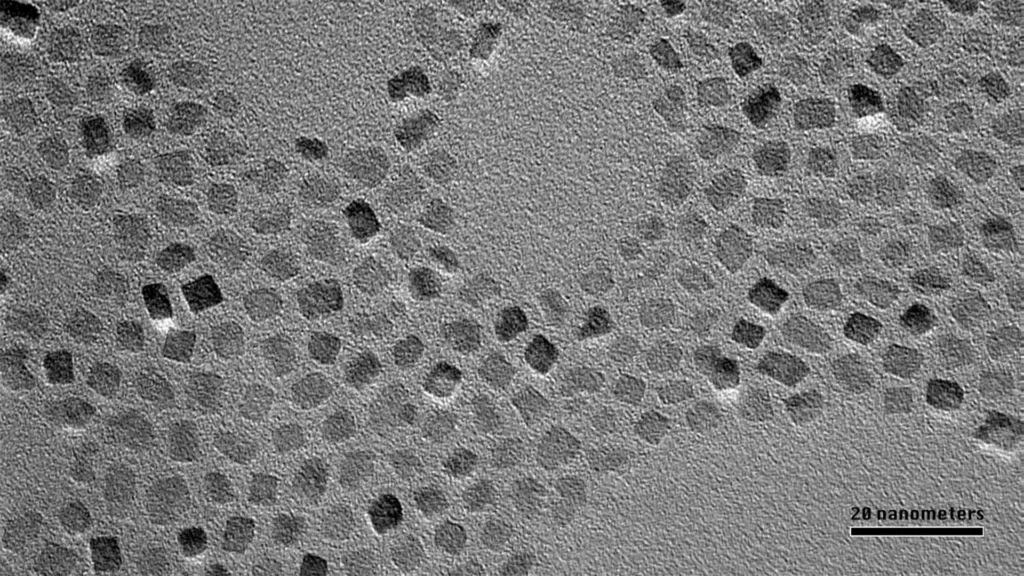
In a landmark development for materials science, researchers at the University of Chicago and Argonne National Laboratory have pioneered a transformative method for synthesizing nanocrystals from metal nitrides. This breakthrough, recently detailed in the journal Nature, addresses a long-standing limitation in the field of nanotechnology, where the production of high-quality nanocrystals has historically been restricted to a narrow subset of materials. By overcoming the formidable chemical bonds that define metal nitrides, the team has opened a new frontier for applications ranging from flexible, high-definition displays to advanced medical implants and industrial catalysts.
The significance of nanocrystal research was underscored globally in 2023 when the Nobel Prize in Chemistry was awarded for the discovery and development of quantum dots. These microscopic crystals, often just a few nanometers in diameter, exhibit unique optical and electrical properties dictated by their size rather than their bulk composition. However, while oxides and chalcogenides have been successfully converted into nanocrystals for years, metal nitrides—despite their immense industrial value—remained largely inaccessible in this form. The new study, led by graduate student Ruiming Lin and Professor Dmitri Talapin, effectively dismantles these traditional constraints, demonstrating the synthesis of nearly a dozen different nitride materials that were previously impossible to produce via conventional chemical routes.
The Evolution of Nanocrystal Science: From Quantum Dots to Nitrides
To understand the magnitude of this discovery, it is essential to consider the historical trajectory of nanomaterials. Nanocrystals are structures so small that they bridge the gap between individual molecules and bulk solids. At this scale, quantum mechanical effects become dominant. For instance, semiconductor nanocrystals, or quantum dots, can be "tuned" to emit specific colors of light simply by changing their size. This property has revolutionized the television industry, leading to the development of QLED displays that offer unprecedented color purity and energy efficiency.
Despite these successes, the "palette" of materials available to nanotechnologists remained limited. Most research focused on materials that could be synthesized at relatively low temperatures using organic solvents. Metal nitrides, however, represent a much more challenging category. Compounds such as gallium nitride (GaN) are prized for their hardness, thermal stability, and excellent semiconducting properties. They are the backbone of modern power electronics and the blue light-emitting diodes (LEDs) that earned the 2014 Nobel Prize in Physics. Yet, the very characteristics that make nitrides desirable—their incredible strength and resistance to heat—made them "uncooperative" in the laboratory when researchers tried to shrink them down to the nanoscale.
The Chemical Barrier: Why Nitrides Resisted Synthesis
The primary obstacle in creating metal nitride nanocrystals lies in the nature of their chemical bonds. In the synthesis of traditional nanocrystals, precursor molecules are dissolved in a liquid and heated. As the molecules react, they form tiny "seeds" that grow into crystals. For a perfect crystal to form, the atoms or ions must have the ability to move, break temporary bonds, and rearrange themselves into a highly ordered lattice.
Dmitri Talapin, the Ernest DeWitt Burton Distinguished Service Professor at UChicago and a senior scientist at Argonne, compares this process to a square dance. For the dance to be successful, partners must be able to let go of one hand and grab another as they move through the formation. In metal nitrides, the bonds between the metal and nitrogen atoms are exceptionally strong—much stronger than those in the oxides or sulfides used to make common quantum dots.
In a typical reaction environment, once a metal-nitrogen bond forms, it is nearly impossible to break. If the atoms settle into the wrong position, they become "locked" in a disordered, amorphous state rather than forming a perfect crystal. This lack of mobility has been described by researchers as a "death sentence" for nanocrystal growth. Without the ability to "error-correct" during the synthesis process, the resulting material lacks the structured integrity required for technological applications.
A Two-Fold Innovation: Molten Salts and Controlled Pressure
The UChicago and Argonne team solved this problem through a combination of innovative chemistry and precise environmental control. Their approach relied on two primary pillars: the use of molten salts as a medium and the identification of a specific "sweet spot" in temperature and ammonia pressure.
Building on previous work from the Talapin lab, the researchers moved away from traditional organic solvents, which often decompose at the high temperatures required for nitride synthesis. Instead, they utilized molten salts—ionic liquids that remain stable at extreme heat. These salts provide a unique environment that can stabilize the surface of a growing nanocrystal, preventing the tiny particles from clumping together into a useless mass.
The second breakthrough involved the atmospheric conditions of the reaction. By introducing ammonia at specific pressures and carefully calibrating the temperature, the team found a window where the metal-nitrogen bonds became "dynamic." In this state, the bonds could break and reform with enough frequency to allow the atoms to find their proper places in the crystal lattice.
"This process is very unusual—it goes against every bit of common sense in the field," Talapin noted, emphasizing that the team had to rethink the fundamental approach to how these materials are coaxed into crystalline forms. The result was a series of high-quality, uniform nanocrystals that retained the robust properties of their bulk counterparts while gaining the benefits of nanotechnology.
Expanding the Catalog: Titanium, Niobium, and Molybdenum
The versatility of this new method was demonstrated by the synthesis of nearly a dozen different materials. While gallium nitride is perhaps the most famous member of the nitride family due to its role in lighting, the team also produced nanocrystals from several other industrially significant compounds:
- Titanium Nitride (TiN): Known for its extreme hardness and gold-like appearance, titanium nitride is commonly used as a coating for drill bits and in medical implants due to its biocompatibility. In nanocrystal form, it could lead to new types of bio-sensors or plasmonic devices.
- Niobium Nitride (NbN): This material is a vital superconductor used in ultra-sensitive radiation detectors and quantum computing components. Creating niobium nitride nanocrystals could allow for the "printing" of superconducting circuits onto flexible substrates.
- Molybdenum Nitride (MoN): Widely utilized as a catalyst in the oil and gas industry for hydrodesulfurization, molybdenum nitride nanocrystals offer a much higher surface area than bulk material, potentially making industrial chemical reactions significantly more efficient and less energy-intensive.
The ability to produce these materials at the nanoscale at a relatively low cost is expected to accelerate their adoption in commercial sectors. Because many of these nitrides are more abundant and less toxic than the heavy metals used in some current quantum dots, they represent a more sustainable path forward for the electronics industry.
Potential Applications: From Flexible Lighting to Smart Fabrics
The transition from rigid films to "liquid" nanocrystal inks is one of the most promising implications of this research. Currently, gallium nitride electronics are manufactured using expensive and rigid substrates through a process called epitaxy. This limits GaN to flat, stiff components like those found in power adapters or LED panels.
With the new synthesis method, metal nitrides can be treated like any other nanoparticle. They can be suspended in inks and printed using inkjet technology or mixed into polymers to create flexible, light-emitting plastics. This could lead to a new generation of wearable technology, such as fabrics that change color or monitor health metrics via integrated sensors.
Furthermore, the biocompatibility of materials like titanium nitride opens doors in the medical field. Nanocrystals could be used as contrast agents for advanced imaging or as part of targeted drug delivery systems. Their resistance to corrosion ensures that they can remain stable within the human body, a feat that many other nanomaterials cannot achieve.
Collaboration and Institutional Support
The success of the study was the result of an extensive collaboration involving various facilities and funding bodies. In addition to the lead authors at the University of Chicago, the research involved a diverse team of scientists, including Ningxin Jiang, Wooje Cho, and John S. Anderson, among others.
The experimental work utilized the specialized resources of the National Science Foundation (NSF) Materials Research Science and Engineering Center at UChicago, the UChicago Soft Matter Characterization Facility, and the Center for Nanoscale Materials at Argonne National Laboratory. These facilities provided the advanced electron microscopy and spectroscopic tools necessary to verify the atomic structure of the new nanocrystals.
Funding for the project was provided by a coalition of public and private entities, including the U.S. Department of Energy, the Air Force Office of Scientific Research, the National Science Foundation, and the Samsung QD Cluster Collaboration. The involvement of Samsung, a global leader in display technology, suggests a high level of industrial interest in the commercialization of nitride-based nanocrystals.
Conclusion and Future Outlook
The development of a reliable method for synthesizing metal nitride nanocrystals marks the end of a long-standing "dead zone" in materials science. By mastering the chemistry of strong-bond materials, the researchers have not only added a dozen new tools to the nanotechnologist’s kit but have also provided a blueprint for synthesizing other difficult materials in the future.
As the industry moves toward more efficient, durable, and flexible electronics, the "sweet spot" discovered by Lin, Talapin, and their colleagues may soon be seen as the catalyst for a new era of manufacturing. While it may take several years for these nanocrystals to move from the laboratory to consumer products, the foundation has been laid for a significant shift in how we build the devices that power modern life. The discovery proves that even the strongest chemical bonds can be negotiated, provided one has the right environment and the scientific persistence to find it.