PI (Physik Instrumente), a global leader in high-precision motion and positioning solutions, has officially launched a dedicated low-temperature development program. This strategic initiative is meticulously focused on advancing multi-axis nanopositioning systems, specifically tailored to meet the exacting demands of cutting-edge quantum applications. This move underscores a significant evolution in precision engineering, addressing the complex challenges inherent in manipulating and observing quantum phenomena at cryogenic temperatures.
The Dawn of a New Era in Precision: Addressing Quantum Challenges
The landscape of scientific research and technological development is increasingly dominated by the promise of quantum technologies. From quantum computing and communications to advanced quantum sensing, these nascent fields hold the potential to revolutionize industries and scientific understanding. However, unlocking this potential hinges on overcoming formidable engineering hurdles, particularly in environments where quantum states can be maintained – often at temperatures mere fractions of a degree above absolute zero.
Early solutions for motion control within these extreme cryogenic environments were typically rudimentary, often relying on stacked XYZ stages. While functional for simpler tasks, the accelerating complexity of modern quantum experiments and applications has rendered these conventional approaches insufficient. Contemporary research and development now necessitate highly sophisticated, multi-degree-of-freedom (DOF) alignment systems. These advanced systems must be capable of supporting larger, more intricate payloads and accommodating complex optical configurations, all while operating with unparalleled precision and stability in the confined, thermally sensitive spaces of cryostats and dilution refrigerators. PI’s new development program directly targets this critical gap, aiming to provide the foundational precision tools required for the next generation of quantum innovation.
Evolution of Cryogenic Motion Control: A Brief Chronology
The journey towards advanced cryogenic nanopositioning has been incremental, driven by the escalating demands of low-temperature physics and, more recently, quantum science.

- Early 20th Century (Early Cryogenics): The liquefaction of gases like helium opened doors to low-temperature research. Initial experiments primarily focused on material properties, and any required motion was often manual or mechanically simplistic, performed outside the cryogenic environment.
- Mid-20th Century (Basic Cryogenic Actuation): As cryostats became more sophisticated, the need for in-situ manipulation arose. This led to the development of rudimentary, often custom-built, mechanical linkages or simple stepper motor-driven systems, which struggled with heat load and precision at low temperatures.
- Late 20th Century (Introduction of Piezoelectrics): The advent and miniaturization of piezoelectric actuators marked a turning point. Their ability to generate precise, sub-nanometer movements with relatively low heat dissipation made them ideal candidates for cryogenic environments. Initial applications typically involved single-axis or stacked XYZ stages, offering limited degrees of freedom but a significant improvement in precision.
- Early 21st Century (Rise of Quantum Technologies): With the rapid advancements in quantum computing, quantum optics, and ultra-cold atom research, the limitations of stacked serial stages became apparent. The demand for simultaneous, coordinated motion in multiple axes (5-DOF, 6-DOF), often with sub-nanometer resolution over millimeter-scale travel, became paramount. This era saw increased investment in developing specialized materials and control electronics for extreme conditions.
- Present Day (PI’s Strategic Initiative): PI’s new program represents a significant leap forward, moving beyond incremental improvements to fundamentally redesign systems for the quantum era. By focusing on parallel kinematics, specialized materials, and advanced control algorithms, the company aims to set new benchmarks for cryogenic nanopositioning, addressing the current and future needs of the rapidly expanding quantum technology ecosystem.
PI’s Innovative Approach: Hexapod Parallel Kinematics for Extreme Environments
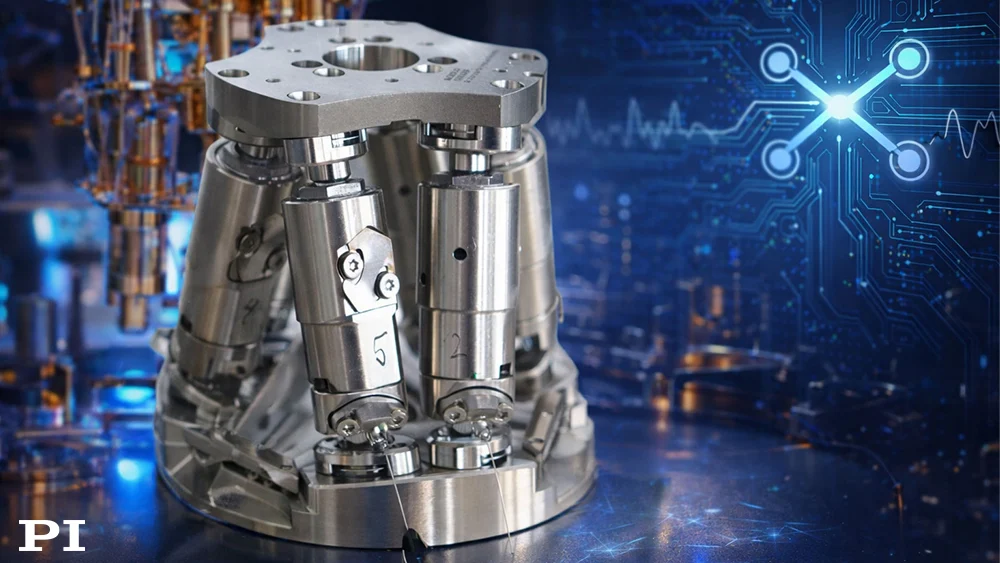
At the core of PI’s innovative strategy is the adoption of compact 6-degree-of-freedom (6DOF) parallel kinematics. This architectural choice represents a significant departure from traditional serial stacked systems and is particularly advantageous for the constrained and sensitive environments of cryostats and dilution refrigerators. Unlike serial stages, where each axis is stacked upon another, leading to error accumulation and increased inertia, parallel kinematics utilize multiple struts connected to a common platform. This design inherently offers several critical benefits:
- Simultaneous 6DOF Control: Hexapod-type systems provide simultaneous and coordinated control over all six degrees of freedom (X, Y, Z translation, and pitch, roll, yaw rotation). This capability is crucial for complex alignment tasks in quantum optics, where precise angular and translational adjustments are often interdependent.
- Reduced Error Accumulation: By distributing the load and motion control across multiple actuators, parallel kinematics inherently reduce the compounding errors often observed in stacked serial systems. This results in superior accuracy, repeatability, and stability – paramount requirements for quantum experiments.
- Compactness and High Stiffness: The parallel design allows for a more compact footprint and a higher ratio of payload capacity to self-weight, making them ideal for the limited space inside cryostats. Furthermore, their inherent structural rigidity contributes to greater mechanical stability and reduced susceptibility to external vibrations.
- Lower Inertia and Energy Requirements: With a simpler, more integrated structure, hexapods typically exhibit lower moving inertia compared to an equivalent stacked system. This translates to more dynamic response and potentially lower energy consumption, a critical factor in minimizing heat load within a cryogenic system.
- Programmable Pivot Point: A unique advantage of hexapod systems is the ability to program the center of rotation (pivot point) anywhere in space. This feature is invaluable for rotational alignment tasks, allowing researchers to precisely rotate an optical element around its own focal point or another critical reference point without introducing translational errors.
- Open Aperture: Many quantum optical setups require clear optical paths. PI’s hexapod designs often incorporate an open aperture through the center of the platform, facilitating the integration of complex optical configurations such as beam steering, lens aberration correction, polarization control, and the precise positioning of dispersive elements like gratings and prisms.
Engineered for the Cryogenic Frontier: Technical Specifications and Material Science
The success of nanopositioning in quantum applications hinges on meticulous engineering for extreme conditions. PI’s systems are specifically designed to operate at temperatures below 4 Kelvin (K), a range typically associated with liquid helium temperatures, and potentially even lower in dilution refrigerators where temperatures can reach millikelvin. Achieving this requires careful consideration of every component:
- Materials Selection: Standard materials often become brittle or exhibit unpredictable behavior at cryogenic temperatures. PI utilizes specialized, non-magnetic materials that maintain their mechanical integrity and dimensional stability at ultra-low temperatures. The non-magnetic property is particularly critical to prevent interference with sensitive quantum devices, which can be highly susceptible to stray magnetic fields.
- Heat Generation Management: Any heat generated by actuators or electronics inside a cryostat must be efficiently removed, as it can significantly impact the cooling power and de-cohere delicate quantum states. PI’s piezo-based architecture is chosen for its inherently low heat dissipation characteristics. Furthermore, these systems often feature self-locking operation when power is switched off. This capability ensures that the position is maintained without continuous power consumption, further minimizing heat load and offering a fail-safe mechanism in thermally sensitive environments.
- UHV Compatibility: Many quantum experiments are conducted in ultra-high vacuum (UHV) environments to prevent contamination and maintain the integrity of delicate quantum systems. PI’s designs incorporate UHV-compatible materials and construction techniques, ensuring minimal outgassing and seamless integration into vacuum chambers.
- Performance Metrics: The systems are engineered to support payloads of several hundred grams, a common requirement for mounting optics, detectors, or other experimental apparatus. They offer millimeter-scale travel ranges, which, while seemingly small, are substantial for ultra-precise alignment tasks at the nanoscale. Crucially, these movements are achieved with exceptional stability and repeatability, often down to sub-nanometer levels, which is indispensable for maintaining coherence and performing reliable measurements in quantum systems.
Broader Impact and Strategic Market Alignment
This development program extends PI’s long-standing expertise in high-precision motion technology into a rapidly expanding and strategically critical domain. The implications of this advancement are far-reaching, touching multiple high-tech industries.
- Quantum Technology Industry: The most direct beneficiary, the quantum technology market, is projected for explosive growth. Estimates suggest the global quantum computing market alone could reach tens of billions of dollars by the end of the decade, with quantum sensing and communication markets showing similar trajectories. PI’s precise cryogenic nanopositioners will serve as fundamental building blocks, enabling researchers to perform more complex experiments, accelerate qubit development, improve quantum gate fidelity, and ultimately bring quantum devices closer to commercial viability. Reliable positioning is critical for tasks such as photon-to-fiber coupling in quantum communication links, precise alignment of optical resonators for quantum light sources, and manipulating individual atoms or ions in quantum registers.
- Photonics Industry: Beyond direct quantum applications, the photonics industry stands to benefit significantly. As integrated photonics and advanced optical systems push the boundaries of performance, there’s a growing need for precision alignment and manipulation, even at cryogenic temperatures. This could involve developing next-generation detectors, cryogenically cooled lasers, or novel optical components for scientific instruments where thermal noise must be minimized. PI’s technology will enable new paradigms for optical testing, characterization, and operational deployment in extreme conditions.
- Semiconductor Industry: While primarily associated with room-temperature fabrication, the semiconductor industry is increasingly exploring cryogenic temperatures for fundamental research into new materials, characterization of advanced devices, and the development of superconducting circuits for quantum computing. PI’s nanopositioning systems can facilitate high-resolution imaging, probing, and manipulation of samples at these extreme temperatures, aiding in the discovery and optimization of materials crucial for future electronics and quantum hardware.
Statements and Industry Perspectives

A spokesperson for PI, while not directly quoted in the initial announcement, would likely emphasize the company’s commitment to pushing the boundaries of precision engineering in critical emerging fields. "Our new cryogenic nanopositioning development program is a testament to PI’s dedication to supporting groundbreaking scientific research and industrial innovation," an executive might state. "The quantum revolution demands tools of unprecedented precision and reliability, especially in challenging environments. By leveraging our deep expertise in piezo-based motion and parallel kinematics, we are providing researchers and developers with the foundational technology needed to unlock the full potential of quantum mechanics."
Industry analysts concur on the critical nature of such specialized components. "The quantum ecosystem is a complex web of highly specialized technologies, and precision motion control at cryogenic temperatures is a non-negotiable requirement," notes Dr. Eleanor Vance, a senior analyst specializing in quantum technologies. "Companies like PI, by investing in these niche but crucial areas, are not just selling components; they are enabling entirely new experimental paradigms and accelerating the timeline for quantum technology commercialization. The shift towards robust, compact 6DOF systems like hexapods is a logical and necessary progression for handling the intricate optical and mechanical alignments inherent in modern quantum setups."
Future Outlook and Strategic Advancement
PI’s cryogenic nanopositioning development program signifies a forward-looking strategy, anticipating and meeting the evolving demands of high-tech research and industry. As quantum technologies mature, the need for even greater precision, faster response times, and enhanced integration capabilities will only intensify. This program positions PI at the forefront of this evolution, contributing foundational hardware that underpins scientific discovery and technological progress. The continued refinement of materials, control algorithms, and system integration promises to further miniaturize these devices, enhance their operational range, and potentially lead to new functionalities, ensuring PI’s pivotal role in shaping the future of precision motion control for the quantum era and beyond. The insights gained from this program will undoubtedly feed back into PI’s broader product portfolio, benefiting a wide array of applications requiring ultra-high precision and reliability.
For more information on PI’s innovative solutions and commitment to advancing scientific frontiers, interested parties are encouraged to visit pi-usa.us.