The Chronoswiss Pulse GMT represents a bold evolutionary leap for the venerable Swiss watchmaker, pushing the boundaries of design and horological expression while retaining an undercurrent of its storied past. This integrated-bracelet timepiece is not merely a functional instrument for timekeeping and travel; it is a statement piece, a fusion of conceptual neo-futurism and the brand’s historical DNA, challenging conventional aesthetics and offering a unique proposition in a competitive luxury market. The Pulse GMT is a watch that demands attention, a deviation from the expected that will undoubtedly polarize opinion but undeniably spark conversation.
A Departure in Design: Biomorphic Forms Meet Industrial Grit
At first glance, the Chronoswiss Pulse GMT defies easy categorization. It straddles the line between a sports watch with an integrated bracelet and a piece of avant-garde conceptual art. The fluid yet complex lines of its case and bracelet evoke biomorphic forms, reminiscent of something one might encounter in stylized science fiction. This is a deliberate departure from the more ornate, pocket-watch-inspired designs that have characterized Chronoswiss in its earlier iterations. The brand, founded in 1988 by Gerd-Rüdiger Lang, was deeply rooted in classical horology, a heritage the Pulse GMT acknowledges while simultaneously reinventing it.

The case, measuring 41.4mm in width (excluding the crown) and approximately 48mm in length, with a thickness of 13.6mm to the apex of its gently domed sapphire crystal, draws inspiration from Chronoswiss’s historical offerings. However, this inspiration is mutated and modernized. The traditional coined-edge bezel and caseback have been replaced with a notched design, offering a more robust, almost dive-watch-like tactile experience, a far cry from the refined elegance of a pocket watch. The mid-case presents a tall, cylindrical profile, distinguished by a flat left flank and a pronounced crown guard on the right, which houses the brand’s signature oversized onion crown.
The Signature Crown: A Point of Contention
Chronoswiss has cultivated an oversized onion crown as a distinctive element across its modern collections. While it serves as a clear visual link to the brand’s heritage and offers excellent grip for winding, its integration into the Pulse GMT’s design presents practical challenges. Including the crown, the watch’s overall width expands to 47.2mm, a dimension that can lead to discomfort and dig into the wrist during wear. Furthermore, the reviewer notes a slight difficulty in pulling the crown out, a minor but notable detraction from an otherwise user-friendly experience. This design choice, while iconic, highlights a recurring tension between aesthetic ambition and ergonomic practicality in haute horlogerie.
The Integrated Bracelet: A Sculptural Masterpiece
In stark contrast to the case’s historical allusions, the integrated bracelet of the Pulse GMT is a purely contemporary creation. Its scale-like links taper smoothly from just over 23mm at the lugs to 18mm at the clasp, eschewing traditional watch bracelet aesthetics for a sculptural, organic form. This design choice, while seemingly at odds with the watch’s case, harmoniously integrates to create a cohesive, albeit unconventional, aesthetic. The bracelet seamlessly melds with the mid-case, yet crucially, it does not simply become one with the case as seen in many contemporary integrated-bracelet watches. This preserves a visual echo of the straight lugs found on Chronoswiss’s more classic timepieces, a subtle nod to continuity amidst radical change.

Both the case and bracelet are meticulously crafted from Grade 5 titanium, a material choice that contributes to the watch’s surprisingly light feel on the wrist despite its substantial presence. The titanium is almost entirely blasted to a smooth, matte gray finish, imbuing the watch with a stealthy, industrial appeal. The only breaks from this muted surface are subtle, polished bevels that run horizontally across the bracelet links, adding a touch of refined contrast. This finishing, while deliberate and contributing to the watch’s dramatic yet subdued aesthetic, might be perceived by some as slightly under-finished for a timepiece commanding a five-figure price tag, a point of discussion that becomes more pertinent when considering its market positioning.
The Dial: An Irregular Regulator Reimagined
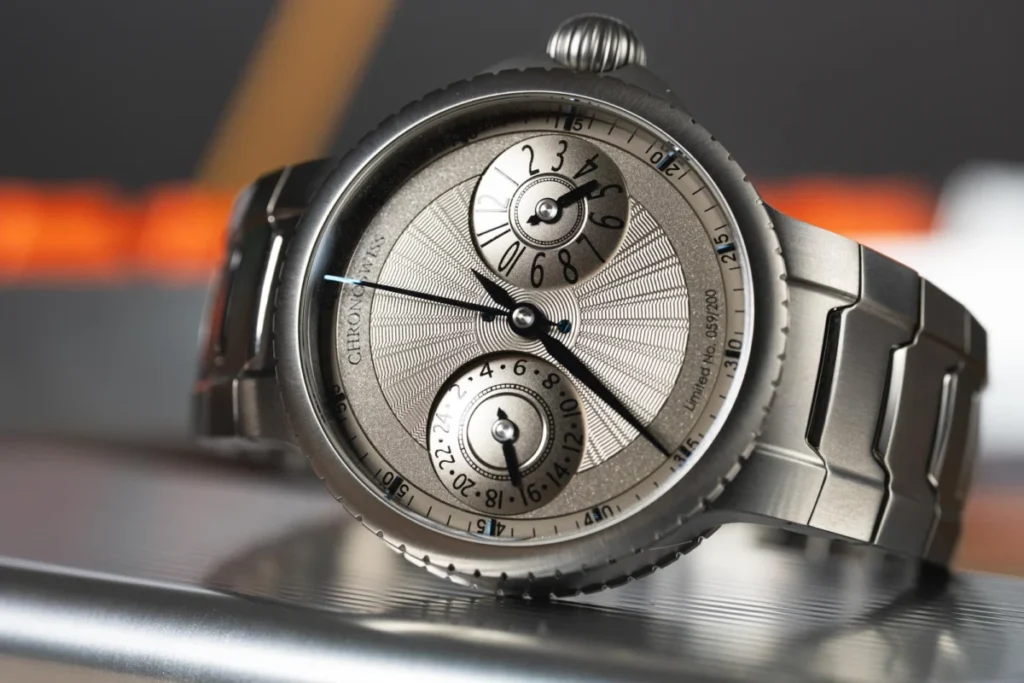
The dial of the Chronoswiss Pulse GMT is a testament to the brand’s willingness to innovate, merging the conceptual elements of the case and bracelet into a composition that is both intricate and strikingly unusual. Drawing inspiration from the Chronoswiss Tora models, known for their dual-time regulator layouts, the Pulse GMT features a highly unconventional display. Central minutes and seconds share an axis, the local hours are positioned at the three o’clock sub-dial, and a 24-hour dual-time or GMT display resides at nine o’clock. This configuration deviates significantly from the standard regulator layout, where hours are typically at nine and minutes at twelve.
The GMT Complication: A Unique Approach to Time Travel
The functional aspect of the dual-time complication is where the Pulse GMT introduces further idiosyncrasies. Unlike conventional GMT watches where the 24-hour hand or the local hour hand jumps in hourly increments, the Pulse GMT’s 24-hour hand operates with a smooth, gliding motion, much like a standard hour hand, entirely independent of the minute markers. While this allows for precise setting in time zones that differ by less than an hour, it requires careful attention to align it precisely at the top of the hour to accurately reflect the desired time difference. This unique approach to the GMT function, while offering granular control, necessitates a different user interaction than typically encountered in travel watches.

A Symphony of Textures and Finishes on the Dial
Beyond its functional peculiarities, the dial itself is a masterclass in horological artistry. It is a sculptural composition with virtually no flat surfaces, a multi-layered construction that creates remarkable depth and visual interest. The main dial is divided into three distinct zones. The outermost ring features a matte finish, serving as a backdrop for a minute and seconds index that combines crisp black printing with small, heat-blued appliqué markers. Adjacent to this is a buffer ring with a beautifully blasted finish that exhibits a subtle sparkle, its dark gray tone closely mirroring that of the titanium case.
The innermost region is where the dial truly comes alive, featuring rose-engine-turned guilloché in a brighter, silver hue. This guilloché pattern eschews the typical curved arcs, opting instead for straight radial lines that kink subtly on either side, creating two semi-rotations per hour. The visual effect is reminiscent of an electrocardiogram (EKG) readout, a striking and unexpected motif. At the very center, the guilloché transitions to concentric circles, punctuated by heat-blued screws that appear to hold the decorative plate in place. This detail, a deliberate revelation of the construction rather than an attempt to conceal it, adds a surprising industrial candor to the dial, complementing its dark, matte tonality and contributing to its overall avant-garde appeal.
The sub-dials at three and nine o’clock, dedicated to the 12-hour and 24-hour indicators respectively, are equally unconventional. These are not merely recessed or flat cutouts but are convexly domed, creating a dramatic shift in geometry and depth as they cut through the inner regions of the dial. They appear as distinct elements, almost like separate pieces set within larger cutouts. The overall domed shape of the dial causes it to thicken towards the center, casting deeper shadows within the inner recesses of these sub-dials, further enhancing the dial’s complexity and visual intrigue.

The hands are equally noteworthy. The minute hand is a long, heat-blued alpha shape, complete with a matching counterweight. The seconds hand is a thinner, similarly shaped counterpart, designed to minimize the risk of accidental misreading. Both hands gracefully curve downwards at their tips to follow the contours of the dial. The hands on the sub-dials are miniaturized versions of this design, meticulously curved to conform to their respective surfaces. These hands are not mere indicators but integral components of the overall design, feeling perfectly at home within the Pulse GMT’s unique aesthetic.
The Movement: A Harmonious Blend of Tradition and Modernity
Powering the Chronoswiss Pulse GMT is the caliber C.6002, a sophisticated automatic movement developed in collaboration with La Joux-Perret, based on the brand’s proprietary C.6000 caliber. This movement operates at a frequency of 28,800 vibrations per hour and offers a respectable 55-hour power reserve. It features a tungsten rotor, hacking seconds, and hand-winding capabilities, all while incorporating the regulator layout and dual-time functionality that define the watch.
The movement’s aesthetic is as modern as the watch it powers. It is ruthenium-plated, imparting an appealing dark gray tone, and features radial Côtes de Genève emanating from the center. Select areas are skeletonized, and both internal and external edges are machine-polished, showcasing a level of finishing that complements the watch’s industrial yet refined character. The movement’s substantial diameter, measuring around 30mm or slightly larger as visible through the caseback, ensures it fills the case beautifully, contributing to the overall visual balance.

A particularly pleasing aspect of the caliber C.6002, as noted by the reviewer, is its winding feel. While automatic, the movement incorporates a long click, reminiscent of manual-wind movements, providing a distinct audible and tactile feedback during winding. This small detail serves as a tangible link to traditional watchmaking, adding a layer of appreciation for the mechanical craftsmanship within this otherwise avant-garde timepiece.
On the Wrist: A Confluence of Comfort and Presence
The wearing experience of the Chronoswiss Pulse GMT is a complex interplay of its defining characteristics. While the Grade 5 titanium construction ensures the watch remains remarkably light, its substantial dimensions and straight case sides contribute to a perception of thickness. The integrated bracelet, though aesthetically striking, exhibits limited flexibility. This results in a "cuff-like" feel that may not be universally comfortable or suitable for all wrist shapes, a point of consideration for potential buyers. The prominent crown further adds to the perceived width, a detail that, while iconic, can be an ergonomic impediment for some.
Aesthetically, the Pulse GMT leans heavily towards the futuristic, its monochromatic titanium-gray palette creating a striking, almost otherworldly presence. While not overtly ostentatious, its unusual form factor is guaranteed to draw attention. The reviewer finds the overall look intriguing, though acknowledges the potential for its novelty to wear off over time. This raises a crucial question for collectors: is the Pulse GMT a statement piece designed for enduring admiration, or a fleeting foray into avant-garde design?

Market Positioning and Value Proposition
Priced at $20,300, the Chronoswiss Pulse GMT enters a highly competitive segment of the luxury watch market. At this price point, buyers have access to a diverse range of exceptional timepieces. Within the independent watchmaking sphere, brands like Kudoke and Garrick offer exquisite hand-finishing, while Ressence and Ming present unique design philosophies, and Armin Strom is renowned for its technical movement prowess. Mainstream luxury brands also offer compelling alternatives, with some even featuring precious metal constructions at comparable price points.
A particularly relevant comparison in terms of aesthetic daring and material choice is the Bulgari Octo Finissimo. At the time of review, the 37mm matte titanium model was priced at $16,600, offering a strong contender for those seeking a similarly modern and minimalist aesthetic. This comparison underscores the fact that while the Pulse GMT excels in its unique GMT regulator display and distinctive design, it faces stiff competition in terms of perceived value and finishing. The matte titanium exterior, while aesthetically appealing and unexpected given the brand’s classical roots, might not offer the level of case finishing that some expect at this price tier, even if this restraint is intentional.
A Vision for Chronoswiss’s Future
The Chronoswiss Pulse GMT leaves the reviewer in a state of conflicted admiration. As an individual watch, its bold design and unique execution present a compelling, albeit imperfect, package. However, as a harbinger of Chronoswiss’s future direction, the Pulse GMT is a resounding success. The brand’s recent collections have explored vibrant colors and textures, and while executed with skill, they have sometimes strayed from the foundational principles established by Gerd Rüdiger Lang. The Pulse line, however, appears to strike a harmonious balance between traditional horological principles and modern, avant-garde design.

This new direction offers a promising outlook for Chronoswiss, suggesting a willingness to embrace innovation while respecting its heritage. The hope is that this evolutionary path will also lead to the development of non-integrated designs and models that are more accessible, potentially falling within the high four-figure range, broadening the appeal of Chronoswiss’s distinctive approach to watchmaking to a wider audience. The Chronoswiss Pulse GMT, therefore, is more than just a watch; it is a testament to a brand charting a bold new course, a fusion of past and future that promises to redefine its place in the horological landscape.