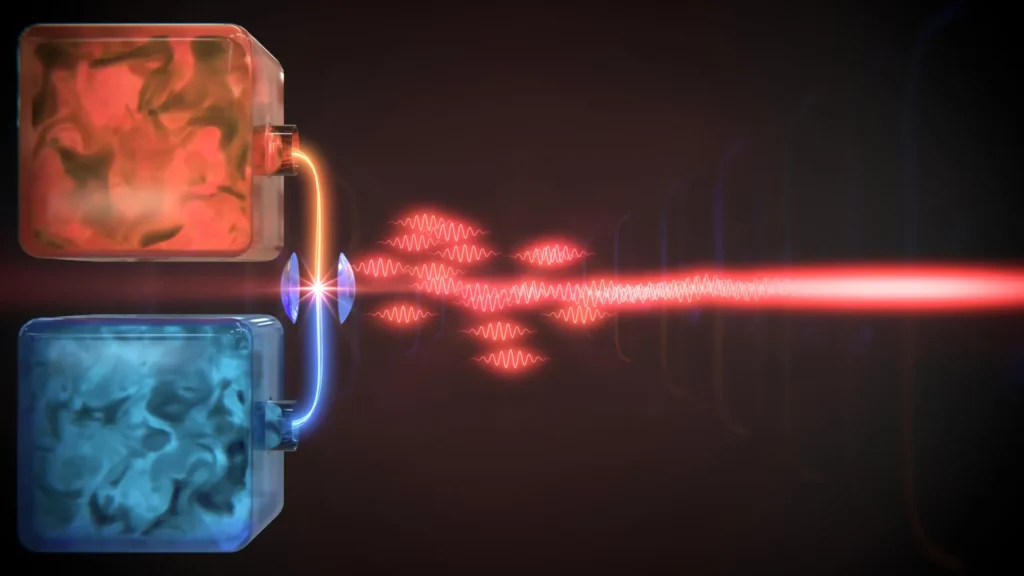
The traditional boundaries between the macroscopic world of steam engines and the microscopic world of subatomic particles are blurring as researchers at the University of Basel in Switzerland have unveiled a new theoretical framework. Published in the prestigious journal Physical Review Letters, the study addresses a fundamental question in modern science: how to define heat and useful work when a machine is comprised of only a single atom and a few particles of light. Led by Professor Patrick Potts and postdoctoral researcher Marcelo Janovitch, the research group has introduced a mathematical approach that allows thermodynamics and quantum physics to function consistently within the same system, solving a long-standing discrepancy that occurs when moving between quantum and classical descriptions.
The Convergence of Two Divergent Disciplines
To understand the significance of the Basel study, one must look at the historical trajectories of the two fields involved. Thermodynamics emerged in the 19th century, born from the practical necessity of improving the efficiency of industrial machines like steam engines. Pioneers such as Sadi Carnot, Rudolf Clausius, and Lord Kelvin established laws governing the flow of energy, defining "work" as organized energy that can move a piston or turn a wheel, and "heat" as the disordered energy lost to the environment.
In contrast, quantum physics was developed in the early 20th century to explain the behavior of atoms and subatomic particles—realms where the classical laws of motion no longer apply. For decades, these two fields existed in relative isolation: thermodynamics dealt with the "large," while quantum physics dealt with the "small." However, the rise of quantum technologies, including quantum computers and ultra-precise sensors, has necessitated a merger. Today, scientists are building "quantum heat engines" so small that their working parts are individual photons or atoms. At this scale, the traditional definitions of heat and work become notoriously difficult to pin down.
The Model: A Light Engine in a Mirror Cavity
The University of Basel team focused their research on a concrete physical model known as a "driven-dissipative system." In this setup, a single atom is placed inside an optical cavity—a space between two highly reflective mirrors. A laser continuously pumps photons (particles of light) into the cavity, while some of those photons inevitably escape through the mirrors.
"Our calculations regard the concrete physical model of an atom that is placed in a cavity between two mirrors, where it can absorb and emit light particles," explained Marcelo Janovitch. This setup serves as a "light engine." The laser provides the energy input, the atom acts as the working fluid, and the escaping light represents the output. In a classical engine, the output is easily categorized as either the work done by the machine or the heat exhausted into the atmosphere. In a quantum light engine, however, the light leaving the cavity possesses dual characteristics that defy simple categorization.
Resolving the Semi-Classical Dilemma
A primary hurdle in quantum thermodynamics is ensuring that a theory remains valid across different scales. This is particularly true for the "semi-classical limit." This limit refers to a scenario where one part of a system (such as the atom) is treated using quantum mechanics, while another part (the electromagnetic field of the light) is treated as a classical wave.
In previous theoretical models, a significant problem arose: if all the light escaping the cavity was counted as "waste heat," the equations used to describe the system would break down as they transitioned from the quantum to the classical limit. The results simply did not match up.
The Basel researchers discovered that the key to consistency lies in how we define the escaping energy. By demonstrating that a portion of the light leaving the cavity can still be used to perform "useful work" on another quantum system, they were able to create a bridge between the two regimes. "Treating the light classically makes it much easier to define which part of the energy can be used to perform work and which part is disordered heat," Janovitch noted. When this distinction is applied to the full quantum model, the theory moves smoothly into the semi-classical limit, providing a unified description that was previously missing.
Chronology of the Development
The development of this framework follows several years of foundational work by the Potts group. The timeline of this breakthrough can be traced through the following milestones:
- Initial Conceptualization (Pre-2022): The group began investigating the thermodynamic properties of "open" quantum systems—systems that are constantly interacting with their environment. They identified that traditional definitions of entropy and work were insufficient for driven-dissipative systems.
- The "Work" Discovery (2022-2023): Professor Potts and his collaborators published preliminary findings suggesting that photons escaping a cavity were not merely "waste." They proved that this light carries "coherence," a quantum property that can be harnessed to drive other quantum processes, thereby qualifying it as work.
- The Mathematical Integration (2024): Marcelo Janovitch and the team developed the current framework, which mathematically proves that by accounting for this "useful" light, the quantum description of the engine aligns perfectly with classical thermodynamics as the system scales up.
- Publication (Present): The findings were peer-reviewed and published in Physical Review Letters, marking a significant contribution to the field of quantum thermodynamics.
Supporting Data and Mathematical Consistency
The researchers’ approach relied on a rigorous mathematical treatment of the "Master Equation," a tool used to describe the evolution of open quantum systems. By analyzing the "flux" of energy leaving the cavity, they were able to partition the energy into two distinct categories:
- Coherent Energy (Work): This is the part of the light that maintains a fixed phase relationship with the driving laser. It can be used to perform tasks, such as powering another quantum bit (qubit) or driving a mechanical oscillator.
- Incoherent Energy (Heat): This is the "noise" or the disordered part of the light that results from spontaneous emission and fluctuations.
The data showed that the "conventional approach"—which treats all output as heat—leads to an "entropy production" rate that does not converge correctly in the semi-classical limit. In contrast, the Basel framework ensures that the laws of thermodynamics, specifically the Second Law (which states that entropy must always increase or stay constant), are satisfied across all scales without losing the nuances of quantum behavior.
Quantum Fluctuations as a Technological Resource
One of the most intriguing findings of the study involves "quantum fluctuations." In classical engineering, fluctuations are usually seen as a nuisance—vibrations or thermal noise that must be dampened. However, in the quantum realm, fluctuations are fundamental.
The Basel team’s calculations correctly described how certain quantum effects can actually reduce the fluctuations in the emitted light, a phenomenon known as "squeezing." By understanding the boundary between heat and work more clearly, researchers can now see these reduced fluctuations as a resource rather than a byproduct.
This has direct implications for quantum metrology—the science of ultra-precise measurements. For example, "squeezed light" can be used to improve the sensitivity of gravitational wave detectors or to enhance the precision of atomic clocks. By accurately identifying how much energy is "work," scientists can better manipulate these fluctuations to create more stable and accurate quantum instruments.
Broader Impact and Future Implications
The implications of the Basel framework extend far beyond the laboratory. As the world moves toward a "Quantum Internet" and large-scale quantum computing, the energy efficiency of these systems will become a critical concern.
1. Energy-Efficient Quantum Computing
Current quantum computers require massive cooling systems to keep their components at near absolute zero. Understanding how heat is generated and dissipated at the atomic level is essential for designing future chips that require less power and generate less waste heat. If we can treat "waste" light as a resource for work, we might be able to recycle energy within quantum circuits.
2. Refining the Second Law
The study contributes to a deeper philosophical and physical understanding of the Second Law of Thermodynamics. It suggests that our definition of "disorder" (entropy) depends heavily on what information we can extract from a system. By showing that "coherent" light can do work, the researchers are essentially refining what it means for a system to be "disordered."
3. Advancing Quantum Sensors
Quantum sensors are poised to revolutionize medical imaging, mineral exploration, and navigation. The ability to distinguish between heat-induced noise and useful signals at the quantum-classical boundary will allow for the development of sensors that can operate in noisier, "warmer" environments than currently possible.
Scientific Community Reaction
While official statements from external bodies are still forthcoming, the reception within the theoretical physics community has been one of cautious optimism. Dr. Janovitch’s work is seen as a vital "sanity check" for quantum thermodynamics. Many theorists have long worried that the field was becoming a collection of specialized models without a unifying thread. The Basel framework provides that thread by ensuring that the "correspondence principle"—the idea that quantum physics must transition into classical physics at larger scales—is upheld.
The University of Basel has solidified its position as a hub for quantum research. This study, supported by the Swiss National Science Foundation and the National Center of Competence in Research (NCCR) Quantum Science and Technology, highlights the importance of fundamental theoretical work in driving the next generation of technological breakthroughs.
As researchers continue to shrink machines down to the size of atoms, the rules of the game are being rewritten. The work of Patrick Potts and Marcelo Janovitch ensures that even as we enter this strange new world, the foundational principles of thermodynamics remain a reliable guide, bridging the gap between the industrial past and the quantum future.