The miniaturization and increasing sophistication of microchips are fundamentally reshaping the landscape of satellite communication and a host of other advanced technological applications. At the heart of this revolution lie specialized components, often no larger than a speck of dust on a circuit board, yet possessing the extraordinary capability to precisely steer radio beams. These are beamforming integrated circuits (ICs), the silent orchestrators behind the powerful and agile phased array antennas that are becoming indispensable for everything from global internet access to precise Earth observation. In a significant recent development, the European Space Agency (ESA) has showcased a new generation of these critical chips, developed by the French company Asygn, marking a crucial step forward in Europe’s strategic autonomy and technological leadership in this vital sector.
The Power of Electronic Beam Steering
Traditional antennas, often recognizable by their large, mechanically rotating dishes, have long been the workhorses of radio communication. Their operation relies on physical movement to point towards a target, whether it be a distant satellite or a ground station. This mechanical approach, while reliable for decades, presents inherent limitations. Moving parts are susceptible to wear and tear, require significant power, and are relatively slow to reorient. In the fast-paced world of modern communication, where rapid adjustments and simultaneous tracking of multiple targets are increasingly demanded, these limitations become significant bottlenecks.
Phased array antennas offer a radical departure from this paradigm. Instead of a single, large reflector, they comprise an array of numerous small antenna elements. The magic lies in the sophisticated microchips embedded within these arrays: the beamforming ICs. These chips do not move the antenna physically. Instead, they electronically manipulate the radio waves emitted or received by each individual element. By precisely controlling the phase and amplitude of the signal at each element, the antenna can effectively "focus" its radio beam in a specific direction. This process, known as beamforming, allows for rapid, precise steering of the radio beam without any moving parts.
A Technological Evolution Driven by Silicon
The advent and rapid advancement of silicon semiconductor technologies have been the primary enablers of this shift. As the manufacturing processes for microchips have become more refined, beamforming ICs have shrunk in size, become more energy-efficient, and significantly more powerful. This miniaturization has had a cascading effect, making phased array antennas more compact, more reliable, and crucially, more affordable. This cost-effectiveness has opened the door for their widespread adoption across a vast spectrum of applications.
In the realm of satellite communications, phased arrays are enabling higher bandwidth and more resilient connections. For navigation systems, they offer enhanced accuracy and the ability to track multiple satellites simultaneously. Earth observation missions benefit from their agility, allowing for more frequent and targeted data acquisition. Even deep space exploration missions can leverage the precision of phased array technology for more efficient communication with spacecraft.
Europe’s Strategic Imperative and ESA’s Role
Recognizing the strategic importance of this technology, ESA has been actively involved in fostering and advancing beamforming capabilities for many years. "For decades, ESA has been at the forefront of beamforming technology, exploring innovative ways to electronically steer radio beams for space and terrestrial applications," stated Václav Valenta, an ESA engineer and expert in phased array technology. This long-standing commitment reflects a broader European strategy to maintain and enhance its technological sovereignty in critical sectors.
The focus of this strategic pursuit is increasingly shifting towards highly integrated analogue and digital beamforming chips that are designed and manufactured within Europe. This dual objective – achieving cutting-edge performance while ensuring a secure and independent European supply chain – is paramount. A disrupted global supply chain can have profound implications for national security, economic stability, and the ability to execute ambitious space missions.
Asygn’s Next-Generation Beamforming ICs
A recent and compelling demonstration of this European-led innovation occurred at ESA’s RF Active Technology Laboratory at ESTEC, the European Space Research and Technology Centre. Here, the French company Asygn presented its latest generation of beamforming integrated circuits. The significance of this event lies not only in the technological advancement itself but also in the collaborative spirit between industry and a leading space agency.
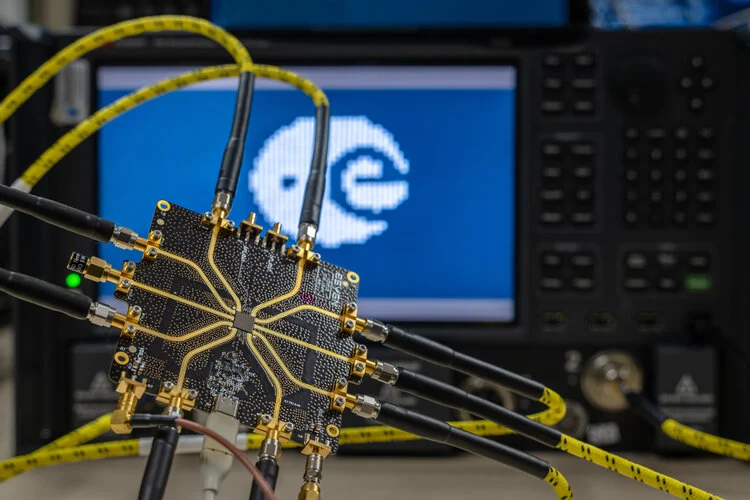
To visually underscore the remarkable control that Asygn’s microchip offers over beamforming, the company engineers orchestrated a striking demonstration. They projected the distinctive blue-and-white ESA logo, composed of hundreds of individually illuminated dots. Each of these dots was precisely positioned and controlled by a specific amplitude and phase setting dictated by Asygn’s beamformer IC. This elegant display served as a tangible representation of the fine-grained precision that these chips enable.
Technical Prowess and Mission-Critical Applications
The technical specifications of Asygn’s new ICs are designed to meet the demanding requirements of modern space-based applications. Clement Jany, Radio Frequency business unit co-director at Asygn, elaborated on the company’s approach: "By designing single-chip solutions dedicated to specific frequency bands – notably X and Ka – we achieve the very high levels of performance required for mission-critical satellite communication applications." The X-band and Ka-band are crucial for many satellite services, including broadband internet, satellite TV, and scientific data transmission, due to their ability to carry large amounts of data.
Jany further highlighted the practical benefits for antenna manufacturers: "Our objective is to simplify system integration for phased array antenna manufacturers by delivering high-precision phase and amplitude control and an ultra-low noise figure on a single chip." This integration of complex functionality onto a single chip reduces the overall complexity, size, and cost of phased array systems, accelerating their development and deployment. An ultra-low noise figure is particularly important for sensitive receivers, ensuring that faint signals from distant spacecraft are not obscured by internal electronic noise.
Supporting Data and Context: The Growth of Phased Array Markets
The market for phased array antennas is experiencing robust growth, driven by the increasing demand for advanced communication systems. According to various market research reports, the global phased array antenna market is projected to grow at a compound annual growth rate (CAGR) of over 10% in the coming years, with the space segment being a significant contributor. Factors such as the proliferation of small satellites, the expansion of satellite constellations for global internet coverage (e.g., Starlink, OneWeb), and the growing need for high-throughput satellite (HTS) services are all fueling this expansion.
The X-band, typically operating between 8 and 12 GHz, is widely used for satellite communications, radar systems, and telemetry. The Ka-band, spanning 26.5 to 40 GHz, offers even greater bandwidth capacity, making it ideal for high-speed data transmission and advanced satellite services. The development of integrated beamforming solutions for these specific bands is therefore a strategic priority for companies and space agencies worldwide.
Chronology of Innovation in Beamforming
The journey towards highly integrated beamforming ICs has been a gradual but consistent evolution.
- Early Days (Mid-20th Century): The foundational concepts of phased arrays emerged, primarily for military radar applications. These early systems were bulky, expensive, and relied on discrete electronic components.
- The Silicon Revolution (Late 20th Century): The development of integrated circuits (ICs) began to miniaturize and improve the performance of phased array components. Monolithic Microwave Integrated Circuits (MMICs) started to appear, integrating multiple RF functions onto a single chip.
- Digital Beamforming Emerges (Early 21st Century): Advances in digital signal processing (DSP) and high-speed analog-to-digital converters (ADCs) and digital-to-analog converters (DACs) enabled digital beamforming. This offered even greater flexibility and accuracy in signal manipulation.
- Increasing Integration (Present Day): The current trend, exemplified by Asygn’s work, is towards highly integrated System-on-Chip (SoC) solutions that combine analogue and digital beamforming functions, along with control logic, onto a single silicon die. This allows for further size reduction, power efficiency, and cost savings.
ESA’s continuous involvement in funding research and development projects in this area, alongside fostering partnerships with European companies like Asygn, represents a strategic investment in maintaining a competitive edge. The recent demonstration signifies a maturation of these efforts, moving from research prototypes to commercially viable, high-performance components.
Broader Impact and Implications
The implications of Europe’s advancements in beamforming IC technology are far-reaching.
- Enhanced European Space Capabilities: The availability of domestically designed and manufactured beamforming chips strengthens Europe’s capacity to develop and deploy its own advanced satellite systems, reducing reliance on external suppliers and enhancing national security.
- Economic Growth and Job Creation: The development and production of these sophisticated components foster innovation within the European semiconductor and aerospace industries, creating high-skilled jobs and driving economic growth.
- Competitive Advantage in Global Markets: By offering high-performance, cost-effective, and secure solutions, European companies can gain a significant competitive advantage in the rapidly expanding global market for phased array antennas.
- Enabling Future Technologies: These advanced beamforming ICs are not only crucial for current satellite applications but will also be foundational for future technologies such as advanced 5G and 6G mobile networks, autonomous vehicles, and sophisticated sensor networks.
- Resilience and Security: The secure European supply chain aspect is critical. In an era of increasing geopolitical uncertainty, having independent access to key technological components is vital for maintaining critical infrastructure and national security.
The precise control over radio beams offered by these miniature marvels is no longer a niche capability; it is becoming a fundamental building block of the modern digital world. As Europe continues to invest in and innovate within this domain, its influence on the future of wireless communication and space exploration is set to grow significantly. The small black chip at the center of the circuit board is, indeed, tiny but mighty, holding the key to a more connected and technologically advanced future.