In the intricate landscape of modern industrial automation, robotics, and advanced embedded systems, efficient and reliable communication protocols are the bedrock upon which complex functionalities are built. While high-level network protocols such as Ethernet, EtherCAT, and CAN facilitate communication across distributed systems, a distinct set of standards governs data exchange at the circuit board level, particularly within microcontrollers and their immediate peripherals. Among these, the Serial Peripheral Interface (SPI) stands out as a ubiquitous and highly effective solution for synchronous serial data transmission, playing a pivotal role in the precise control and diagnostic capabilities of motion microcontrollers.
The Foundational Role of SPI in Embedded Systems
SPI is an input-output standard primarily employed in embedded systems for short-distance communication between various integrated circuits (ICs). Its prominence stems from its simplicity, speed, and full-duplex communication capability, making it an ideal choice for the tightly integrated environments found within motion control applications. Unlike parallel bus systems that require multiple data lines, SPI leverages a four-wire serial interface, significantly conserving valuable printed circuit board (PCB) space – a critical factor in the miniaturization and cost-efficiency demands of contemporary electronics.
The core of SPI’s operation revolves around its four standard signals:
- SCLK (Serial Clock): Generated by the master device to synchronize data transmission.
- MOSI (Master Out, Slave In): Data transmitted from the master to the follower (often referred to as slave).
- MISO (Master In, Slave Out): Data transmitted from the follower to the master.
- SS/CS (Slave Select/Chip Select): An active-low signal from the master to select a specific follower device for communication. This allows a single master to communicate with multiple followers sequentially.
This architecture enables full-duplex communication, meaning data can be sent and received simultaneously. Data rates for SPI can range from a few megahertz (MHz) up to 10 MHz or even higher in specialized implementations, accommodating the rapid data exchange often required for real-time control. The flexibility extends to data transmission width, which can be programmed from 2 to 24 bits, depending on the specific application and microcontroller capabilities.
Bridging the Gap: SPI in Motion Control Ecosystems
Within motion control systems, SPI serves as the crucial link between microcontrollers – the "brains" of the operation – and a diverse array of peripheral devices essential for precise movement. These peripherals include various sensor types (e.g., encoders for position feedback, current sensors), specialized control devices, memory cards for parameter storage, and display interfaces for user interaction.
A primary application of SPI in motion control is its integration with motor drivers. A typical configuration involves a microcontroller equipped with an SPI port connected to a motor driver that also features SPI connectivity. The microcontroller sends high-level control signals, such as Pulse Width Modulation (PWM) signals, over the SPI bus to command the motor driver. These PWM signals, once received by the driver, are translated into the appropriate current and voltage waveforms required to actuate the motor. In more integrated designs, the controller logic might reside on the same chip as the motor driver, with internal SPI-like communication pathways facilitating direct control signal generation.
Beyond mere control, SPI is equally indispensable for diagnostic purposes. Modern motion systems require continuous monitoring to ensure optimal performance, predict potential failures, and facilitate troubleshooting. Through SPI, microcontrollers can poll motor drivers and other sensors for operational data, error codes, temperature readings, current consumption, and positional feedback. This bidirectional flow of information is vital for implementing advanced control algorithms, such as closed-loop feedback systems, and for maintaining system health and reliability.
Master/Follower Configurations and Practical Implementations
The master/follower (often called master/slave) configuration is fundamental to SPI’s operational paradigm. In this setup, a single master controller orchestrates communication with one or more follower devices. Each follower device typically has its own dedicated Chip Select (CS) line, allowing the master to selectively activate and communicate with a specific peripheral without interfering with others on the bus. This multiplexing capability is particularly advantageous in systems requiring control over multiple axes or diverse sets of sensors.
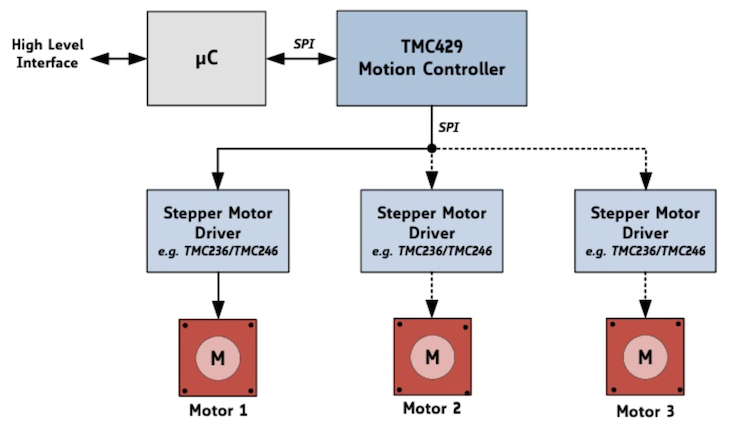
Consider a practical example, such as a motion control system centered around a specialized chip like the Analog Devices TMC429 motion controller. The TMC429 is engineered to function as a sophisticated multi-axis motion controller, frequently handling up to three axes. This chip incorporates dedicated SPI controller and driver interfaces, allowing it to act as both a master and a follower in different communication contexts.
In a typical setup, the TMC429 might serve as a follower device, communicating with a higher-level host microcontroller via one of its SPI interfaces. The host microcontroller would send high-level commands and parameters to the TMC429, instructing it on desired motion profiles, target positions, and velocity parameters. Concurrently, the TMC429 acts as a master, utilizing a separate SPI interface to communicate with and control multiple stepper motor drivers, often daisy-chained to minimize wiring complexity. The TMC429 translates the high-level commands into precise step and direction pulses, which are then transmitted to the stepper motor drivers. These drivers, in turn, convert these digital signals into the specific coil currents necessary to move the stepper motors with high accuracy. This dual-role capability underscores SPI’s flexibility and its capacity to manage complex hierarchical control structures within embedded systems.
Evolution and Broader Applications of SPI in Automation
The adoption of SPI-enabled motion control chips has seen a significant surge across a wide spectrum of industries, driven by the increasing demand for precision, automation, and miniaturization. Its reliability and ease of implementation have made it a preferred choice for developers across various sectors.
In laboratory automation equipment, SPI-controlled motion microcontrollers are integral to robotic sample handlers, automated microscopes, and precision fluid dispensing systems. These applications demand extremely accurate and repeatable movements, where the rapid and deterministic communication offered by SPI ensures the integrity of experimental protocols.
3D printing systems heavily rely on SPI for controlling stepper motors that drive the print head and build platform. The intricate layering process requires precise synchronization of multiple axes, and SPI provides the necessary bandwidth and low-latency communication for real-time adjustments, contributing to the quality and speed of the printing process.
Beyond these specific examples, general industrial automation has embraced SPI for applications ranging from conveyor belt control and pick-and-place robots to automated assembly lines and packaging machinery. The ability to integrate sensors, actuators, and control logic seamlessly via SPI streamlines design, reduces cabling, and enhances the overall robustness of industrial systems.
SPI in Automotive and Emerging Sectors
The automotive industry represents a rapidly expanding frontier for SPI integration, particularly with the accelerating trend of vehicle electrification. Modern vehicles are incorporating an ever-increasing number of electric motors, not just for propulsion but for various subsystems such as power windows, seat adjustments, climate control flaps, electronic steering, and advanced driver-assistance systems (ADAS). This proliferation of motors necessitates efficient and reliable control mechanisms at the component level.
Chip manufacturers are responding to this demand by introducing highly integrated motor controllers specifically designed for automotive applications, frequently featuring embedded SPI interfaces. Toshiba, for example, has developed gate drivers like the TB9104FTG, engineered for brushed DC motors in automotive contexts. This specific gate driver exemplifies the benefits of SPI integration by featuring:
- Integrated SPI: Facilitating communication with the vehicle’s central electronic control unit (ECU) or a local microcontroller for command and diagnostic data.
- On-board motor control circuits: Handling the low-level logic for motor operation.
- Built-in motor current sense amplifiers circuitry: Providing real-time feedback on motor current, crucial for overcurrent protection, stall detection, and precise torque control.
- Built-in PWM drive circuit: Directly generating the necessary PWM signals to drive the brushed DC motor.
The integration of SPI within such automotive-grade components simplifies the overall system design, reduces the number of external components, and enhances the reliability of critical vehicle functions. The ability to perform diagnostics over SPI is particularly valuable in automotive environments, enabling advanced fault detection and potentially contributing to predictive maintenance strategies.
Supporting Data and Market Context
The widespread adoption of SPI underscores its enduring relevance in the embedded systems market. While specific market share figures for SPI versus other serial protocols like I2C or UART can vary by application niche, industry reports consistently highlight the growth of the embedded systems market, which reached an estimated valuation of over $200 billion in 2022 and is projected to grow substantially in the coming years. Motion control, as a critical segment within this market, contributes significantly to this growth, with projections indicating a compound annual growth rate (CAGR) of around 7-8% for the global motion control market, reaching over $20 billion by the end of the decade. This expansion directly translates to increased demand for robust, compact, and efficient communication protocols like SPI at the component level.
Leading semiconductor manufacturers like Analog Devices, Texas Instruments, NXP Semiconductors, and STMicroelectronics consistently integrate SPI interfaces into their microcontrollers, digital signal processors (DSPs), and specialized motor control ICs. This widespread industry support further solidifies SPI’s position as a de facto standard for on-board synchronous serial communication.
Challenges and Considerations in SPI Implementation
Despite its numerous advantages, SPI is not without its considerations. One primary challenge lies in its lack of a standardized addressing scheme; unlike I2C, which uses a unique address for each device, SPI relies on individual Chip Select (CS) lines for each follower. While effective for a moderate number of devices, this can lead to an increased number of GPIO pins required on the master microcontroller as the number of followers grows, potentially complicating PCB routing and increasing board space if not managed carefully.
Furthermore, signal integrity can become an issue over longer trace lengths, particularly at higher clock speeds. While SPI is primarily designed for short-distance communication on a single PCB, applications requiring signals to travel across connectors or slightly longer distances may necessitate careful layout design, impedance matching, and potentially buffer ICs to maintain reliable data transmission.
Another aspect is the lack of inherent bus contention detection or error-checking mechanisms beyond what might be implemented at a higher software layer. While its simplicity contributes to its speed, designers must account for potential data corruption through external means or by implementing custom checksums if data integrity is paramount in noisy environments.
Future Trends and Innovations
Looking ahead, SPI is poised to remain a cornerstone of embedded communication. While new, higher-speed serial protocols continue to emerge for specialized applications, SPI’s fundamental advantages – simplicity, low pin count, full-duplex operation, and high data rates for its class – ensure its continued relevance. Future innovations may focus on enhancing its robustness in electrically noisy environments, integrating more advanced error correction capabilities directly into hardware, or optimizing its power consumption for battery-powered applications.
Moreover, the increasing complexity of embedded systems and the trend towards system-on-chip (SoC) designs suggest that SPI will continue to be a vital internal communication backbone, connecting various intellectual property (IP) blocks within a single silicon die. Its ability to serve as a bridge between a central processing unit and dedicated hardware accelerators or peripheral controllers within an SoC ensures its long-term viability.
Implications for Industry and Design
The enduring utility of SPI carries significant implications for industrial design and product development. For engineers, its well-understood nature and broad support across component manufacturers simplify the design process, reducing development cycles and time-to-market for new products. The cost-effectiveness of integrating SPI-enabled components, combined with the space savings on PCBs, contributes directly to lower manufacturing costs and allows for more compact product designs.
From a performance standpoint, the deterministic and synchronous nature of SPI is crucial for real-time control, where timing is critical. This enables the development of highly responsive and precise motion systems that are essential for advanced robotics, medical devices, and high-throughput manufacturing. The diagnostic capabilities facilitated by SPI also contribute to improved system reliability and easier maintenance, leading to reduced downtime and operational expenses.
In conclusion, the Serial Peripheral Interface, while seemingly a low-level protocol, is an indispensable element in the architecture of modern motion microcontrollers. Its elegant simplicity, coupled with its robust performance characteristics, allows for efficient communication between microcontrollers and a myriad of peripherals. As automation and embedded intelligence continue their relentless march forward, SPI’s role as a fundamental enabler of precise, reliable, and compact motion control solutions is only set to deepen, cementing its legacy as a cornerstone of technological progress.