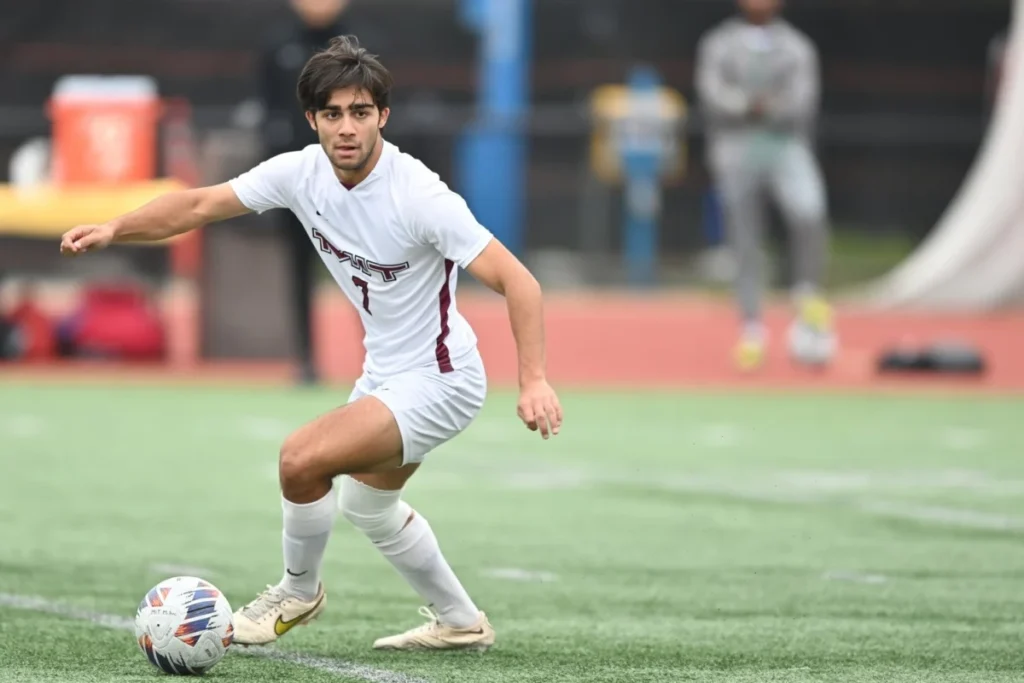
The dual identity of the "student-athlete" is a cornerstone of the American collegiate experience, but few individuals embody the literal interpretation of the term as precisely as Dilin Meloni. A rising senior at the Massachusetts Institute of Technology (MIT), Meloni has spent the last three years navigating two high-pressure environments: the competitive arena of NCAA Division III soccer and the rigorous laboratories of the Department of Nuclear Science and Engineering. As an attacking midfielder for the MIT Engineers and a double major in Nuclear Science and Engineering (Course 22) and Physics (Course 8), Meloni represents a rare intersection of elite physical performance and cutting-edge scientific inquiry. His journey, marked by high school accolades and collegiate leadership, offers a window into the evolving culture of one of the world’s most demanding academic institutions.
A Foundation of Excellence: From Needham to Cambridge
Meloni’s trajectory toward MIT was fueled by a combination of athletic dominance and early intellectual curiosity. At Needham High School, he established himself as one of the premier soccer talents in the Northeast. His senior year was a masterclass in performance, earning him the title of Massachusetts Boys Soccer Player of the Year and a selection as an All-American. While such accolades often lead athletes toward powerhouse Division I programs where sports take precedence over academics, Meloni’s sights were set on a different kind of prestige.
The catalyst for his decision to attend MIT was not a recruitment pitch from a coach, but rather a scientific paper. During his junior year of high school, Meloni encountered research published by the MIT Plasma Science and Fusion Center (PSFC). The work, which detailed advancements in fusion energy—the process that powers the sun and holds the promise of near-limitless clean energy—resonated with his interests in physics and engineering.
This discovery created a unique synergy. Meloni realized he could pursue a career as an "Engineer" on the soccer pitch while training to become a literal engineer in the classroom. His commitment to MIT was a rejection of the siloed collegiate experience, choosing instead a path where his intellectual and physical ambitions could coexist.
The Social Architecture of MIT Athletics
For many outside the MIT community, the image of the university is one of solitary late-night study sessions and intense laboratory work. However, Meloni describes a much more vibrant social ecosystem, largely anchored by the athletic community. Upon arriving in Cambridge, Meloni found that the athletic department provided an immediate and robust social framework, particularly for fall athletes who arrive on campus weeks before the general student body for preseason training.
"MIT has a huge social experience people don’t really understand from the outside," Meloni noted. "A lot of it is driven by our athletic communities."
This community serves as a vital support system. For Meloni, the transition to college was smoothed by the presence of peers who shared his dual dedication. He observes that athletes at MIT are often kindred spirits: individuals who have spent a decade or more mastering a sport and refuse to abandon that part of their identity, even when faced with the workload of a world-class engineering program.
This bond extends into the residential life of the campus. Meloni’s fraternity has evolved into a hub for the soccer team, while also housing members of the football, swimming, and track teams. This living arrangement creates a micro-community of high-achievers who understand the specific pressures of balancing a four-hour practice block with a quantum mechanics problem set.
Bridging the Gap: Nuclear Science and the Varsity Athlete
While the social life of an athlete is integrated, Meloni admits that his academic path remains somewhat anomalous within the athletic department. As a double major in Course 22 (Nuclear Science and Engineering) and Course 8 (Physics), he occupies a space where few varsity athletes are found.
Nuclear engineering is often perceived as one of the most demanding disciplines at MIT, requiring a deep mastery of complex mathematics, thermodynamics, and subatomic physics. Meloni has made it a personal mission to demystify these fields for his teammates and incoming freshmen. He views the lack of overlap as an opportunity for recruitment, encouraging younger players to see the nuclear and physics departments not as daunting obstacles, but as rewarding paths that offer a different kind of "ecosystem" than the athletic fields.
Meloni’s academic life is characterized by a "non-siloed" approach. While his evenings are spent with the soccer team, his days are spent in research labs with students and faculty from diverse backgrounds, many of whom have no connection to organized sports. This ability to move between the physical intensity of the pitch and the intellectual intensity of the lab is, in Meloni’s view, a privilege that prevents the "tunnel vision" that can sometimes plague students at specialized institutions.
Leading the Charge: The Student-Athlete Advisory Committee
Beyond his personal balance of sports and science, Meloni has taken on a significant leadership role as the co-president of the Student-Athlete Advisory Committee (SAAC). This organization serves as the primary bridge between the student-athlete population and the university administration, specifically the Department of Athletics, Physical Education, and Recreation (DAPER).
Representing the needs of 33 varsity sports—one of the largest athletic programs in the country—is a logistical and diplomatic challenge. The diversity of the programs means that "pain points" vary significantly from one team to another. Last summer, Meloni and his leadership team initiated a comprehensive outreach program, meeting with coaches and athletes to identify systemic issues.
The concerns brought to SAAC range from the mundane to the structural:
- Facility Access: The allocation of time in the new Sports Performance Facility is a recurring topic of debate. With over 800 varsity athletes requiring access to specialized strength and conditioning equipment, scheduling becomes a zero-sum game.
- Infrastructure Maintenance: For the seven teams that utilize the major turf fields, the quality and availability of playing surfaces are paramount. Meloni noted that issues such as field-sharing conflicts with non-varsity student clubs can be a significant source of frustration.
- Nutrition and Logistics: The quality of food provided during preseason and the timing of meal services to accommodate late-night practices are critical for athlete recovery and performance.
- NCAA Legislation: SAAC also serves as a forum for discussing national policy changes, including Name, Image, and Likeness (NIL) regulations and their implications for Division III schools.
Meloni’s approach to leadership is rooted in a background of student governance; in high school, he served on his town’s school committee and represented students at the state level in Massachusetts. He views his role in SAAC as one of "realistic advocacy." He acknowledges that while students will always ask for more than is logistically or financially feasible, the goal is to find a middle ground where the administration feels heard and the students feel valued.
Professional Integration: Commonwealth Fusion Systems
The culmination of Meloni’s academic interests is currently taking shape through his summer internship at Commonwealth Fusion Systems (CFS). A high-profile spin-out from MIT’s Plasma Science and Fusion Center, CFS is at the forefront of the global race to commercialize fusion energy. The company is currently developing SPARC, a compact, high-field tokamak designed to demonstrate net energy gain from fusion for the first time in history.
Working at CFS allows Meloni to apply the theoretical knowledge gained in his Course 22 and Course 8 studies to real-world engineering challenges. This professional experience mirrors his athletic experience: it requires teamwork, precision, and the ability to perform under the scrutiny of high stakes. The internship is a full-circle moment for Meloni, who was drawn to MIT specifically by the research that laid the groundwork for CFS.
The Broader Impact: A Tipping Point for MIT Athletics
According to Meloni, the relationship between student-athletes and the MIT administration has reached a "tipping point" of increased cooperation. Staff from DAPER and Student Life have become increasingly receptive to the feedback provided by SAAC, moving beyond mere listening to actively overhauling administrative processes based on student input.
This shift is crucial because student-athletes represent a significant portion of the MIT undergraduate population. By improving the "student-athlete experience," the university is essentially improving the retention and well-being of a large segment of its most active leaders. Meloni argues that when athletes feel supported and heard, they are more likely to contribute positively to the broader campus culture.
"Obviously, it’s a privilege to come to this school," Meloni said. "But if you’re here, you still need to be heard."
Conclusion: The Future of the Engineer-Engineer
As Dilin Meloni enters his senior year, his legacy at MIT is defined by his refusal to choose between his passions. He has proven that the discipline required to be an All-American soccer player is the same discipline required to master nuclear physics. Through his work with SAAC, he has ensured that the path will be smoother for those who follow in his footsteps, advocating for a campus environment that recognizes the unique contributions of the varsity athlete.
Whether he is directing play as an attacking midfielder or analyzing plasma stability in a fusion reactor, Meloni’s career at MIT serves as a blueprint for the modern student-athlete. In an era where specialization is often demanded at an early age, his success in two vastly different fields suggests that the most effective "Engineers" are those who can find the common ground between the physical and the theoretical, the pitch and the lab. As he looks toward graduation and a potential career in the burgeoning fusion energy industry, Meloni remains a testament to the idea that at MIT, the greatest breakthroughs often happen when different worlds collide.