The partial oxidation of methane (POM) has long been recognized as a cornerstone of modern industrial chemistry, serving as a vital pathway for the production of syngas—a versatile mixture of hydrogen and carbon monoxide. Syngas acts as the primary feedstock for the synthesis of methanol, ammonia, and synthetic liquid fuels through the Fischer-Tropsch process. For decades, the scientific community operated under the consensus that metallic nickel (Ni) nanoparticles were the primary active species driving this transformation. However, a groundbreaking study published in Nature Catalysis has upended this traditional understanding, revealing that the true catalyst is a transient, reconstructed atomic structure that forms only during the reaction itself.
This discovery, spearheaded by a multi-institutional team of researchers from the Dalian Institute of Chemical Physics (DICP) of the Chinese Academy of Sciences (CAS), Xi’an Jiaotong University, and Cardiff University, provides a definitive answer to a long-standing debate in surface science. The findings demonstrate that what scientists previously observed as metallic nickel might merely be a byproduct of the cooling process or a secondary phase, rather than the "engine" of the catalytic cycle.
The Challenge of Methane Activation
Methane (CH4) is the primary component of natural gas and a potent greenhouse gas. Its chemical stability is legendary among chemists; the four C-H bonds in a methane molecule are exceptionally strong, requiring significant energy to break. In the industrial production of syngas, the goal is to break these bonds selectively to produce CO and H2 without over-oxidizing the carbon into CO2.
Nickel-based catalysts have been the industry standard for this process due to their relative abundance and low cost compared to noble metals like platinum or rhodium. However, nickel is highly dynamic. Under the high-temperature (typically above 700°C) and redox-intensive conditions of POM, nickel can fluctuate between various oxidation states and rearrange its atomic structure. This volatility has historically made it nearly impossible to "see" the catalyst in its working state. Most traditional studies relied on "ex situ" analysis—examining the catalyst before and after the reaction—which led to the assumption that metallic Ni was the active site because it was frequently found in spent catalyst samples.
A Paradigm Shift: The [Ni1O4Ni4] Structural Unit
The research team, led by Profs. Tao Zhang, Aiqin Wang, and Xiaoyan Liu from DICP, alongside international collaborators like Prof. Graham J. Hutchings of Cardiff University, utilized advanced in situ characterization techniques to observe the catalyst in real-time. They discovered that the surface of nickel oxide (NiO) undergoes a sophisticated reconstruction when exposed to methane and oxygen at high temperatures.
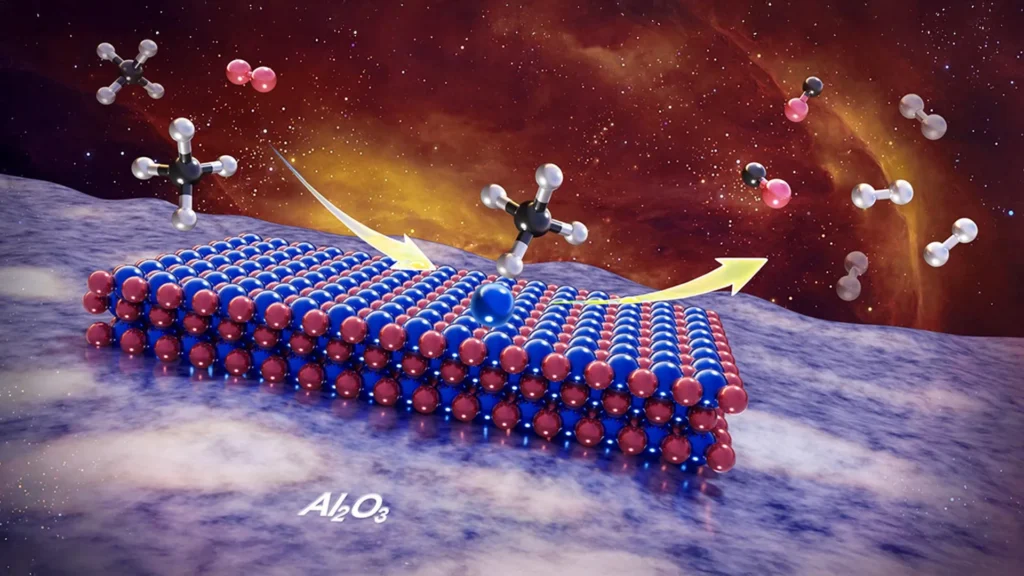
Specifically, the researchers identified the formation of a unique structural motif described as [Ni1O4Ni4] on the NiO(100) crystal surface. This structure is not present in the catalyst as synthesized; it is a "dynamic active center" that emerges only under operational conditions. This finding suggests that the catalyst is not a static object but a living system that adapts to its environment to facilitate chemical transformations.
Experimental Breakthrough: Performance with Minimal Loading
To test their hypothesis, the research team developed a specialized Ni/Al2O3 catalyst using a microemulsion method. This catalyst was designed with an exceptionally low nickel loading of just 0.8 weight percent (wt%). In the world of industrial catalysis, such a low concentration of active metal is usually insufficient to drive high-volume reactions.
However, the results were startling. Despite having only one-tenth the nickel content of standard industrial catalysts (which typically use around 8.0 wt%), the 0.8 wt% catalyst exhibited superior performance:
- Methane Conversion: 92%
- CO Selectivity: 87.0%
- H2 Selectivity: 87.0%
- H2/CO Ratio: A stable 2.0, which is the ideal stoichiometric ratio for downstream chemical synthesis.
When the researchers compared this to an 8.0 wt% Ni catalyst prepared by traditional impregnation methods, the low-loading catalyst performed comparably, if not better, in terms of stability and efficiency. More importantly, when they tested a 0.8 wt% Ni catalyst prepared by traditional impregnation, it failed to catalyze the POM reaction effectively, instead resulting in total combustion (producing CO2 and water). This proved that the method of preparation and the resulting ability of the surface to reconstruct were more important than the total amount of nickel present.
Chronology of the Discovery
The journey to this discovery involved several phases of rigorous experimentation and theoretical validation:
- Initial Synthesis and Testing: The team synthesized various nickel loadings using the microemulsion method. They noticed that the 0.8 wt% samples were unexpectedly active, prompting a deeper investigation into why "less was more."
- Post-Reaction Analysis Mystery: Upon examining the 0.8 wt% catalyst after the reaction, the researchers were surprised to find almost no metallic nickel. According to traditional theory, the catalyst should have failed. This discrepancy suggested that the active phase was something other than metallic Ni.
- In Situ Observation: Using environmental electron microscopy and other real-time spectroscopic tools, the team observed the catalyst while it was hot and submerged in the reactant gases. They witnessed the NiO surface rearranging itself into the [Ni1O4Ni4] units.
- Density Functional Theory (DFT) Validation: Prof. Tao Yang from Xi’an Jiaotong University led the computational effort. The DFT calculations provided the "why" behind the "what." They showed that the [Ni1O4Ni4] structure dramatically lowers the energy barrier for the first C-H bond cleavage—the rate-determining step of the reaction.
Technical Data: Comparing Energy Barriers
The significance of the [Ni1O4Ni4] structure is best understood through the lens of activation energy. The activation barrier is the "mountain" the molecules must climb to react. The lower the barrier, the faster and more efficient the reaction.
- Intact NiO(100) Surface: 38.5 kcal·mol⁻¹ (Extremely difficult to activate methane).
- Metallic Ni(111) Surface: 15.7 kcal·mol⁻¹ (The previously assumed active site).
- Reconstructed [Ni1O4Ni4] Surface: 12.5 kcal·mol⁻¹ (The newly discovered active site).
The barrier for the reconstructed site is significantly lower than even the metallic nickel surface. This 3.2 kcal·mol⁻¹ difference between metallic Ni and the reconstructed site might seem small, but in chemical kinetics, such a difference leads to a substantially higher reaction rate, explaining why the low-loading catalyst was so effective.
Reaction from the Scientific Community and Implications
The implications of this study reach far beyond the niche of methane oxidation. It challenges the "static" view of catalysis that has dominated the field for over a century.
"Our study highlights the critical role of in situ characterization in identifying dynamic active structures under reaction conditions," noted Prof. Xiaoyan Liu of DICP. "Dynamic reconstruction enables low-loading catalysts to achieve high performance, offering new opportunities for the rational design of efficient catalysts while reducing reliance on high metal loadings."
Industry experts suggest that this research could lead to a "democratization" of catalyst design. If high performance can be achieved with 90% less metal, the cost of industrial chemical production could drop significantly. Furthermore, this opens the door for using non-noble metals in reactions where expensive metals like platinum or palladium were previously thought necessary.
Environmental and Economic Impact
From an environmental perspective, the ability to efficiently convert methane into syngas at lower temperatures or with higher selectivity reduces the carbon footprint of the chemical industry. Methane is often flared at oil rigs or wasted in remote locations because it is difficult to transport. Small-scale, highly efficient POM reactors—enabled by these new low-loading catalysts—could allow for the on-site conversion of methane into liquid fuels, preventing waste and reducing greenhouse gas emissions.
Economically, the shift toward "single-atom" or "low-loading" catalysis is a major trend in green chemistry. By maximizing the efficiency of every single metal atom, manufacturers can save millions in raw material costs. The DICP study provides a blueprint for how to achieve this: not by simply adding more metal, but by engineering the support and the preparation method to encourage the formation of these "hidden" active structures.
Future Directions in Catalysis Research
The success of the collaborative effort between Chinese and British institutions underscores the importance of global cooperation in tackling fundamental energy challenges. Moving forward, the research team plans to investigate whether similar dynamic reconstructions occur in other metal-oxide systems, such as those involving cobalt or iron.
The discovery of the [Ni1O4Ni4] motif marks a new chapter in surface science. It serves as a reminder that in the microscopic world of chemical reactions, things are rarely as they appear at rest. As in situ technology continues to advance, the scientific community expects to uncover more "hidden" structures that could revolutionize how we produce the energy and materials of the future.
In conclusion, the work of Profs. Zhang, Wang, Liu, and their colleagues provides a masterclass in modern catalytic research. By questioning the status quo and looking closer at the "active" life of a catalyst, they have provided the chemical industry with a path toward more sustainable, efficient, and cost-effective methane utilization.