For years, analyzing the chemical makeup of materials has required large and costly laboratory instruments known as spectrometers. These systems are used in everything from disease diagnosis and food inspection to pollution monitoring, serving as indispensable tools across scientific, industrial, and medical sectors. Traditional spectrometers function by physically splitting light into its constituent colors using prisms or diffraction gratings, subsequently measuring the intensity of each individual wavelength. This process inherently necessitates light to traverse a relatively long distance to achieve sufficient spectral separation, a fundamental requirement that renders these instruments often bulky, immobile, and notoriously difficult to miniaturize. The physical constraints imposed by the laws of optics have long presented a significant barrier to the widespread, portable deployment of advanced spectroscopic capabilities.
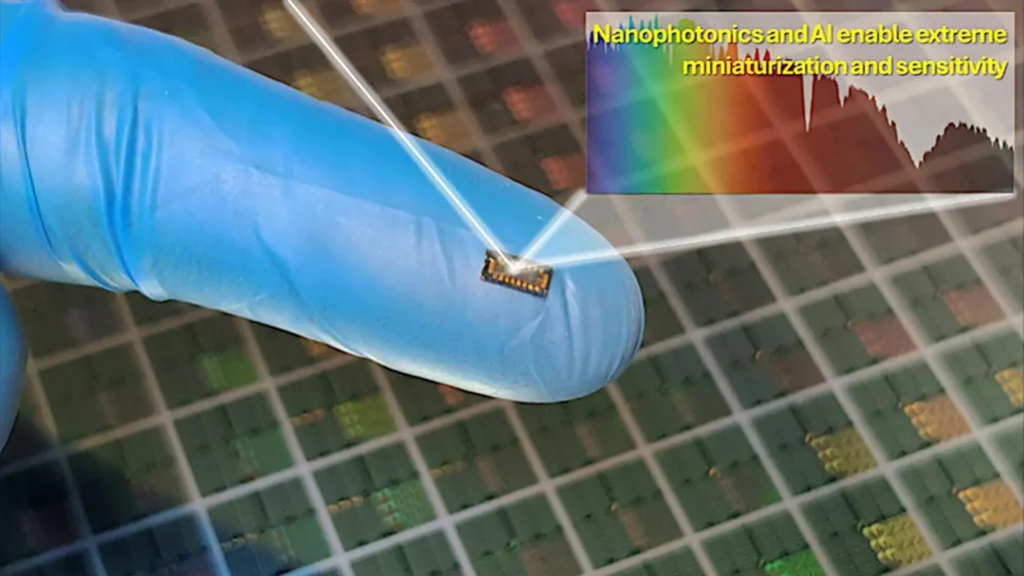
Now, a groundbreaking development from researchers at the University of California Davis (UC Davis) promises to fundamentally alter this landscape, offering a dramatically smaller and more accessible alternative. Published in the prestigious journal Advanced Photonics, the research team has unveiled a spectrometer-on-a-chip so minuscule that its dimensions approach that of a single grain of sand. This innovative system eschews the conventional reliance on substantial optical components to physically separate light. Instead, it leverages the power of artificial intelligence (AI) in conjunction with a compact array of meticulously engineered sensors to computationally reconstruct the complete light spectrum, marking a profound paradigm shift in analytical instrumentation.
The End of Bulky Optics: How AI Reimagines Light Analysis
The core of this transformative technology lies in its radical departure from standard spectroscopic methodologies. Rather than spreading light into a discernible rainbow of colors, the UC Davis chip employs an array of 16 distinct silicon detectors. Each of these detectors has been uniquely designed and fabricated to exhibit a slightly different, yet precise, response to incoming light. Crucially, these detectors do not directly isolate individual colors or wavelengths. Instead, they collect highly encoded signals, each containing a fragmented but vital piece of the overall spectral information.
One might conceptualize this system as a panel of highly specialized "tasters," each sensing a particular aspect or flavor of a complex chemical mixture. Individually, each detector’s output offers only a partial glimpse into the light’s composition. However, when these diverse signals are aggregated and processed collectively, they generate an information rich dataset. This collective data becomes the raw input for the second pivotal component of the system: a sophisticated, fully connected neural network.
The neural network, a form of artificial intelligence, is the brain behind the chip’s analytical prowess. It has been rigorously trained on thousands of examples, learning to decipher the intricate and often noisy relationship between the encoded signals emanating from the 16 detectors and the actual, underlying spectrum of light. This advanced AI approach is adept at solving what researchers refer to as an "inverse problem" – inferring an original cause (the light spectrum) from its observed effects (the detector signals). Through this computational alchemy, the system can accurately reproduce spectral data with an impressive resolution of approximately 8 nanometers (nm), all without requiring any bulky optical hardware whatsoever. This resolution is sufficient for a vast array of applications, from identifying molecular fingerprints in chemical compounds to distinguishing subtle changes in biological tissues.
Extending Silicon’s Reach: Unlocking the Near-Infrared Spectrum
A significant and particularly impactful breakthrough achieved by the UC Davis team pertains to the extension of the chip’s spectral sensitivity. Standard silicon photodiodes, while excellent for detecting visible light, traditionally struggle to effectively capture near-infrared (NIR) light, typically wavelengths up to 1100 nm. The inability of conventional silicon to efficiently detect NIR has long been a limiting factor for miniaturized spectroscopic devices, as NIR light holds immense importance across numerous applications. For instance, in biomedical imaging, NIR light is highly valued for its ability to penetrate deeper into human tissue compared to visible light, offering less scattering and absorption, which allows for clearer imaging of subcutaneous structures, blood oxygenation monitoring, and early disease detection.
The researchers ingeniously overcame this inherent limitation by modifying the surface of standard silicon photodiodes with specialized "photon-trapping surface textures" (PTSTs). These intricately engineered nanostructures dramatically alter how light interacts with the silicon layer. Instead of permitting NIR photons to pass directly through the thin silicon layer, which they would ordinarily do with minimal absorption, the textured surface repeatedly scatters the incoming light within the chip’s active volume. This increased optical path length and multiple opportunities for interaction significantly boost the likelihood that the silicon will absorb the NIR photons. The net result is a spectrometer chip that boasts sensitivity across a much wider spectral range than conventional silicon sensors, effectively bridging a critical gap in miniaturized analytical capabilities. This enhancement broadens the chip’s applicability to areas previously dominated by more exotic and expensive materials, such thereby lowering the barrier to entry for NIR spectroscopy.
Capturing the Unseen: Ultrafast Light Interactions
Beyond its remarkable miniaturization and extended spectral range, the new architecture introduces another powerful capability: the detection of ultrafast light interactions. The chip incorporates high-speed sensors specifically designed to measure photon lifetime with exceptionally high temporal precision. Photon lifetime refers to the duration a photon remains within a particular medium or system before being absorbed or scattered. Analyzing these ultrafast interactions – which can occur on femtosecond to picosecond timescales – provides crucial insights into the dynamic properties of materials, such as charge carrier dynamics in semiconductors, energy transfer processes in biological molecules, and transient chemical reactions.
Traditional spectrometers are generally ill-equipped to capture such rapid phenomena, often missing them entirely due to their inherent temporal averaging. The integration of high-speed temporal resolution within this compact spectrometer opens entirely new avenues for advanced forms of sensing and imaging. Researchers anticipate that this capability could unlock previously inaccessible data, enabling the development of novel diagnostic techniques, advanced material characterization, and deeper understanding of fundamental physical and chemical processes that once necessitated far larger, more complex, and prohibitively expensive laboratory setups.
The Journey to Miniaturization: A Historical Context
The development of the UC Davis spectrometer-on-a-chip represents the culmination of decades of scientific endeavor aimed at making analytical instrumentation more compact and accessible. Since the early 20th century, spectrometers have evolved from bulky laboratory apparatuses into sophisticated, yet still relatively large, research-grade instruments. Their underlying principles, relying on the physical dispersion of light, have remained largely unchanged for over a century. This reliance on optical path length for spectral resolution has been the primary impediment to true miniaturization.
The persistent quest for portability in scientific instruments gained significant momentum with the advent of microelectromechanical systems (MEMS) and lab-on-a-chip technologies in the late 20th and early 21st centuries. These fields demonstrated the feasibility of integrating complex laboratory functions onto a single, small chip. However, spectrometers, with their inherent optical requirements, posed a unique challenge. Previous attempts at miniaturizing spectrometers often involved compromises in performance, such as reduced spectral resolution, limited sensitivity, or a narrower operating range. The breakthrough by the UC Davis team lies in circumventing these traditional optical constraints entirely, by shifting the burden of spectral deconvolution from physical optics to intelligent computation. This conceptual leap, enabled by advancements in AI and nanoscale material engineering, positions this new device as a pivotal step in the democratization of advanced analytical tools, aligning with the broader trend of making sophisticated technologies pervasive and ubiquitous.
Broader Implications and Future Horizons
The completed UC Davis system is remarkably compact, occupying a mere 0.4 square millimeters while simultaneously maintaining high sensitivity and demonstrating strong resistance to electrical noise. This latter attribute is particularly critical for portable, low-cost electronics, where signal integrity can easily be compromised by environmental interference. Even in electromagnetically noisy environments, the AI-assisted design intelligently processes and reconstructs clear signal quality, ensuring reliable performance in real-world scenarios.
This convergence of machine learning with enhanced silicon light detection technology is poised to pave the way for a new generation of compact, real-time hyperspectral sensing devices. The potential applications are vast and transformative:
- Portable Medical Diagnostics: Imagine handheld devices for instant, non-invasive disease diagnosis at the point of care, remote clinics, or even in emergency field situations. This could include rapid detection of biomarkers for cancer, infectious diseases, or metabolic disorders, significantly accelerating diagnosis and treatment initiation.
- Wearable Health Monitors: Integration into smartwatches or other wearables could enable continuous, real-time monitoring of physiological parameters, such as blood glucose levels (non-invasively), oxygen saturation, or even early detection of skin conditions, moving towards truly personalized medicine.
- Environmental Remote Sensing: Drones or mobile platforms equipped with these miniature spectrometers could provide granular data on air and water quality, detect pollutants, monitor agricultural health, or identify hazardous materials over wide areas, providing unprecedented data resolution for environmental management.
- Food Quality Analysis: From ensuring the freshness and authenticity of produce in supermarkets to detecting contaminants or adulterants in food processing plants, these chips could offer rapid, on-site quality control, enhancing food safety and supply chain integrity.
- Industrial Process Control: Real-time spectral analysis directly on manufacturing lines could optimize chemical reactions, monitor product purity, and ensure consistent quality, leading to greater efficiency and reduced waste.
- Security and Defense: Compact spectrometers could aid in the rapid identification of explosives, narcotics, or chemical agents in challenging environments.
Expert Reactions and Industry Outlook
While specific official statements are pending, the scientific community and industry analysts are expected to view this breakthrough with significant enthusiasm. Lead researchers at UC Davis would likely emphasize the interdisciplinary nature of the project, highlighting the synergy between material science, electrical engineering, and artificial intelligence that made this innovation possible. They would underscore the potential for democratizing access to advanced analytical capabilities, moving spectroscopy from specialized laboratories into the hands of everyday users and into novel, previously inaccessible environments.
Industry experts anticipate that this technology could disrupt segments of the global spectroscopy market, which is valued in the billions of dollars annually. The ability to dramatically reduce the size, cost, and complexity of spectrometers while maintaining high performance opens up entirely new market segments, particularly in the realm of consumer electronics, IoT (Internet of Things) devices, and embedded sensing solutions. Companies specializing in medical devices, environmental monitoring equipment, and smart agriculture technologies would likely be eager to explore the integration of this chip into their next-generation products. The low manufacturing cost inherent in silicon-based fabrication suggests a rapid path to commercialization and widespread adoption, once scaling challenges are addressed.
The path forward will involve further research into refining the AI algorithms, potentially expanding the spectral range even further, and integrating the chip with other sensor modalities. Critically, the journey from laboratory prototype to mass-produced commercial product will require addressing manufacturing scalability, cost optimization, and, for medical applications, rigorous regulatory approvals. Nonetheless, the UC Davis spectrometer-on-a-chip represents a monumental leap forward, promising to make the invisible visible, empowering a new era of ubiquitous chemical analysis and sensing that could profoundly impact science, industry, and daily life.