The global construction industry, a cornerstone of human civilization and economic development, faces an increasingly urgent challenge: its substantial environmental footprint. At the heart of this issue lies concrete, the most ubiquitous building material on Earth, yet also one of the largest contributors to anthropogenic carbon emissions. The production of cement, the key binder in concrete, accounts for approximately 8% of global CO2 emissions. In an effort to mitigate this environmental impact, researchers have been exploring innovative manufacturing techniques, with 3D printing of concrete emerging as a particularly promising avenue. This additive manufacturing process, akin to a colossal robotic icing dispenser, lays down concrete layer by layer, precisely where it is needed. This method inherently reduces waste by eliminating the labor-intensive formwork required for traditional casting and allows for the creation of complex geometries previously unattainable.
However, a significant hurdle has emerged in harnessing the full potential of 3D-printed concrete. Computer-aided design (CAD) software, particularly employing topology optimization, can generate mathematically ideal structural designs that maximize strength while minimizing material usage. These designs, often characterized by intricate, organic, and seemingly delicate lattice-like structures, are theoretically the most efficient. Yet, the physical limitations of current large-scale concrete 3D printers—their substantial nozzle diameters, restricted articulation, and the imperative to print in a continuous motion—render many of these hyper-efficient designs unbuildable. The gap between computational perfection and practical fabrication has been a persistent obstacle, leading to designs that, while theoretically sound, are practically impossible to realize.
A breakthrough in bridging this critical divide has now been announced by a team of researchers at the Massachusetts Institute of Technology (MIT). Their novel computational framework, detailed in a recent publication in the journal Additive Manufacturing, directly integrates the physical constraints of concrete 3D printers into the design optimization process. This innovative approach ensures that the resulting structural designs are not only mathematically optimal for material efficiency and strength but are also inherently manufacturable by existing robotic systems, significantly reducing or even eliminating the need for manual redesign.
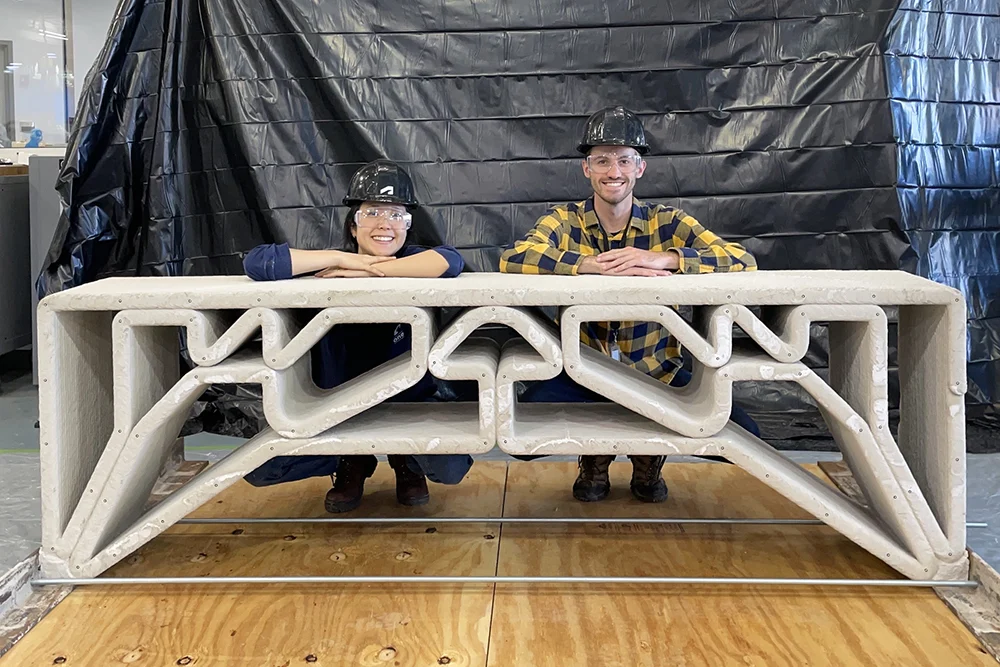
To demonstrate the efficacy of their framework, the MIT team undertook the ambitious task of designing, 3D printing, and load-testing a 2.3-meter concrete bridge. The results of this pioneering project provided crucial insights, revealing that the primary limitation on how light and efficient a concrete structure can be is not the material itself, but rather the capabilities of current printing hardware.
"We were finding a lot of cracks you can fall through when it comes to translating these super-optimal designs into manufacturable designs," explained Hajin Kim-Tackowiak, a postdoctoral researcher in MIT’s Department of Civil and Environmental Engineering (CEE) and a co-first author of the study. "Those cracks were like chasms." This statement vividly illustrates the disconnect between theoretical design and practical implementation, where the elegance of a computer-generated form could be rendered useless by the blunt realities of robotic construction.
Designing for the Machine: A Collaborative Approach to Real-World Constraints
The development of the MIT framework was a testament to a collaborative spirit, with the research team actively engaging with industry experts to understand the nuanced limitations of large-scale concrete 3D printers. As part of the Autodesk Research Residency Program, the engineers spent time directly with the operators of these advanced printing machines at Autodesk’s Technology Center in Boston.
"They pointed at some of our sharp angles, and they went, ‘I don’t feel safe printing something like that,’" Kim-Tackowiak recalled, highlighting the practical feedback that directly informed their research. This hands-on experience was instrumental in identifying three paramount constraints that dictated the manufacturability of complex concrete geometries: the minimum thickness of each extruded concrete bead, the permissible sharpness of the printer’s nozzle turns, and the absolute necessity for the printing process to be continuous, without interruption.
These identified limitations were then meticulously translated into the mathematical language of the research team’s optimization framework. This direct incorporation of fabrication realities into the design algorithm represents a paradigm shift from previous methodologies. Historically, the process involved first optimizing a structure for strength and material efficiency and then attempting to adapt that design to the limitations of the printing hardware—a post-processing phase that was often time-consuming and prone to error.
Kim-Tackowiak elaborated on the efficiency gains: "Existing 3D-printed structures are typically produced with older methods that optimize the shape first, and then require ‘a massive amount of post-processing,’ taking days to run." In stark contrast, the MIT team’s integrated framework was capable of generating fully printable designs in approximately two minutes on a standard laptop. This remarkable speed proved invaluable during the bridge printing process; when a minor adjustment to the bridge’s scale was needed on the day of printing, the team could simply re-run the optimization, yielding an updated design within five to ten minutes.
The computational power required for this rapid optimization is a recent development in the field of mixed-integer optimization, a complex mathematical technique that was previously considered too computationally intensive for such real-time applications. "Reaching that speed at all is recent," stated Zane Schemmer, a PhD student in CEE and the study’s other co-first author. He further elaborated on the evolution of the technology: "The math the method relies on, mixed-integer optimization, was long considered too hard to use. You go back five, 10 years ago, the solver we used, even three years ago, could not solve these problems. This field has been avoided, because everyone thinks that’s not an avenue we can go down. But with new algorithms and resources, it’s becoming a way we can start to frame problems."
A Bridge to Understanding: The Hardware as the Bottleneck
To rigorously validate their new framework, the MIT researchers returned to Autodesk’s facility to bring their 2.3-meter concrete bridge design to life. The printing of the bridge itself was a relatively swift operation, taking approximately 30 minutes and utilizing standard, off-the-shelf mortar.
"The bridge took about 30 minutes to make and was built from off-the-shelf mortar," noted Josephine Carstensen, the Gilbert W. Winslow (1937) Career Development Professor in Civil Engineering and the senior author of the research paper. Following its fabrication, the approximately 900-pound structure underwent rigorous load testing. It demonstrated remarkable resilience, supporting over 2,000 pounds distributed across its span with negligible deflection, a performance that closely aligned with the team’s simulated predictions.
However, the load tests yielded a surprising and significant revelation: the primary limiting factor in achieving an even lighter and more material-efficient design was not the inherent properties of the concrete but the constraints imposed by the printing hardware. "What we found was our result was super over-engineered," Kim-Tackowiak commented. "From zero to 200,000 pounds, your design is entirely driven by these ‘can I build it or not’ constraints. And then, after 200,000 pounds, you can start to think about the physics." This finding fundamentally shifted the researchers’ understanding, pinpointing the technological capabilities of 3D printers as the bottleneck for optimizing structural efficiency, rather than the material’s strength characteristics.
A Roadmap for Innovation: Quantifying the Impact of Hardware Improvements
The MIT framework’s ability to identify the mathematically optimal design also provides a powerful tool for quantifying the precise material cost associated with each hardware limitation. "With mixed-integer optimization, we can find the global optimum, the best solution there is, as opposed to just a good solution," Carstensen explained. "Because we know we’re finding the best solution out there, we can also quantify: If we had a machine that could do other things, what would that mean for how much material we’re using?"
The analysis revealed that the width of the printed bead was the most significant factor influencing material usage. The bridge was constructed using a 4-centimeter bead. The researchers’ calculations indicated that a hypothetical printer capable of extruding a 1-centimeter bead could reduce material consumption by an astounding 76%, while still maintaining robust safety margins. This finding was particularly striking for Carstensen, who had initially anticipated that the constraint on continuous printing paths would have a more substantial impact. "I thought the continuous path would be the problem, the one that had the highest effect. But it wasn’t. It was the bead width," she remarked.
This quantitative assessment serves as a clear roadmap for manufacturers of concrete 3D printing hardware. It highlights that even modest improvements in machine capabilities, particularly concerning nozzle precision and bead width control, could unlock substantial gains in structural efficiency and, consequently, significantly reduce the carbon footprint of concrete construction.
A key element that enabled the bridge’s optimized design was its compression-only nature. Concrete is exceptionally strong under compression (when squeezed) but relatively weak under tension (when pulled). "With concrete, it’s really good when you push on it, really bad when you pull on it," Schemmer elaborated. "We’re able to guarantee that every piece of concrete that you see is in compression, there’s no part that’s being pulled on." This design strategy maximizes the inherent strengths of concrete while avoiding its weaknesses.
The savings derived from this approach extend beyond material reduction. The elimination of formwork is a significant advantage, especially for custom or one-off structural components. Carstensen envisions immediate applications in disaster relief scenarios: "You can quickly put up new infrastructure without needing to make formwork." This rapid deployment capability could be crucial in rebuilding efforts following natural disasters.
The bridge’s compression-only design was dramatically illustrated after the testing phase. While it had withstood immense pressure, a subsequent incident revealed its vulnerability to tensile forces. When a worker attempted to lift a corner of the bridge to sweep beneath it, the structure broke. This failure was not indicative of a design flaw in terms of its intended load-bearing capacity but rather a poignant demonstration of the principle it embodied: a structure optimized for compression is inherently susceptible to tension. "It’s optimal in one way, but it’s definitely not optimal in every way," acknowledged Kim-Tackowiak.
The Future of Printed Concrete: Reinforcement and Refinement
This insight into the limitations of pure concrete structures has paved the way for the team’s next research objective: incorporating reinforcement into 3D-printed concrete designs. "We know a pure concrete structure is not necessarily going to be the most optimal thing, so we’re moving it more into the world we live in today, which is reinforced concrete," Kim-Tackowiak stated. The challenge now lies in developing methods to seamlessly integrate reinforcing materials, such as rebar, into the printing process. "though working out how to feed rebar into a printed concrete structure," she added, "is proving its own challenge."
The successful completion of this research was made possible through funding from the National Science Foundation and support from the MIT Center for Advanced Production Technologies. Alongside Kim-Tackowiak, Schemmer, and Carstensen, the study’s co-authors include Pittipat Wongsittikan, a PhD student in the MIT Building Technology Architecture program, and Jackson Jewett, an alumnus and former postdoc.
The implications of this MIT framework are far-reaching. By enabling the design of lighter, more material-efficient structures that are directly manufacturable, it offers a tangible pathway to reducing the environmental impact of the construction industry. Furthermore, the ability to precisely quantify the performance gains achievable through hardware improvements provides a clear directive for manufacturers, potentially accelerating the development of more sustainable and advanced 3D printing technologies for concrete. As the world grapples with the urgent need to decarbonize its built environment, innovations like this MIT framework represent critical steps toward a more sustainable future for construction.