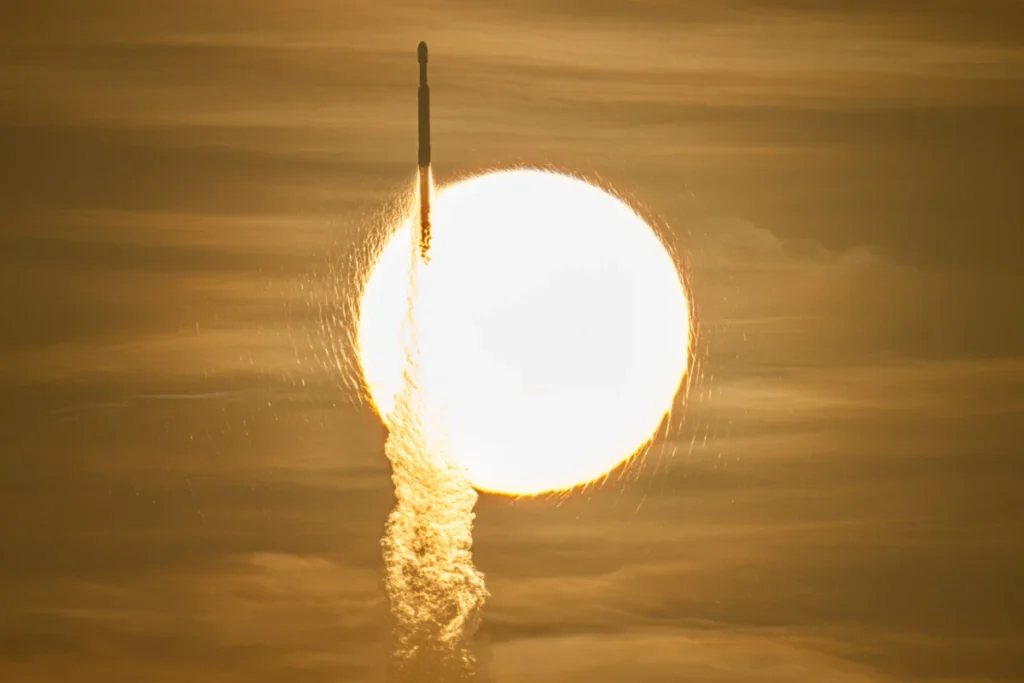
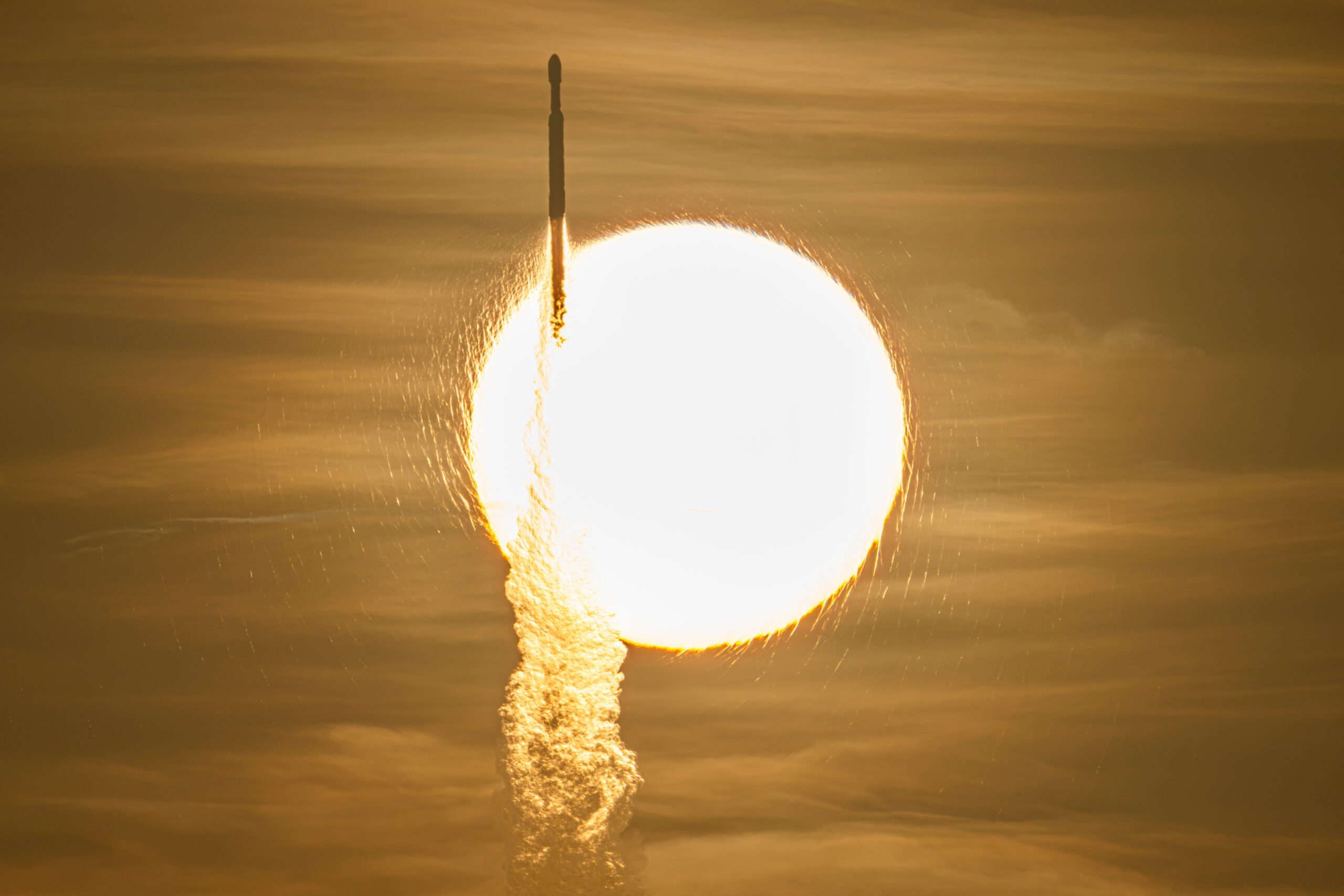
The Nancy Grace Roman Space Telescope, NASA’s ambitious new observatory, has commenced its critical three-month transit to deep space, marking a pivotal advancement in the agency’s quest to discover legions of exoplanets and probe the enigmatic realms of dark energy and dark matter. The launch, a spectacle of engineering prowess, occurred precisely at 7:26 a.m. Eastern time from Kennedy Space Center, Florida, as a SpaceX Falcon Heavy rocket ascended into the dawn sky, silhouetted against the rising sun over the Atlantic Ocean. Approximately thirty minutes after liftoff, Roman successfully separated from the rocket’s upper stage, initiating its trajectory towards its operational orbit around the Sun-Earth Lagrange Point 2 (L2), a gravitationally stable location 1.5 million kilometers (930,000 miles) from Earth.
A New Era of Astronomical Observation Begins
This journey to L2 is not merely a physical transit; it is the prelude to a comprehensive commissioning phase. During this crucial period, NASA mission controllers will meticulously guide the telescope through the startup and calibration of its sophisticated onboard instruments. This meticulous process ensures that Roman is operating at peak performance, ready to deliver unprecedented data. The launch commentator’s assertion that Roman is "poised to revolutionize our understanding of the universe" underscores the profound expectations placed upon this groundbreaking observatory.
Roman is designed to operate in concert with NASA’s iconic Hubble and James Webb Space Telescopes, forming a formidable trio of space-based observatories. While Hubble and Webb excel at capturing highly detailed, high-resolution images of specific celestial targets, Roman’s unique strength lies in its expansive field of view. With an observational sweep 100 times wider than Hubble’s and 50 times greater than Webb’s, Roman is engineered to rapidly survey vast swathes of the cosmos, enabling the discovery of phenomena that might otherwise escape detection. This complementary approach promises a more holistic and profound understanding of the universe.
NASA has allocated a substantial budget of $4.3 billion for the Roman mission, with plans for its operational lifespan to extend for at least a decade, contingent upon the onboard propellant reserves. This long-term commitment signifies the immense scientific potential that NASA sees in Roman’s capabilities.
Engineering Marvel: The Design and Capabilities of Roman
At first glance, the semi-trailer-sized observatory bears a visual resemblance to the Hubble Space Telescope. Its cylindrical "trunk" houses the intricate system of mirrors designed to capture and focus photons from distant stars and galaxies. Central to its observational power is the Wide Field Instrument (WFI), an infrared camera poised to be the workhorse of many of Roman’s scientific endeavors. Roman’s primary mirror, measuring 2.4 meters in diameter, is identical in size to Hubble’s. However, the design of Roman’s optical system, featuring a significantly shorter distance between its primary and secondary mirrors, is what enables its exceptionally wide field of view.
Precision Mechanics for Unparalleled Data
The journey of light within Roman is a marvel of precision engineering. Photons entering the telescope will be reflected by the mirrors and directed to the Focal Plane System. This system is comprised of multiple sensors and 18 high-resolution detectors arranged on a mosaic plate. This plate possesses the remarkable capability to be repositioned during operations as needed, allowing for fine-tuning of focus and observation targets.
For the rigors of launch, including the intense vibrations of the Falcon Heavy rocket, the focal plane plate and its controlling motors were locked into a fixed position. Jeff Kruk, Roman’s deputy senior project scientist, explained in a written response that "After launch, the mechanisms are moved to their nominal in-focus position and then adjusted later as-needed" during the calibration and aiming phases. This careful staging ensures the delicate instruments are protected during their ascent.
The development of the WFI’s focal plane assembly and calibration system was undertaken by NASA’s Goddard Space Flight Center. The remainder of the instrument, including the crucial "element wheel" responsible for precisely articulating eight optical filters along with a prism and grism (a prism with a diffraction grating), was engineered by BAE Systems at their facilities in Colorado. BAE Systems also developed the vital mechanical, structural, electrical, and thermal systems that maintain the WFI’s stability and ensure the large detector array remains adequately cooled.
The stringent stability requirements for the focal plane are a testament to Roman’s precision. BAE Systems highlighted that "The focal plane needs to stay stable to within two microns," a dimension comparable to the size of a bacterium and significantly smaller than a red blood cell. This level of stability is at least ten times greater than Hubble’s, whose focus can shift by over 25 microns per orbit, underscoring Roman’s advanced engineering for precise astronomical measurements.
Thermal Management: A Crucial Component for Sensitive Observations
Maintaining a stable and extremely cold environment is paramount for the WFI’s infrared instruments to function optimally. BAE Systems designed a sophisticated thermal management system to keep the hardware surrounding the focal plane below -143 degrees Celsius (-225 degrees Fahrenheit). While this is exceptionally cold, it is worth noting that the instruments aboard the James Webb Space Telescope operate at even lower temperatures, down to -266 degrees Celsius (-447 degrees Fahrenheit), reflecting the different observational requirements of each mission.
Calibration and Commissioning: Laying the Groundwork for Discovery
A primary focus during the commissioning phase will be the meticulous calibration of the WFI. To achieve this, NASA scientists will direct Roman towards well-characterized star fields. The images captured by Roman will then be meticulously compared with historical data from Hubble and other telescopes. Key targets for this calibration process include the Large Magellanic Cloud, a dwarf galaxy selected for its high density of stars within an optimal brightness range, and the star cluster NGC 6811 in the constellation Cygnus. These celestial benchmarks, as detailed in a 2025 paper by Roman researchers, will serve as crucial reference points for ensuring the accuracy and reliability of Roman’s observations.
Data Deluge: Unprecedented Scientific Output
Upon becoming fully operational, Roman is projected to transmit approximately 1.4 terabytes of compressed science data to Earth on a daily basis. This volume dwarfs the daily data output of its predecessors, significantly exceeding Hubble’s approximately 3 gigabytes per day and Webb’s 50-60 gigabytes per day.
"Roman’s total downlinked data volume is unprecedented for a space-based astrophysics mission," Kruk stated. "This necessitated new developments in detector readout electronics and data storage as well as in the radio-frequency system for actually transmitting the data from a million miles away." This surge in data volume underscores the transformative nature of Roman’s scientific capabilities and the technological innovations required to handle such an influx of information.
Unlocking Exoplanet Secrets and Dark Universe Mysteries
Among Roman’s foremost scientific objectives is the comprehensive cataloging and surveying of exoplanets within the Milky Way galaxy. A key technique employed for this endeavor will be gravitational microlensing. This method leverages the phenomenon where the gravity of an intervening object – be it a star, planet, or even a black hole – bends the light from a more distant star or galaxy. By observing these subtle distortions, scientists can infer the presence and characteristics of unseen celestial bodies.
Scott Gaudi, a professor of astronomy at Ohio State University and a principal investigator for the Roman Galactic Exoplanet Survey Project Infrastructure Team, emphasized that it is not solely the wide field of view but Roman’s ability to rapidly survey vast regions at high resolution that makes it invaluable for exoplanet surveys. "We can look at 100 million stars every 12 minutes, so that means what was previously considered rare phenomena become common, and that is the true power of Roman for the exoplanet survey," Gaudi explained in an interview.
Gaudi further elaborated on the unique importance of microlensing events: "I’m most interested in the microlensing events, because they do not repeat. They happen once and if you miss it, it’s gone. And so you have to characterize it when you’re seeing it. In other words, you have to get it right the first time." This highlights the critical need for Roman’s rapid observation capabilities and the precise data it will provide.
Beyond exoplanet discovery, Roman’s broad survey capabilities are essential for tackling the profound mysteries of dark energy and dark matter. By mapping the distribution of galaxies and observing their evolution over cosmic time, scientists aim to gain crucial insights into the nature of these elusive components that constitute the vast majority of the universe’s mass-energy. The telescope’s ability to image large portions of the sky efficiently will allow for unprecedented statistical studies of these cosmological phenomena, potentially revealing the expansion rate of the universe and the influence of dark energy over billions of years.
Timeline and Context of the Mission
The development of the Nancy Grace Roman Space Telescope has been a multi-year undertaking, building upon decades of advancements in space-based astronomy. The concept for a large-field infrared survey mission emerged in the early 2000s, evolving through various proposals and redesigns. The project officially entered its formulation phase in 2011, with significant contributions from international partners, including the European Space Agency. The selection of the Falcon Heavy rocket for Roman’s launch signifies a strategic choice for its payload capacity and reliability, ensuring a smooth and successful transition to its deep-space destination. The L2 point has become a favored location for space observatories, offering a stable thermal environment and unobstructed views of the cosmos, away from the interference of Earth’s atmosphere and light.
Broader Implications for Scientific Discovery
The successful launch and commissioning of the Nancy Grace Roman Space Telescope represent a significant leap forward for astrophysics and cosmology. The unprecedented volume of data it will generate, coupled with its powerful observational capabilities, promises to yield discoveries that could fundamentally alter our understanding of planetary systems, the formation and evolution of galaxies, and the very fabric of the universe. The mission’s collaborative nature, working alongside Hubble and Webb, exemplifies a coordinated strategy to maximize scientific return from NASA’s flagship observatories. As Roman embarks on its journey, the scientific community eagerly anticipates the revelations that will emerge from its deep-space vantage point, ushering in a new era of cosmic exploration.