Researchers at MIT have introduced a groundbreaking new system dubbed "bifur-circuits," representing a significant leap forward in the field of mechanical metamaterials. These innovative structures are designed with intrinsic intelligence, allowing them to dynamically change shape and sense their configuration, sending corresponding messages to an electronic display. The core of this advancement lies in combining the unique mechanical properties of auxetic metamaterials with embedded electrical conductivity and leveraging the principle of mechanical bifurcation, opening up a vast array of possibilities for reconfigurable objects and smart systems.
The team, led by mechanical engineering graduate student Marwa AlAlawi, demonstrated the versatility of bifur-circuits through several interactive objects. A notable example is a chair that seamlessly converts into a table with integrated storage, and can further flatten for compact stowing. Beyond smart furniture, the technology holds immense promise for applications such as communications and sensing antennas that can dynamically adjust their frequencies by forming new shapes in response to changing environmental conditions, all without the need for bulky or complex mechanical parts. This research, detailed in a recent paper, will be presented at the prestigious ACM Symposium on User Interface Software and Technology, marking its formal introduction to the wider scientific community.
"Metamaterials can make complex mechanical assemblies easy to manufacture just by using repeating units. Our work expands on this design space," stated Marwa AlAlawi, the lead author of the paper. "If we think of mechanical metamaterials as building blocks, then our work is one way to take advantage of their geometry to embed intrinsic intelligence into hardware, which could open many possibilities." AlAlawi collaborated with co-senior authors Ticha Sethapakdi, an electrical engineering and computer science (EECS) graduate student at MIT, and Stefanie Mueller, an associate professor in MIT’s departments of EECS and Mechanical Engineering, who also leads the Human-Computer Interaction Group at the Computer Science and Artificial Intelligence Lab (CSAIL). The extensive research effort also involved co-authors from MIT, the University of Tokyo, and the University of Michigan, highlighting a collaborative, international approach to this complex scientific challenge.
The Evolution of Intelligent Materials: From Static Structures to Dynamic Systems
The concept of metamaterials has been a focal point of advanced materials research for decades, driven by the desire to engineer materials with properties not found in nature. Unlike conventional materials whose properties are dictated by their chemical composition, metamaterials derive their unique characteristics from their intricate, often periodic, structural designs at scales smaller than the wavelengths of the phenomena they influence. This structural engineering allows them to exhibit extraordinary mechanical, optical, or electromagnetic behaviors.
Within this broad category, mechanical metamaterials have garnered significant attention for their ability to be programmed to deform in specific, often counter-intuitive ways. These are three-dimensional structures composed of repeating units, meticulously designed to form complex shapes when subjected to external forces such like squeezing, pushing, or pulling. Their geometries dictate precise bending or twisting responses, offering a novel approach to mechanical design that moves beyond traditional monolithic components. A particularly fascinating subset are "auxetic" metamaterials, which defy conventional material behavior by getting wider when stretched, rather than narrowing. This property, observed in certain foams and polymers, has captivated researchers due to its potential for enhanced impact absorption, improved fracture toughness, and unique shape-changing capabilities.
Prior to the development of bifur-circuits, the MIT researchers had already demonstrated impressive capabilities using auxetic metamaterials. Their earlier work successfully produced reconfigurable antennas that could adopt three distinct shapes based on how the structure was stretched. This innovation allowed the antenna to dynamically adjust its frequency range, a critical function in modern telecommunications, without relying on cumbersome and failure-prone complex moving parts. Such a development represented a significant step towards more versatile sensing and communication systems. However, a key limitation of these earlier auxetic designs was their confinement to a finite, small number of fixed states. This restricted the extent of their reconfigurability and the breadth of applications they could serve, prompting the team to seek a more expansive solution.
Unpacking Bifur-Circuits: The Fusion of Mechanics and Electronics
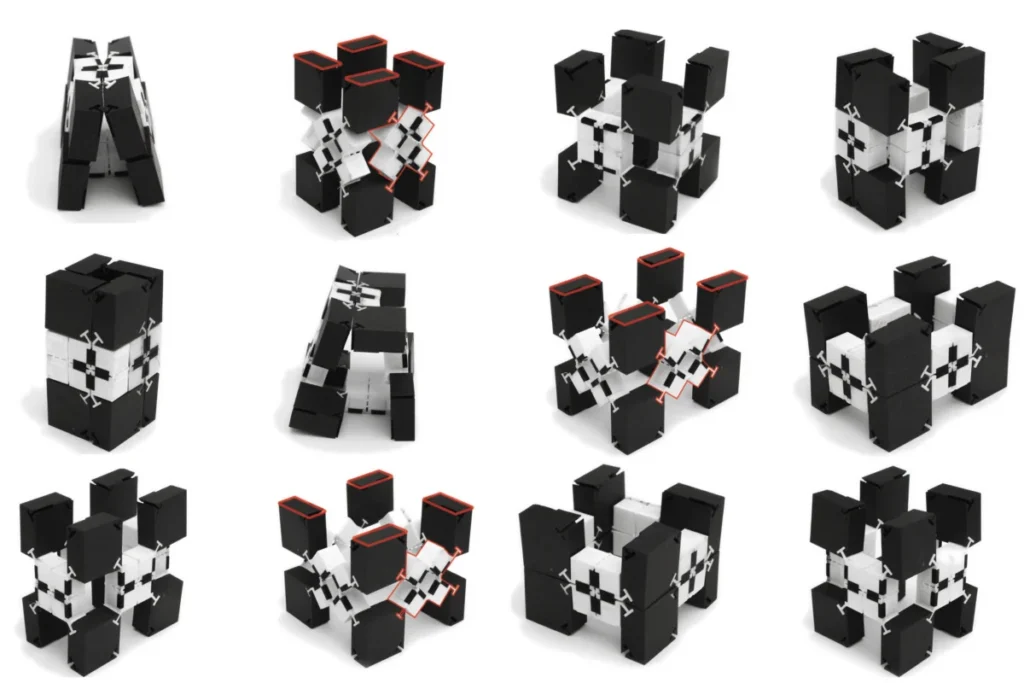
The current research directly addresses these limitations by introducing "bifur-circuits," a sophisticated evolution of auxetic metamaterials. This new generation of materials can form a vastly greater number of shapes, a capability derived from the intricate way their modular units are interconnected and rotated. The ingenuity of bifur-circuits lies not only in their mechanical reconfigurability but also in their seamless integration of electrical modularity. Conductive materials are strategically incorporated into the design, ensuring that electrical connections are maintained throughout the structure, regardless of how the object is rotated, pressed, or twisted to assume new configurations. This unbroken electrical pathway is fundamental to the "intrinsic intelligence" that the researchers aimed to embed within the hardware.
The exponential increase in potential configurations is primarily attributed to a property known as mechanical bifurcation. Mechanical bifurcation describes a sudden, often dramatic, change in a mechanism’s behavior when a force applied to it crosses a critical threshold, or "tipping point." A common analogy is gently bending a plastic ruler: initially, it deforms smoothly, but once the applied force reaches a certain magnitude, the ruler abruptly buckles into a new stable state. In bifur-circuits, this principle is meticulously engineered to occur when connected blocks are rotated around specific pivot points. This controlled bifurcation allows connected blocks to form a significantly greater number of stable configurations than a single block could achieve independently. Crucially, adding more bifur-circuit units to a structure does not merely add linearly to the possibilities but exponentially increases the number of potential configurations. "Bifurcation allows us to significantly expand on this reconfigurability space. Just adding one extra unit gives us so many more combinations out of the same structure," AlAlawi explained, underscoring the power of this design principle.
This dynamic interaction between mechanical movement and electrical conductivity is what enables the structures to "sense" their own configuration. As components are connected and rotated, they activate a unique circuit between adjacent units. This inherent interactivity allows the units to communicate with one another, providing real-time feedback on the structure’s current shape and state.
A significant hurdle during the development process was the integration of a suitable conductive material. The material needed to be flexible enough to withstand repeated bending and twisting without compromising its structural integrity, yet also efficient enough to facilitate a reliable flow of electricity. "The conductive material was a constraint we had to work around in the design process, and it dictated how the sensing between blocks would happen," AlAlawi noted, highlighting the interdisciplinary challenges of material science and electrical engineering. After perfecting the design, the researchers rigorously tested the durability of these reconfigurable structures. They subjected them to over 10,000 compression cycles, a testament to their robust engineering. The results were conclusive: the structures exhibited no degradation in electrical connectivity, affirming their potential for long-term, real-world applications.
To democratize the design and fabrication of these complex metamaterials, the researchers also developed a user-friendly construction and simulation tool. This software simplifies the bifur-circuit design process, allowing users to explore various configurations and behaviors virtually. Once a design is finalized, the software generates precise instructions for a multimaterial 3D printer, which can then fabricate the reconfigurable objects in a single pass, streamlining production and enabling rapid prototyping. This integration of design software and advanced manufacturing techniques is crucial for scaling up the technology and making it accessible for diverse applications.
Transformative Applications and Broader Implications
The practical demonstrations of bifur-circuits underscore their immense potential across various sectors. Beyond the reconfigurable chair/table that intelligently senses its geometry as it transforms, the team showcased a shape-shifting controller designed to launch one of several video games based on its current configuration. This playful application vividly illustrates the concept of "intrinsic intelligence" and how physical interaction can directly influence digital outcomes without external sensors or complex programming.
The implications for telecommunications are particularly exciting. The global market for reconfigurable antennas is projected to grow significantly, driven by the demands of 5G, IoT, and satellite communications for adaptive, compact, and efficient solutions. Traditional antennas are often fixed-frequency devices or rely on complex mechanical actuators to change their operating parameters, adding weight, bulk, and points of failure. Bifur-circuits offer a paradigm shift, enabling antennas to dynamically adjust their frequencies by merely changing their physical shape. This could lead to more compact, versatile, and robust communication devices capable of optimizing performance in real-time environmental conditions, from urban canyons to atmospheric disturbances.
In the realm of robotics, bifur-circuits could revolutionize the design of modular soft robots. Current soft robots often struggle with precise manipulation and reconfigurability due to their inherent compliance. Shape-changing grippers built with bifur-circuits could adapt to various object geometries, offering enhanced dexterity and versatility in tasks ranging from delicate handling in manufacturing to exploration in unstructured environments. The global soft robotics market is experiencing rapid growth, driven by applications in healthcare, logistics, and human-robot interaction, and such innovative gripper technology could unlock new capabilities.
Beyond these high-tech applications, bifur-circuits also hold promise for more humanitarian uses. Imagine reconfigurable shelters that could be deployed rapidly after a natural disaster. These structures could dynamically respond to changing environmental conditions – say, transforming to optimize for wind resistance or solar exposure – providing adaptable and resilient temporary housing. The ability to embed intelligence directly into the physical structure could simplify deployment and operation in critical scenarios. Interactive rehabilitation tools represent another compelling application, where devices could adjust their form and function to suit individual patient needs and provide real-time feedback on progress, enhancing the efficacy of physical therapy.
From a manufacturing perspective, bifur-circuits represent a potential paradigm shift. The ability to create complex mechanical assemblies from repeating, intrinsically intelligent units simplifies the design and production process significantly. Instead of designing and assembling numerous disparate parts, engineers can focus on the geometry and connectivity of modular units, leveraging advanced additive manufacturing techniques like multimaterial 3D printing for single-pass fabrication. This approach could lead to reduced manufacturing costs, faster prototyping cycles, and less material waste, aligning with principles of sustainable engineering.
The concept of embedding intelligence directly into hardware, rather than relying solely on external sensors and software, is a profound implication of this work. It pushes the boundaries of human-computer interaction, making physical objects more intuitive and responsive to human manipulation. This intrinsic intelligence could reduce the complexity and power consumption of electronic systems, as the structure itself provides much of the sensing and adaptive capability.
Looking ahead, the researchers are keen to explore an even broader range of applications for bifur-circuits. They also aim to enhance the interactivity of these structures and investigate additional metamaterial shapes, pushing the boundaries of what these intelligent building blocks can achieve. "Bifur-circuits are one step toward developing mechanical building blocks with integrated intelligence," AlAlawi concluded, outlining a vision for the future. "It would be interesting to build on this work and come up with building blocks that allow us to create a structure with any form or shape we want, and which are structurally stable and can be actuated." This ambition points towards a future where intelligent, adaptive materials are not just components but fundamental elements of design, capable of transforming and interacting with their environment in ways previously confined to science fiction. This pioneering work, supported in part by Japan’s Science and Technology Agency and the Bahrain Crown Prince International Scholarship Program, lays a robust foundation for that future.