The frontiers of quantum mechanics have been extended into the realm of high-energy particle physics as an international research team, including prominent physicists from the University of Oxford, successfully demonstrated that quantum entanglement persists among Z bosons. These particles are among the heaviest and most short-lived entities known to science, and their observation in an entangled state at the Large Hadron Collider (LHC) represents a significant milestone in our understanding of the fundamental laws of the universe. The study, titled "Measurements of Z-boson pair entanglement in decays of Higgs bosons at the ATLAS experiment," has been formally published in the prestigious journal Physical Review Letters, signaling a new era where the "spooky" world of quantum information meets the violent environment of subatomic particle collisions.
Quantum entanglement is a physical phenomenon that occurs when a pair or group of particles is generated, interact, or share spatial proximity in a way such that the quantum state of each particle cannot be described independently of the state of the others. Even when separated by vast distances, the measurement of one particle’s properties—such as spin, position, or momentum—instantaneously influences or reveals the state of its partner. This concept famously troubled Albert Einstein, who, along with Boris Podolsky and Nathan Rosen, proposed that the theory of quantum mechanics might be incomplete because it appeared to allow for "spooky action at a distance" that bypassed the speed of light. However, decades of experiments with photons and electrons have consistently validated the existence of entanglement, which has now become the cornerstone of the second quantum revolution, powering technologies like quantum computers and cryptography.
Testing the Robustness of Quantum Reality
Until recently, most observations of quantum entanglement were conducted in highly controlled, low-energy laboratory environments. Scientists typically used photons (massless particles of light) or trapped ions cooled to temperatures near absolute zero to maintain the delicate quantum states required for study. The primary challenge in the field has been decoherence—the process by which a quantum system loses its "quantumness" due to interaction with its external environment.
The research conducted at the ATLAS experiment at CERN sought to determine if this delicate connection could survive the extreme conditions of the Large Hadron Collider. The LHC is the world’s largest and most powerful particle accelerator, a 27-kilometer ring of superconducting magnets that smashes protons together at nearly the speed of light. These collisions generate temperatures and energy densities not seen since the moments immediately following the Big Bang. Proving that entanglement exists in this chaotic, high-energy environment demonstrates the remarkable robustness of quantum mechanics.
To achieve this, the researchers focused on Z bosons. Unlike the stable or long-lived particles used in previous entanglement studies, Z bosons are massive particles that mediate the weak nuclear force. They are approximately 97 times more massive than a proton and exist for a vanishingly small period—roughly $3 times 10^-25$ seconds. This lifespan is so short that the particles decay long before they can travel even a fraction of the width of an atom.
Experimental Methodology and the Role of the Higgs Boson
The source of the Z bosons in this experiment was the Higgs boson, the particle discovered at the LHC in 2012 that explains how other fundamental particles obtain their mass. In the high-energy environment of the LHC, protons colliding at energies of 13 trillion electron volts (13 TeV) occasionally produce a Higgs boson. While the Higgs boson is itself short-lived, one of its rare decay pathways involves transforming into a pair of Z bosons.
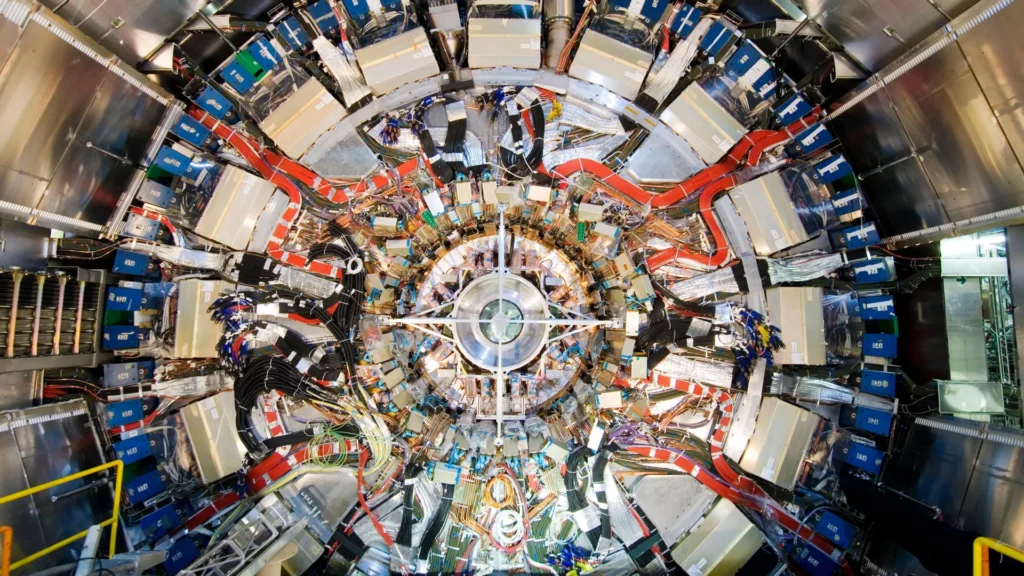
Because these two Z bosons originate from the decay of a single "parent" particle (the Higgs boson), the laws of conservation in quantum mechanics dictate that their properties, such as spin, must be correlated. However, detecting this correlation is a feat of extreme technical precision. Since Z bosons decay almost instantly, they cannot be measured directly. Instead, the ATLAS detector—a seven-story-tall instrument designed to track the debris of particle collisions—measures the "daughter" particles produced by the Z bosons’ decay.
Typically, a Z boson will decay into a pair of leptons, such as electrons or muons. By meticulously analyzing the angles and trajectories at which these leptons emerged, the Oxford-led team and their international collaborators were able to mathematically reconstruct the spin states of the original Z bosons. The statistical analysis of these reconstructed spins provided the "smoking gun" evidence: the Z bosons were entangled, exhibiting correlations that defy classical physics and align perfectly with quantum mechanical predictions.
A Chronology of High-Energy Entanglement
The discovery of Z boson entanglement is the latest in a series of breakthroughs that have bridged the gap between quantum information science and high-energy physics.
- July 2012: The discovery of the Higgs boson at CERN provides a new "laboratory" for studying fundamental interactions.
- 2021-2022: Theoretical physicists, including Professor Alan Barr of Oxford, begin publishing proposals suggesting that the LHC’s massive datasets could be used to test Bell’s inequalities and quantum entanglement at unprecedented energy scales.
- September 2023: The ATLAS collaboration reports the first observation of entanglement between top quarks, which are the heaviest known elementary particles. This was a landmark moment, as it moved entanglement research from the "lightweight" world of photons to the "heavyweight" world of quarks.
- 2024: The current study confirms entanglement in Z bosons. This is particularly significant because Z bosons are force-carriers (bosons), whereas quarks are matter particles (fermions), proving that entanglement is a universal feature across different classes of particles at high energies.
Expert Perspectives and Institutional Impact
Professor Alan Barr, a co-author of the study and a central figure in Oxford’s Department of Physics, has been a long-time advocate for using the LHC as a tool for quantum foundations research. Having been involved in the construction of the LHC, Barr’s transition toward quantum information highlights the evolving nature of the field.
"We’re used to thinking of entanglement as something delicate, seen in laboratory experiments with single photons," Professor Barr noted. "Finding it alive and well among particles as heavy and short-lived as Z bosons, created in some of the most violent collisions we can produce on Earth, shows just how fundamental and robust this quantum effect really is."
The project also features a unique interdisciplinary collaboration with the Faculty of Philosophy at Oxford. Professor Chris Timpson, a co-PI on the project, emphasized the philosophical weight of these findings. According to Timpson, entanglement remains the most "puzzling aspect of quantum reality," and testing it at the frontier of high-energy physics allows researchers to probe whether the "rules" of the universe change at different scales or energy levels.
The technical execution of these experiments relies on the continued maintenance and upgrading of the CERN infrastructure. Professor Daniela Bortoletto, the UK coordinator for the ATLAS detector’s pixel system upgrade, highlighted the scientific power of the collaboration. She noted that Oxford’s leadership in developing new modules for the High-Luminosity LHC (HL-LHC) will be crucial for future discoveries. The HL-LHC, expected to be operational later this decade, will provide a ten-fold increase in data, allowing for even more precise measurements of quantum phenomena.
Data Analysis and Implications for the Future
The implications of this research extend far beyond the walls of the physics lab. By integrating quantum information theory with particle physics, researchers are developing "quantum-sensitive" ways to analyze data.
Supporting Data and Technical Metrics:
- Collision Energy: 13 TeV (Teraelectronvolts), representing the highest energy levels at which entanglement has ever been measured.
- Particle Mass: The Z boson weighs ~91.2 GeV/c², making it one of the heaviest subjects of quantum study.
- Statistical Significance: The evidence for entanglement exceeded the standard "5-sigma" threshold, the gold standard in particle physics for claiming a discovery.
This interdisciplinary approach could lead to the detection of "New Physics"—phenomena that the Standard Model of particle physics cannot currently explain, such as dark matter or the asymmetry between matter and antimatter. If researchers find a discrepancy in how particles are entangled at high energies, it could provide the first clue to a more comprehensive theory of the universe.
Furthermore, the robustness of entanglement demonstrated in this study provides a conceptual boost to the field of quantum computing. If quantum correlations can survive the "violent" environment of a particle collider, it suggests that the fundamental principles underlying quantum bits (qubits) are deeply embedded in the fabric of nature, potentially offering new insights into how to protect quantum information from decoherence in future technologies.
As CERN prepares for the High-Luminosity upgrade, the ATLAS collaboration remains at the forefront of this journey. The successful measurement of Z boson entanglement serves as a reminder that the universe, at its most fundamental level, is interconnected in ways that continue to challenge our perception of space, time, and reality. The work of the Oxford physicists and their global partners has not only confirmed a century-old theory in a new domain but has also opened a window into the next generation of scientific exploration.