The UK Bebras Challenge, the nation’s preeminent computing competition for primary and secondary schools, has officially launched its latest iteration, aiming to build upon the record-breaking participation levels of the previous academic year. In the last cycle alone, more than 526,000 students from across the United Kingdom engaged with the platform, positioning it as the largest initiative of its kind in the country. Organized to introduce fundamental concepts of computational thinking without the requirement for prior programming knowledge or extensive classroom preparation, the challenge serves as a critical entry point for students aged 6 to 19 into the world of computer science. By utilizing interactive, puzzle-based tasks, the UK Bebras Challenge seeks to democratize access to digital literacy, ensuring that students from all socioeconomic backgrounds can discover their potential in a field that is increasingly vital to the modern global economy.
The Evolution of the Bebras International Movement
The UK Bebras Challenge is the British arm of an international movement that began in Lithuania in 2004. Founded by Professor Valentina Dagienė of Vilnius University, the "Bebras" initiative—named after the Lithuanian word for "beaver," an animal known for its industriousness and engineering skills—was designed to promote informatics and computational thinking among school-aged children. What started as a localized effort has since expanded into a global phenomenon, with over 50 countries now participating in the International Beaver Day on Informatics and Computer Fluency.
In the United Kingdom, the challenge is delivered through a partnership between the University of Oxford and the Raspberry Pi Foundation. This collaboration ensures that the content remains pedagogically sound while leveraging modern digital infrastructure to reach hundreds of thousands of students simultaneously. The growth of the program in the UK reflects a broader national shift toward prioritizing Science, Technology, Engineering, and Mathematics (STEM) education, particularly in the wake of government reforms to the national computing curriculum.
Framework and Accessibility of the Challenge
The 2024-2025 UK Bebras Challenge is structured as a 45-minute online assessment, meticulously tailored to different age groups to ensure that the difficulty level is appropriate yet stimulating. The competition is divided into several categories:
- Kits (Ages 6-8): Focuses on basic pattern recognition and logical sequencing.
- Castors (Ages 8-10): Introduces simple algorithmic thinking.
- Juniors (Ages 10-12): Explores more complex data representation and decomposition.
- Intermediates (Ages 12-14): Challenges students with optimization and logic gates.
- Seniors (Ages 14-16) and Elite (Ages 16-19): Delves into advanced graph theory, recursive algorithms, and complex problem-solving.
A cornerstone of the Bebras philosophy is inclusivity. The challenge is free to enter for all UK schools, removing financial barriers that often hinder participation in extracurricular academic competitions. Furthermore, the organizers have developed a specialized version of the challenge for secondary students with severe sight impairments, ensuring that the visual nature of some puzzles does not exclude talented individuals from the computing community. This commitment to accessibility is a key driver behind the massive participation figures recorded year-on-year.
New Incentives: Digital Badges and School Recognition
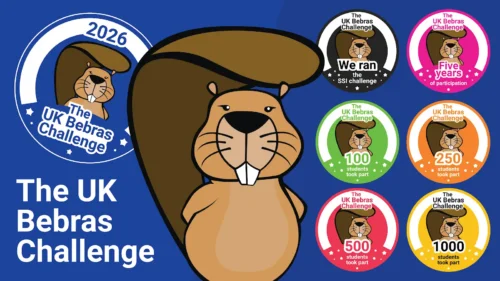
A significant update to the program this year is the introduction of a comprehensive digital badging system designed to recognize the commitment of participating institutions. While individual students have traditionally received certificates—ranging from participation honors to "Gold" certificates for those scoring in the top 10% nationally—the new system focuses on the school as a collective unit.
Schools can now earn digital badges based on participation milestones and longevity. These badges are categorized by the number of students enrolled in the challenge and the number of consecutive years the school has participated. Specifically, a "5 Years" badge is available to honor long-term commitment to computational thinking. Other badges are non-cumulative and reset annually, encouraging schools to maintain high levels of engagement each year. Once the results of the challenge are processed, coordinators are emailed links to download these digital credentials, which can be displayed on school websites, social media platforms, and in newsletters. This gamification of school participation is intended to foster a sense of pride and healthy competition between educational institutions, ultimately driving higher student engagement.
Integration with the Ada Computer Science Platform
To bridge the gap between solving fun puzzles and understanding formal computer science, the UK Bebras Challenge has deepened its integration with the Ada Computer Science platform. Ada is a free online learning resource for teachers and students, developed by the Raspberry Pi Foundation and the University of Cambridge.
Every task within the Bebras Challenge is now explicitly linked to a corresponding topic on the Ada platform. After the live challenge window concludes, teachers can use these links to guide students through the underlying theory. For example, a puzzle involving a series of instructions to move an object might be linked to the concept of "Algorithmic Thinking" or "Sequence and Iteration." This provides a seamless transition from intuitive problem-solving to academic mastery, allowing the Bebras Challenge to function not just as a one-off event, but as a diagnostic tool and a springboard for a full year of learning.
Pedagogical Impact: Perspectives from the Frontline
The impact of the challenge is best articulated by the educators who implement it in their classrooms. Jonathan Phillips, a teacher at Hereford Cathedral School, noted that the challenge provides a unique environment for students to apply problem-solving skills outside of the standard curriculum. "The UK Bebras challenge provides an engaging way for students to apply their problem-solving skills in a fun, competitive environment," Phillips stated. "It complements our coding curriculum, encouraging critical thinking and enhancing computational thinking."
Similarly, Sharon Pendreigh from Brownedge St Mary’s Catholic High School emphasized the broader cognitive benefits of the initiative. "The challenges are designed to push students to think critically and creatively, developing essential problem-solving skills that are applicable both inside and outside of the classroom," she remarked. These testimonials underscore a growing consensus among educators that computational thinking—the ability to break down complex problems and design systematic solutions—is a foundational skill as important as traditional literacy and numeracy.
Technical Analysis of Computational Thinking Tasks
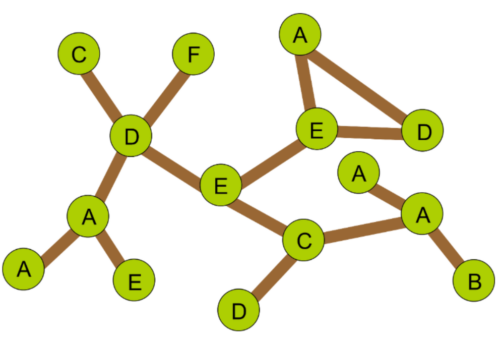
To understand why the Bebras Challenge is so effective, one must look at the design of the tasks themselves. A classic example is the "Park Walk" puzzle, which was featured in the Junior category. In this task, students are presented with a map of a park where trees (vertices) are connected by paths (edges). Some trees share the same label, but the paths are structured such that any walk starting from a specific point can be uniquely identified by the sequence of letters.
From a computer science perspective, this task introduces students to "Graph Theory," a branch of mathematics and informatics that deals with networks. The puzzle requires students to model a real-world scenario (walking in a park) using a symbolic representation (a graph). It also touches upon "Deterministic Finite Automata," as the sequence of letters dictates a specific, unambiguous path through the nodes.
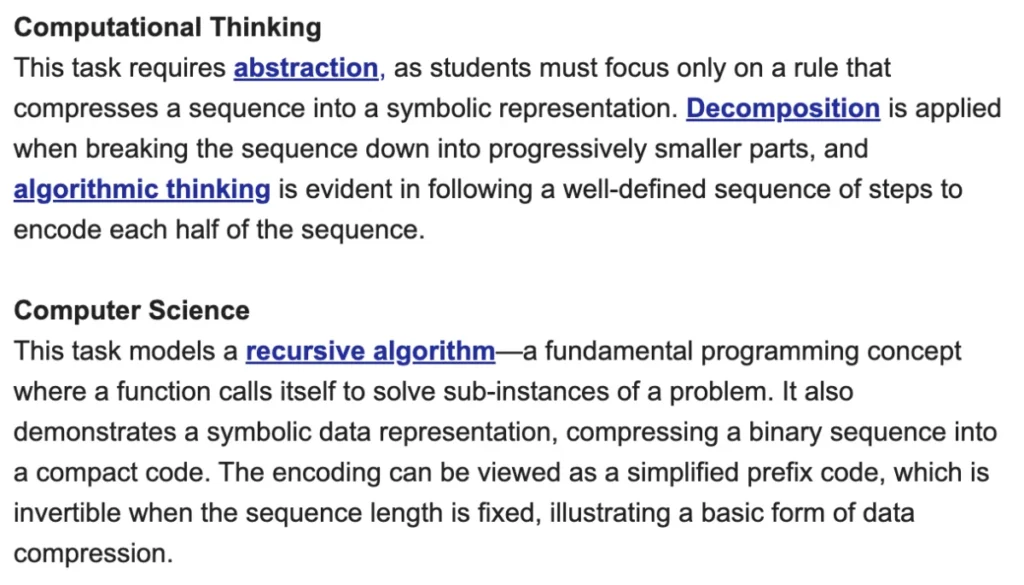
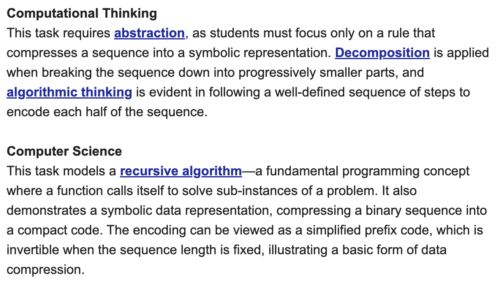
Another common Bebras task involves data compression. Students might be asked to represent a long string of binary code using a shorter set of symbols. This introduces the concepts of "Abstraction" (ignoring irrelevant details to focus on the pattern) and "Decomposition" (breaking the sequence into smaller, manageable parts). By the time a student reaches the "Elite" level, they are tackling tasks that model recursive algorithms—functions that call themselves to solve sub-problems—which are a fundamental concept in professional software engineering.
Chronology and the Path to Participation
The UK Bebras Challenge follows a structured annual timeline to align with the school calendar:
- Registration Phase: Teachers and school coordinators register their institutions on the official Bebras website. Registration is free and grants access to an archive of past questions.
- Preparation and Practice: Using the archive, teachers can create custom quizzes and "warm-up" sessions. These activities are self-marking, allowing students to track their progress and build confidence.
- The Challenge Week: The live challenge typically takes place over a two-week window in November. Students complete the 45-minute task under supervised conditions in their schools.
- Results and Certification: Following the challenge, results are processed, and national boundaries for "Gold" certificates are determined. Schools receive their digital badges and student certificates shortly thereafter.
- Post-Challenge Learning: Teachers utilize the links to Ada Computer Science to explore the concepts behind the puzzles, turning the competition into a comprehensive educational module.
Broader Implications for the UK Economy and Society
The massive scale of the UK Bebras Challenge has significant implications for the nation’s future. As the UK strives to position itself as a "science and technology superpower," the primary bottleneck remains the "skills gap." According to various industry reports, thousands of roles in software development, data science, and cybersecurity remain unfilled due to a lack of qualified candidates.
By engaging over half a million students annually, Bebras helps to widen the "top of the funnel" for the tech industry. It demystifies computer science, showing students that it is not just about writing lines of code in a dark room, but about logic, creativity, and puzzles. This is particularly important for increasing the participation of girls and underrepresented minorities in tech. Research suggests that early exposure to computational thinking in a low-stakes, fun environment can significantly increase the likelihood of students choosing CS-related subjects at GCSE and A-Level.
Furthermore, the skills developed through Bebras—logical reasoning, pattern recognition, and systematic thinking—are highly transferable. Even for students who do not pursue a career in technology, these cognitive tools are essential for navigating an increasingly complex, data-driven world. In an era where artificial intelligence and automation are transforming every sector from healthcare to law, the ability to think computationally is becoming a prerequisite for informed citizenship.
The UK Bebras Challenge stands as a testament to the power of collaborative, accessible education. By transforming complex informatics concepts into engaging puzzles, it has created a national movement that empowers the next generation of thinkers, engineers, and problem-solvers. As registration opens for the new cycle, the expectation is that participation will continue to climb, further cementing the challenge’s role as a cornerstone of the UK’s educational landscape.