The landscape of modern technological advancement, from the vivid displays on the latest smartphones to the high-efficiency solar panels powering the green energy transition, relies heavily on the field of precision optics. For decades, the development of these technologies has been tethered to a grueling process of manual experimentation. Scientists and engineers spend months in darkened laboratories, meticulously adjusting mirrors, lenses, and lasers to measure the optical properties of new materials. This paradigm of "bench-top" science, while foundational, is notoriously slow, physically demanding, and prone to human error. However, a breakthrough from the Massachusetts Institute of Technology (MIT) suggests that the era of manual optical alignment may be drawing to a close.
Researchers at MIT’s Research Laboratory of Electronics (RLE) have developed a reconfigurable, fully autonomous robotic optics laboratory. This system is capable of assembling complex optical setups from scratch, tuning them with micron-scale precision, and even dismantling them to begin new experiments—all without human intervention. By integrating advanced robotics, computer vision, and specialized software, the team has created a platform that could potentially accelerate the pace of scientific discovery by orders of magnitude.
The Architecture of an Autonomous Optics Lab
A traditional optics experiment is often described as a "miniature city." On a vibration-dampened metallic table, dozens of components—lenses, beam splitters, polarizers, and mirrors—are arranged in precise configurations. A single millimeter of misalignment or a fraction of a degree of tilt can render an entire experiment useless. Traditionally, a doctoral student or research scientist would spend hours using manual knobs to "walk" a laser beam into alignment, a process that requires both extreme patience and specialized intuition.
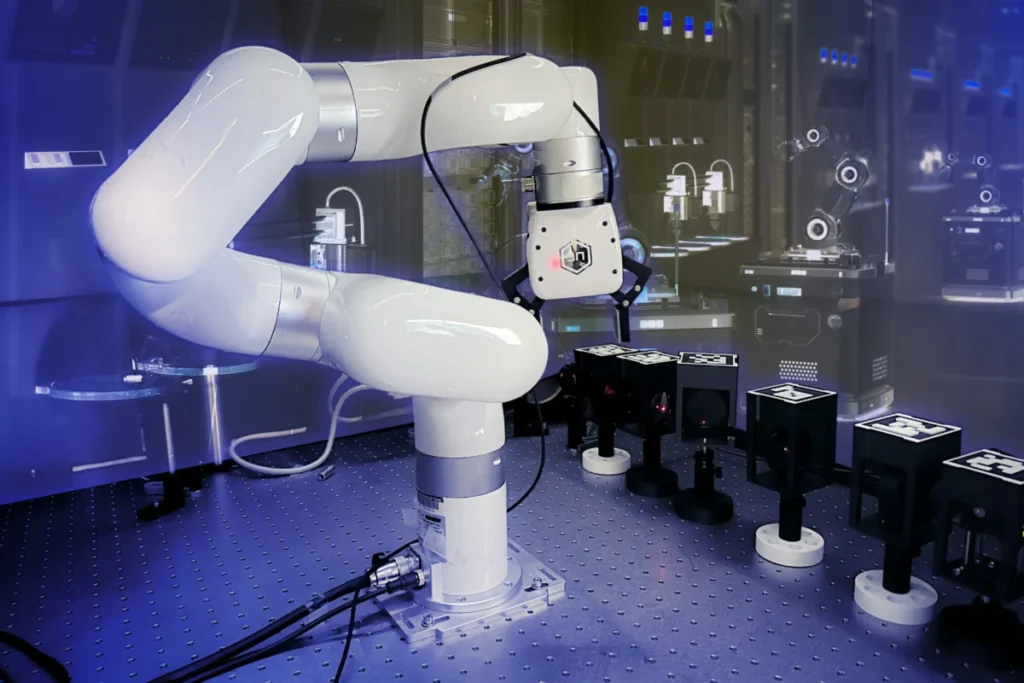
The MIT system replaces this manual labor with a sophisticated hardware and software ecosystem. At the center of the laboratory is a robotic arm equipped with seven moveable joints, providing the dexterity necessary to navigate a crowded experimental space. To make the components "robot-friendly," the researchers developed custom 3D-printed plastic housings for standard optical parts. Each housing features a magnetic base, ensuring that once the robot places a component on the metallic tabletop, it remains securely in place.
Furthermore, each component is tagged with a unique QR code. An overhead camera system scans the workspace, allowing the robot to identify exactly which part it is holding—whether it is a concave lens or a high-reflectivity mirror—and its exact dimensions. This vision system acts as the "eyes" of the laboratory, providing a constant feedback loop that prevents collisions and ensures spatial accuracy.
Precision Tuning and the "Fine-Adjustment Tool"
While placing components is a significant hurdle, the true challenge of optics lies in the "tuning" phase. To address this, the MIT team engineered a specialized, Wi-Fi-enabled fine-adjustment tool. This motorized device clips onto the mounts of standard optical components, essentially acting as a set of robotic fingers that can turn adjustment knobs with sub-micron precision.
"The way humans do this tuning is by feel, and based on a lot of intuition," explained Sachin Vaidya, a postdoc in MIT’s Research Laboratory of Electronics. "This tool is at least as precise as a human, but in reality, it is much more precise."
The software stack developed for the system serves as the "brain," translating high-level experimental goals into specific physical maneuvers. If a researcher wants to center a laser beam through a series of four lenses, the software calculates the optimal path for the robotic arm, identifies the necessary components, places them, and then uses the fine-adjustment tool to reach the target alignment.
Case Study: The Assembly of a Tabletop Laser Cavity
To demonstrate the system’s capabilities, the researchers tasked the robot with building a laser cavity—a fundamental but challenging component in optical physics. A laser cavity requires two mirrors to be perfectly aligned on either side of a gain medium (such as a crystal). Light must bounce back and forth between these mirrors thousands of times, passing through the crystal to amplify its intensity until it reaches the threshold to produce a laser beam.
The alignment of a laser cavity is a benchmark task in optics; it is a skill that typically takes human trainees weeks or months to master. The MIT robotic system, however, completed the task with startling efficiency.
Experimental Chronology:
- Component Identification: The robot scanned the available inventory, identifying the specific mirrors and the crystal required for the cavity.
- Autonomous Placement: The arm executed a series of maneuvers to place the components in a rough linear configuration on the magnetic table.
- Active Alignment: Using the Wi-Fi-enabled tuning tool and real-time feedback from light sensors, the robot performed 50 distinct maneuvers to refine the angles of the mirrors.
- Completion: In just 30 minutes, the system achieved a fully functional, stable laser output.
Beyond mere assembly, the system demonstrated a "self-healing" capability. In many labs, environmental factors like temperature fluctuations or floor vibrations can cause mirrors to drift over time, ruining long-term data collection. When the MIT researchers intentionally disturbed the setup by moving a component, the robot detected the drop in laser intensity and automatically recalibrated the mirrors to restore peak performance.
Data and Comparative Analysis
The implications of this automation are best understood through the lens of laboratory throughput and data reliability. In a traditional setting, a complex experiment might take 48 to 72 hours of active "bench time" to set up and align. If a component fails or needs to be swapped, the process often starts over.
| Feature | Manual Laboratory Setup | MIT Robotic Laboratory |
|---|---|---|
| Setup Time (Laser Cavity) | 3–6 Hours (Expert) / Days (Trainee) | 30 Minutes |
| Precision | Human Intuition / Mechanical Limits | Micron-scale / Motorized Precision |
| Operational Hours | ~8–10 Hours per day | 24/7/365 |
| Remote Accessibility | None (Physical Presence Required) | Full (Cloud-based Interface) |
| Error Recovery | Manual Realignment | Autonomous "Self-Healing" |
By operating 24 hours a day without fatigue, the robotic lab effectively triples the available research time of a standard facility. Furthermore, the precision of the motorized tuning ensures that experiments are repeatable. In manual science, "human variables"—such as how tightly a screw was turned—can lead to subtle discrepancies in data. The robot eliminates these variables, providing a standardized environment for material characterization.
The Vision for a Cloud-Based Scientific Infrastructure
The MIT team, led by Marin Soljacic, the Cecil and Ida Green Professor of Physics, is not looking to just automate a single room. They envision a global shift in how optical research is conducted. The researchers are currently developing a cloud-based application that allows users to access the physical robot from anywhere in the world.
In this future "Optics-as-a-Service" model, a scientist in another country could design an experimental protocol on a virtual interface, submit the query, and have the MIT robot assemble the physical experiment, run the tests, and return the data digitally. This would democratize access to high-end experimental setups, allowing institutions with fewer resources to conduct world-class research.
"A robot isn’t going to get bored," says Professor Soljacic. "It can work 365 days, 24 hours a day, on very boring things. That will free up so much creativity and time for scientists to then push theories and see what we can do. Science could progress much faster."
Analysis of Broader Implications
The introduction of autonomous robotics into optics is part of a broader trend known as "Self-Driving Laboratories" (SDLs). While SDLs have already begun to transform synthetic chemistry and genomics, optics has remained a manual stronghold due to the extreme sensitivity of light-based measurements.
Impact on Consumer Electronics
The consumer electronics industry is currently in a race to develop next-generation augmented reality (AR) and virtual reality (VR) goggles. These devices require incredibly complex waveguide optics that are difficult to prototype. An autonomous lab could iterate through hundreds of different lens and mirror configurations in the time it currently takes a human team to test five, potentially shaving years off product development cycles.
Advancements in Climate Technology
The MIT researchers are already applying their system to the field of sustainability. They are using the robotic lab to test carbon-capture materials. By shining specific wavelengths of light at new material candidates, they can observe how effectively these substances absorb carbon dioxide. The speed of the robot allows them to screen a vast library of materials that would have been impossible to analyze manually.
The Future of Scientific Labor
While the automation of laboratory tasks often raises concerns about the displacement of human researchers, the MIT team argues that it will instead elevate the role of the scientist. By removing the "tedious and physically exhausting" aspects of the job, researchers can focus on high-level hypothesis generation and data interpretation. The robot becomes a tool—much like the computer replaced the slide rule—allowing the human mind to operate at a higher level of abstraction.
Conclusion and Research Support
The MIT team is scheduled to present the comprehensive details of their robotic system at the Intelligent Robots and Systems (IROS) conference later this month. The project is a multidisciplinary effort involving co-leads Seou Choi, Sachin Vaidya, and several others from MIT, alongside collaborators from Nokia Bell Labs and Arizona State University.
The research has garnered significant support from a diverse range of institutions, reflecting its broad potential impact. Funding was provided by the Korea Foundation for Advanced Studies, the U.S. National Science Foundation (NSF), the U.S. Army Research Office, and private contributors including Shell International Exploration and Production Inc.
As the system moves from a proof-of-concept to a standard laboratory tool, it represents a fundamental shift in the scientific method. By bridging the gap between digital design and physical experimentation, the MIT robotic optics lab is poised to become the backbone of a new, high-velocity era of discovery, where the only limit to scientific progress is the speed of human imagination, rather than the steadiness of a human hand.