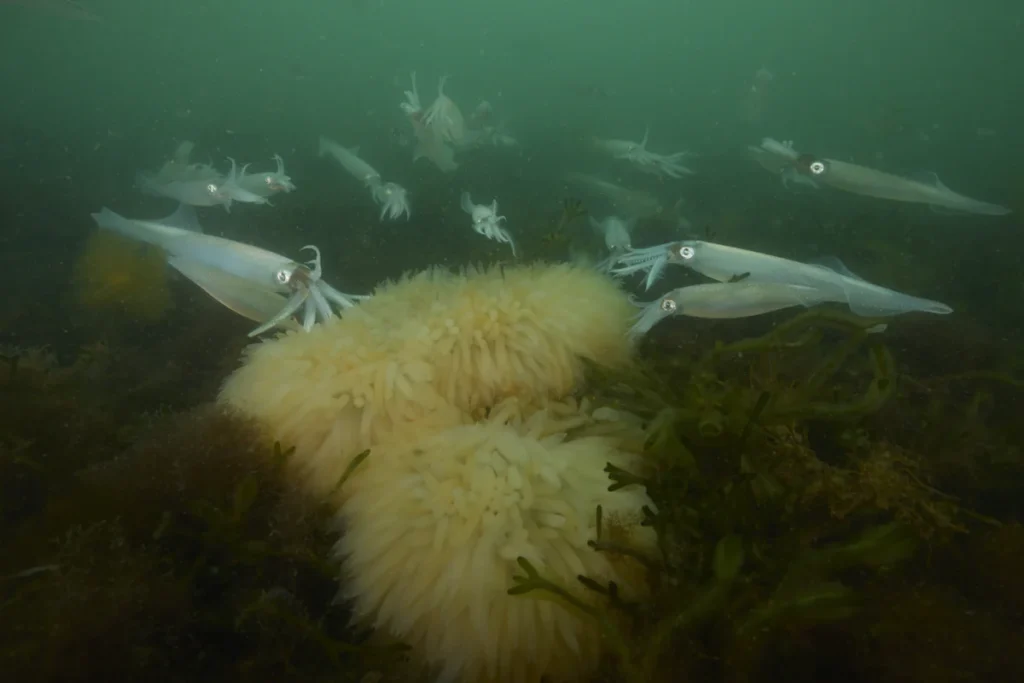
For centuries, the depths off New England’s coast have been a canvas for maritime legends, populated by tales of strange, tentacled creatures that captured the imagination of fishermen and naturalists alike. From widely publicized giant squid reports in the 1800s to the more common encounters with smaller, yet equally fascinating, cephalopods, the ocean’s mysteries have long beckoned. Today, a particular species, the longfin inshore squid (Doryteuthis pealeii), affectionately known as the "Boston squid," continues this legacy, proving to be not only a vital component of the region’s commercial fisheries but also a creature of remarkable biological complexity, its life cycle unfolding in the turbid, nutrient-rich emerald green waters off Massachusetts.
A Photographer’s Odyssey into the Emerald Depths
The quest to capture the hidden life of the longfin squid has drawn individuals like Keith Ellenbogen, a distinguished resident artist with MIT Sea Grant and an acclaimed underwater photographer. Ellenbogen is intimately familiar with these challenging waters, where visibility rarely extends beyond 20 feet on a good day, often far less. Despite his extensive experience and dedication, these swift, elusive cephalopods evaded his lens for many months, presenting a formidable photographic challenge that underscored their natural agility and the difficulty of observing marine life in their natural, often dimly lit, habitat. His years-long pursuit culminated in a remarkable breakthrough in 2023, following extensive collaboration with a network of local fishermen who helped pinpoint concentrations of squid beneath the surface. Ellenbogen chartered a vessel, embarking on a meticulous search for the species’ crucial spawning grounds. Even with precise coordinates, locating a cluster of eggs and the attendant squid 30 to 40 feet below the surface in the limited visibility of Cape Cod’s coastal waters was far from guaranteed.
Ellenbogen recounted his descent: “As I descended through the emerald-green waters of Cape Cod, I couldn’t see anything at first. I knew I was in the right area, but the seafloor seemed empty. Then I noticed a few faint shadows moving in the distance.” What began as an indistinct blur slowly resolved into a vibrant, bustling scene. “First came the squid, then the egg masses, and then hundreds more animals appearing out of the green water. Suddenly I found myself surrounded by squid flashing colors, courting, competing, and spawning,” he described. “It felt like being in a theater, watching a carefully choreographed performance unfold all around me.” This rare glimpse into the secret world of the longfin squid offered an unparalleled view of their intricate reproductive rituals, a spectacle typically concealed from human eyes.
The Economic Pulse of the "Boston Squid" Fishery
Beyond their captivating biology, longfin squid play a critical role in the economic fabric of Massachusetts. Consistently ranked among the top 10 commercially landed species in the state, alongside iconic catches like the American lobster, Atlantic surf clam, and sea scallop, the longfin squid underscores the enduring significance of its presence in the regional seafood industry. The value of this fishery is substantial, reflecting both the demand for the species and the industrious efforts of the local fishing fleets.
In 2023, Massachusetts commercial fisheries landed an impressive volume of longfin squid, exceeding 2.85 million pounds. This translates to an estimated 6 million individual squid, generating a significant economic impact with a value surpassing $2.82 million. This robust performance highlighted a period of exceptional abundance for the species. However, the subsequent year brought a dramatic shift. Preliminary data for 2024 indicated a sharp decline in landings, plummeting to under 750,000 pounds – roughly a quarter of the previous year’s catch. This stark reduction was corroborated by scientific surveys; the spring 2024 trawl survey, detailed in the Massachusetts Division of Marine Fisheries Annual Report, documented a historic low in longfin squid biomass, following the record high observed in 2023.
Understanding Population Dynamics: A Tale of Fluctuations
While such a precipitous drop in landings and biomass might typically signal alarm for a species, experts caution against premature conclusions regarding the long-term health of the longfin squid population. Kimberly Hyde, a biological oceanographer with the National Oceanic and Atmospheric Administration (NOAA)’s Northeast Fisheries Science Center (NEFSC), emphasizes that longfin squid are known for their highly variable abundance from year to year. This inherent unpredictability is largely attributed to two key biological factors: their remarkably short lifespan and their acute sensitivity to shifting ocean conditions.
Longfin squid live fast and die young, typically completing their life cycle within a mere six to nine months. This abbreviated existence means that environmental fluctuations – changes in water temperature, nutrient availability, or the presence of predators – can have immediate and dramatic impacts on population numbers within a single generation. A particularly favorable year can lead to a boom, while slightly adverse conditions can result in a significant bust, creating the observed "rollercoaster" effect in biomass and catch data. Such species require nuanced management strategies that account for these natural oscillations rather than assuming every downturn signals a crisis.
The Elaborate Ritual of Spawning
Ellenbogen’s photographic journey culminated in witnessing the longfin squid’s most critical life event: spawning. The scene he described was one of intense, coordinated activity. Dozens of squid hovered in a circular formation, arms and tentacles outstretched toward the focal point: a large, pale cluster of eggs firmly anchored to a bed of slipper shells and fingerlike seaweed. Thousands of gelatinous, translucent egg capsules swayed gently in the current, each a delicate cradle for the next generation. From the periphery of this gathering, male and female pairs emerged with almost ceremonial precision, darting inward to deposit and fertilize eggs. Their alien-like bodies pulsed and flickered with an astonishing array of colors—flares of rust-red, golden yellow, iridescent pink, and flashes of lightning white—a vibrant testament to the culmination of their brief lives in this vital act of reproduction.
Longfin squid exhibit incredible exponential growth throughout their lifespan. They hatch from these gelatinous egg capsules as minuscule planktonic paralarvae, approximately 1.5 millimeters long, already bearing the simplified form of their adult counterparts. These fast-growing juveniles feast on planktonic prey in coastal surface waters, gradually moving deeper as they mature. As natural-born ambush and pursuit predators, they employ jet propulsion and their ten grasping arms and tentacles to hunt small crustaceans, other invertebrates, and even other squid, establishing their place in the marine food web.
Masters of Disguise and Communication
One of the most captivating aspects of squid biology is their mastery of camouflage and communication through rapid color changes. Like their octopus relatives, squid possess specialized chromatophore organs—pigmented cells controlled by an intricate network of nerves and muscles via their central nervous system. The swift contraction or dilation of these sacs results in mesmerizing shifts in iridescence and color. This dynamic color-changing ability serves multiple crucial purposes: camouflage to evade predators or ambush prey, intricate displays for courtship, and a complex visual language for communication within their species.
Adding an intriguing layer to this phenomenon, squid themselves are effectively colorblind. While their eyes are exquisitely adapted to detect contrast, brightness, movement, and even polarization of light, they do not perceive hues in the same way humans do. Despite this, their communication relies heavily on these visual signals. A 1999 paper published by the Marine Biological Laboratory meticulously cataloged 34 distinct visual displays, encompassing various colors, brightness levels, spots, stripes, iridescence, and polarization signals. Furthermore, researchers identified 17 specific positions and movements employed by squid on the spawning grounds. For example, squid were observed flashing white as a signal to repel rivals, almost exclusively when engaged in mate guarding, egg laying, or competitive confrontations. Interestingly, female squid can also display a dark patch on one side of their mantle, akin to a human blush, which functions as a repellent to courting males. Despite these detailed observations, much of squid communication remains an "encrypted secret," underscoring how much more there is to learn about these intelligent invertebrates.
Life Cycle and Reproductive Strategies
Nearing adulthood, longfin squid undertake a migration offshore, overwintering in deeper, warmer waters along the continental shelf. At night, they form large schools, grouped by body size, and move upward in the water column to feed. Their growth remains rapid and is temperature-dependent, with males typically growing faster and larger than females.
Longfin squid are continuous spawners, reproducing year-round, though with distinct seasonal and geographic peaks. In New England waters, spawning activity is predominantly reported from May to August. The egg clusters, or "mops," like the one Ellenbogen photographed, serve as central hubs for these reproductive gatherings. According to NOAA Fisheries, female squid meticulously lay fertilized egg capsules, each containing approximately 150 to 200 eggs, in these clusters attached to the ocean bottom. A typical female will return repeatedly over several weeks to deposit multiple clutches, ultimately laying a total of 3,000 to 6,000 eggs.
Spawning often occurs in seasonal pulses linked to water temperature and other environmental conditions, sometimes triggering massive spawning aggregations—dense gatherings where individuals are constantly interacting. The reproductive biology and behavior of longfin squid are further complicated by unique strategies. The NEFSC report highlights that females can store sperm from previous spawning events for later use. Moreover, eggs within the same capsule from a single female may be fertilized by sperm from multiple males across various spawning events, enhancing genetic diversity.
Mating competition is intense, guided by a sophisticated interplay of visual and chemical signals, including pheromones indicating reproductive readiness, rapid color and pattern changes, and specific arm postures and whole-body displays. Larger males, known as "consort males," often pair with a single female during spawning, guarding her with their arms and using their size to deter rivals. In contrast, smaller, unpaired males, termed "sneaker males," employ stealth and speed to circumvent the consorts and secure a mating opportunity with paired females. Males deposit bundles of spermatophores into the female’s mantle cavity or a specialized pouch near her head, ensuring fertilization.
Collaborative Research and Future Implications
The inherent unpredictability of longfin squid populations, coupled with their economic and ecological importance, has spurred increased scientific interest and collaborative research efforts. Kimberly Hyde notes that NEFSC research scientists have significantly expanded their squid research over the past few years, including a dedicated two-year study focused on longfin squid to gain a deeper understanding of their life history, track their maturity, and assess their readiness to spawn.
Across the Northeast, scientists are actively collaborating with the fishing industry, recognizing the invaluable practical knowledge held by those who interact with these species daily. These cooperative initiatives include the Longfin Squid Biological Sampling Program (SQUIBS), the Collaborative SQUid Size Monitoring (SQUISM), and the "Squid-Squad"—a highly interdisciplinary team comprising scientists, industry members, and managers. Their common goal is to enhance squid science, ensuring that management strategies are informed by the best available data and a comprehensive understanding of these complex marine animals. Such collaborations are vital for developing sustainable fisheries practices, especially for species with highly variable populations.
As Keith Ellenbogen’s stunning photography attests, the longfin squid remains a creature of profound mystery and beauty. “Keith’s rare glimpse of squid in their natural environment beautifully bridges art and science, reminding us that we still have much to learn,” says Hyde. For many, squid are known primarily as a culinary delight or as shadowy figures from maritime lore. Yet, each spring, beneath the cool, emerald waters of Cape Cod, millions of longfin squid gather in this remarkable, vibrant reproductive event. It serves as a powerful reminder of the rich biodiversity and extraordinary productivity that characterizes Massachusetts’ marine ecosystems.
MIT Sea Grant actively supports sustainable fisheries and champions environmental education and stewardship of our vital coastal and ocean resources. Keith Ellenbogen, in his role as resident artist, is dedicated to a long-term project documenting the extraordinary species and ocean events unfolding just off our coast. His work reveals hidden moments that few ever have the opportunity to witness, transforming abstract scientific data into tangible, compelling visual narratives. The longfin squid stands as one of the region’s most valuable marine resources, and images such as Ellenbogen’s are crucial in revealing the intricate, beautiful, and often unseen events that shape its existence, urging continued research, conservation, and appreciation for the complex life thriving just beyond our shores.