Astronomers utilizing the James Webb Space Telescope (JWST) have identified a celestial phenomenon that challenges the traditional boundaries between stars and black holes, potentially solving one of the most persistent mysteries of the early universe. A research team led by the Massachusetts Institute of Technology (MIT) has detailed the discovery of a "black hole star"—an exotic object featuring a central black hole roughly 100,000 times as massive as the sun, encased within a gargantuan envelope of hydrogen gas the size of our entire solar system. This discovery, centered on an object designated MoM-BH*-1, provides a compelling explanation for the "little red dots" that have populated JWST’s deep-field images since the observatory began its mission.
The study, published by a collaborative group including lead author Rohan Naidu, a NASA Hubble Fellow and Pappalardo Fellow at MIT’s Kavli Institute for Astrophysics and Space Research (MKI), suggests that our understanding of the infancy of the cosmos is shifting rapidly. The object in question represents a "mirage" of sorts—a source so bright it was initially mistaken for an entire galaxy, but which now appears to be a singular, monumental entity powered not by nuclear fusion, but by the gravitational pull of a massive black hole.
The Mystery of the Little Red Dots
Since the James Webb Space Telescope first began transmitting data in 2022, astronomers have been puzzled by the ubiquity of small, crimson-hued pinpricks of light in the distant reaches of space. These "little red dots" appear in nearly every deep-space observation targeting the early universe, specifically the era occurring just a few hundred million years after the Big Bang. While they are prevalent in the ancient past, they are notably absent from the modern, local universe.
The nature of these dots has sparked intense debate within the astrophysical community. Some researchers hypothesized they were extremely compact galaxies teeming with old stars, while others suggested they were obscured quasars—active black holes hidden behind thick veils of cosmic dust. However, the data gathered by the MIT-led team suggests a third, more exotic possibility: the black hole star.
"These little red dots seem to be everywhere in the early universe but essentially disappear by the present day," Naidu noted. "What exactly these objects are has been one of the most debated topics of the JWST era." The discovery of MoM-BH*-1 offers a blueprint for understanding these objects, suggesting they are a transitional phase of cosmic evolution that only existed when the universe was young, dense, and rich in pristine hydrogen.
The Mirage or Miracle Survey
The discovery was made as part of a JWST survey titled "Mirage or Miracle" (MoM). The primary objective of the MoM survey was to identify and characterize the most distant galaxies in existence to understand how the first structures in the universe formed. In the early stages of JWST’s operation, astronomers were shocked to find an abundance of extremely bright galaxies at redshifts corresponding to just a few hundred million years after the Big Bang. According to standard cosmological models, galaxies of such brightness and maturity should not have had enough time to form so early.
This discrepancy led to the "Miracle" vs. "Mirage" framework. If these objects were truly massive galaxies, they were a "miracle" that required a rewrite of cosmological history. If they were something else—smaller objects masquerading as giant galaxies due to some unknown physical process—they were a "mirage."
MoM-BH*-1 stood out as a primary candidate for investigation. It appeared as a singular, intensely red, and incredibly bright dot. Initial observations suggested it could be a galaxy containing billions of stars, but as the team scrutinized the light spectrum, the "miracle" of a giant early galaxy began to look more like a "mirage" of a different kind.
Decoding the Spectral Signatures
To determine the true nature of MoM-BH-1, the researchers analyzed its light using spectroscopy, a method that breaks light into its component wavelengths to reveal the chemical composition and physical state of the source. Two specific features of the light from MoM-BH-1 defied conventional explanation.
First, the team looked at the redness of the object. In astronomy, redness is often attributed to "extinction" by dust. Much like how smoke from terrestrial wildfires can turn the sun a deep crimson by scattering shorter blue wavelengths of light, cosmic dust can make blue stars appear red. Robert Simcoe, the Director of MKI and the Bruno B. Rossi Professor of Experimental Physics, explained that while dust was a possible culprit, the specific signatures of dust-reddening did not align perfectly with the data.
Second, and more importantly, the team identified a "Balmer break." This is a sharp drop-off in light intensity at specific wavelengths, caused by dense hydrogen gas absorbing photons. While Balmer breaks are common in the atmospheres of stars like Vega, the break observed in MoM-BH*-1 was unprecedented.
"The break we observed in this object is the deepest break we have ever observed in any object, ruling out ‘ordinary’ stars as the source," Naidu stated. This indicated that the light was passing through a screen of hydrogen so dense it behaved like a stellar atmosphere, but on a scale far beyond any known star. Furthermore, the spectrum showed an almost total absence of "metals"—astronomical shorthand for any element heavier than hydrogen and helium. This lack of chemical complexity is a hallmark of the very first generation of objects in the universe.
The Architecture of a Black Hole Star
Faced with a source that was too bright to be a single star but too chemically pure and structurally unique to be a standard galaxy, the team turned to computer simulations. They sought to create a model that could produce the observed red light and the deep Balmer break using only hydrogen and helium, without the presence of dust.
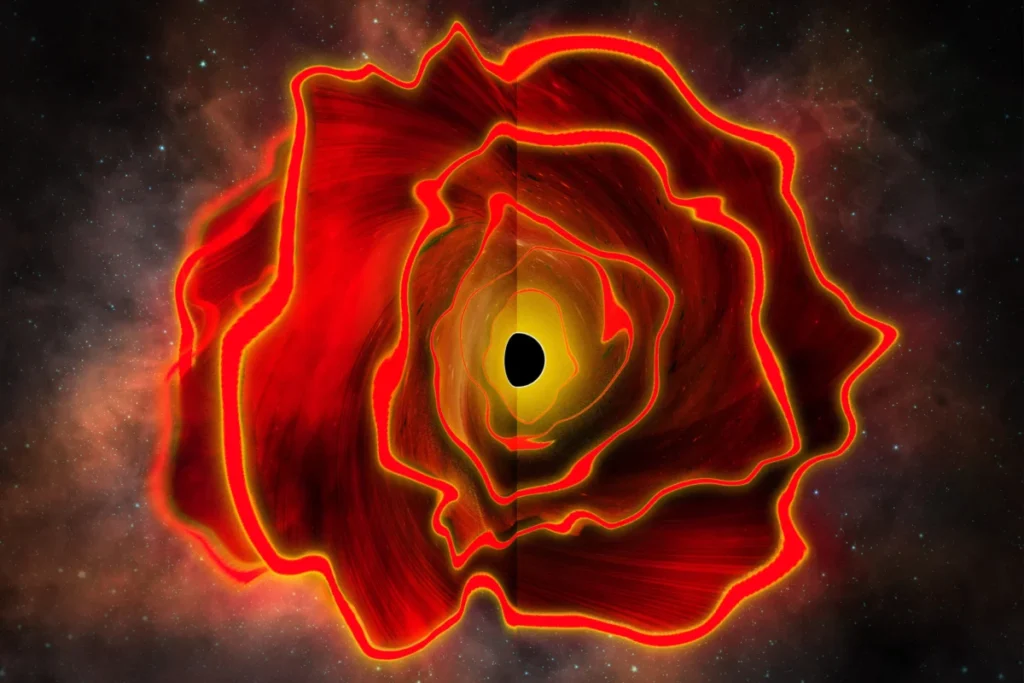
The simulations revealed a startling possibility: a hybrid object. At the center lies an intermediate-mass black hole, approximately 100,000 times the mass of the sun. This black hole is actively accreting matter, a process that releases staggering amounts of energy—roughly 100 billion times the luminosity of the sun.
In a typical quasar, this energy would be visible as high-energy X-rays or ultraviolet light. However, in the case of MoM-BH*-1, the black hole is trapped within a colossal, dense cocoon of hydrogen gas. This "envelope" is so large that it spans the diameter of our solar system. The hydrogen absorbs the intense radiation from the central black hole and re-emits it at longer, redder wavelengths, creating the appearance of a giant, cool star.
Because the energy is provided by gravitational accretion rather than nuclear fusion, the object can maintain a brightness that would be physically impossible for a star of that size. This explains why MoM-BH*-1 outshines its entire host galaxy, allowing astronomers to see the "pure" light of the black hole star without interference from surrounding stellar populations.
Chronology of the Discovery and Research
The identification of MoM-BH*-1 is the result of a multi-stage research effort that began shortly after JWST’s first data release:
- July 2022: JWST releases its first deep-field images, revealing an unexpected number of "little red dots" in the high-redshift universe.
- Late 2022 – Early 2023: The "Mirage or Miracle" survey is initiated by Naidu and colleagues to investigate whether these bright sources are massive early galaxies or individual exotic objects.
- Mid-2023: MoM-BH*-1 is identified as a unique target due to its extreme brightness and spectral anomalies.
- Late 2023: Advanced spectroscopic analysis and simulations are conducted at MIT, ruling out dust-obscured galaxies and confirming the "black hole star" model.
- 2024: The team publishes their findings, proposing that MoM-BH*-1 is the first confirmed member of a class of objects that could explain the LRD phenomenon.
Implications for Cosmology and Black Hole Growth
The discovery of MoM-BH*-1 has profound implications for our understanding of how the universe’s largest structures began. One of the greatest mysteries in modern astronomy is the "supermassive black hole problem": how did black holes with billions of solar masses form so quickly after the Big Bang?
Standard models suggest black holes grow slowly by consuming gas and merging with other black holes. However, JWST has found supermassive black holes existing so early that there shouldn’t have been enough time for them to grow to such sizes. MoM-BH*-1 may represent the "missing link" or the "seed" of these giants. A black hole that starts at 100,000 solar masses—likely formed by the direct collapse of a massive gas cloud rather than the death of a single star—has a significant "head start" in reaching supermassive status.
Furthermore, the existence of black hole stars suggests that the early universe was a much more violent and exotic place than previously thought. If the "little red dots" are indeed black hole stars, it means the early universe was populated by massive "seeds" that eventually grew into the supermassive black holes found at the centers of galaxies like our own Milky Way.
Scientific Consensus and Future Observations
The MIT-led research has been met with significant interest from the global astronomical community. While the "black hole star" model fits the current data from MoM-BH*-1, researchers emphasize that more observations are needed to determine if all "little red dots" share this nature.
The Space Telescope Science Institute (STScI) and NASA have indicated that upcoming observation cycles for JWST will likely include more targeted spectroscopic studies of these objects. By examining the light from a larger sample of red dots, astronomers hope to confirm whether MoM-BH*-1 is a unique outlier or the first of a common population of cosmic hybrids.
This research was supported by the MIT Department of Physics, NASA, and the Space Telescope Science Institute. As the JWST continues to peer further into the past, the "evolving picture" described by Naidu and his team promises to reshape the fundamental narrative of cosmic dawn, turning what were once thought to be miracles of galaxy formation into a new understanding of the power of black holes.