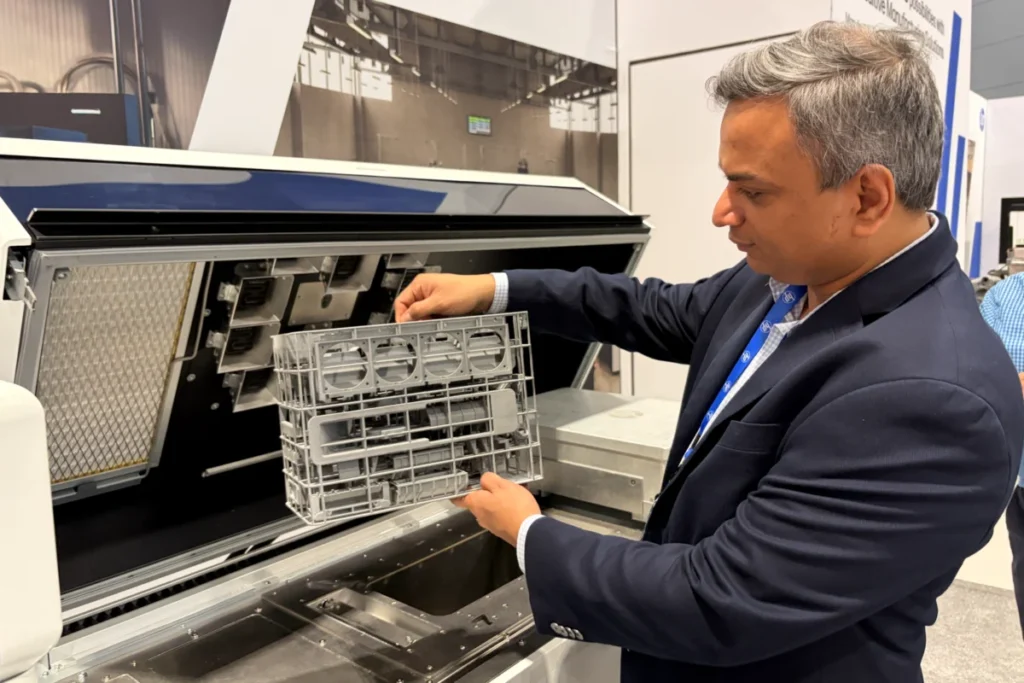
The International Manufacturing Technology Show (IMTS) 2026, held biennially at Chicago’s McCormick Place, served as a pivotal platform for the additive manufacturing (AM) sector to showcase its rapid evolution. This year, the Additive Sector’s relocation to the South Building, adjacent to the established Metal Removal Sector, underscored its growing significance and integration within the broader manufacturing ecosystem. For editors of Additive Manufacturing Media, the event offered a crucial vantage point, not only for observing AM-specific advancements but also for understanding its synergy with complementary technologies like CNC machining, inspection, parts cleaning, artificial intelligence, and robotics.
The show illuminated several key trends and one significant challenge within the AM landscape, pointing towards a future where the technology is more accessible, efficient, and integrated into mainstream production.

OEMs Embrace Part Production: Bridging the Gap from Machine to Market
A dominant theme at IMTS 2026 was the increasing commitment of additive manufacturing equipment Original Equipment Manufacturers (OEMs) to direct part production. This strategic shift signifies a maturation of the AM market, moving beyond solely selling machinery to offering comprehensive solutions that include manufacturing services. This approach addresses a critical barrier for many potential adopters: the perceived complexity and investment required to integrate AM technology in-house.
Hermle, a notable player in the machinery sector, exemplified this trend by showcasing parts produced through its Metal Powder Application (MPA) process. This hybrid manufacturing technique, offered as a service, allows for the creation of multi-material components with graded transitions and layered materials. Applications range from intricate injection mold tooling to specialized electromagnetic shielding for drones and sophisticated satellite components. The demand for such complex parts, capable of solving challenging engineering problems, has naturally driven Hermle to offer MPA as a direct production service.
Velo3D, a leader in laser powder bed fusion (LPBF) technology, has further solidified this trend with the opening of its Livermore production campus, Forge 1. This facility not only manufactures Velo3D printers but also undertakes customer part production. Sid Raje, Director of Sales and Business Development at Velo3D, explained the strategic rationale: "It’s about meeting the customer where they are." He highlighted that not all manufacturers possess the necessary space, personnel, or inclination to invest in and operate their own 3D printing facilities. By offering production as a service, Velo3D aims to expand the overall AM market by easing customer entry. This allows businesses to explore additive manufacturing with reduced initial investment and accelerated timelines, leveraging Velo3D’s expertise and infrastructure. Raje emphasized that "The machine OEM has the most levers to pull" in process development, making their contracting arms the most efficient route to production for many.

Similarly, EOS Additive Minds, a division of the German AM giant EOS, is increasingly engaging in turnkey projects designed to "de-risk the path to production." While EOS has a long history of supporting proof-of-concept and proof-of-process development, they are now extending their services to "proof-of-production." Their Texas facility is actively supporting initial and bridge production for select customer programs, with a clear strategy to avoid becoming a large-scale contract manufacturer. Gregory Hayes, Senior Vice President of Global at EOS Additive Minds, stated, "There’s always an exit plan," typically involving a handover to the customer or another contractor within 8 to 18 months. This approach allows EOS to validate production viability while fostering the growth of their customer’s internal AM capabilities.
The trend extends to other AM technologies as well. Formalloy, a Directed Energy Deposition (DED) equipment supplier, has also established a new facility that integrates machine construction with part production services. CEO Melanie Lang confirmed that while Formalloy remains primarily a printer OEM, they’ve witnessed a significant surge in demand for their services, particularly for new programs. "Customers want us to do the initial qualification," Lang noted, which accelerates development cycles, often leading to a subsequent handover for scaled manufacturing. Formalloy’s powder-fed DED process facilitates multimaterial printing, and the company is actively developing software tools to enable engineers to design parts with functionally graded materials (FGMs), such as a blisk (blade-disk) component transitioning from stainless steel 316L to Inconel 625.
Technological Advancements Accelerate User Adoption and Efficiency
Beyond the shift towards production services, a concurrent trend at IMTS 2026 was the development of technologies that simplify the initial setup, calibration, and programming of AM machines. This focus on user experience is crucial for broadening the adoption of additive manufacturing across a wider range of industries and user skill levels.

EOS has implemented powderless acceptance tests for its LPBF systems. This innovative approach allows for the verification of a new printer’s scanners and lasers upon delivery without the need for material, thereby eliminating powder handling steps and preventing material waste.
Renishaw highlighted its Optical System Verification (OSV) solution, designed to streamline ongoing machine calibration. The OSV kit for their RenAM 500 series employs a plate with 169 hemispheres, arranged in a 13×13 grid. When placed on the machine’s heater plate, a dedicated software program allows users to calibrate the system’s lasers within approximately 20 minutes, ensuring consistent positional accuracy across the powder bed. This regular verification process is critical for maintaining part quality and repeatability.
Software development is also playing a pivotal role in simplifying the build preparation and slicing processes. Arvind Rangarajan, Global Head of Product and Strategy at HP Additive Manufacturing Solutions, emphasized user-friendliness as a core design principle for the software driving HP’s MJF 1200. Developed in collaboration with Materialise, Magics Print for HP offers a guided workflow aimed at minimizing clicks and accelerating the path to finished parts. This user-centric design is particularly relevant for the MJF 1200, scheduled for release in 2027, which is anticipated to be deployed in less industrial environments like offices and design studios.

For manufacturers managing multiple machines, potentially from different vendors, advancements in software interoperability are equally significant. Thomas Pomorski of Ursa Major shared insights into their work with Dyndrite to develop a customizable slicer named Polaris. This Python library, built upon Dyndrite’s geometry toolpath engine, can adapt a design to specific machine parameters for various LPBF systems, including those from EOS, SLM Solutions, Velo3D, and Aconity. This capability mirrors the function of G-code postprocessors in CNC machining, offering a significant step towards a more unified and adaptable AM workflow.
Robotic Systems Enhance Flexibility and Scalability in Large-Format AM
The integration of robotics into large-format additive manufacturing (LFAM) systems continues to evolve, offering enhanced flexibility, process control, and scalability. At IMTS 2026, companies like Caracol and Rapid Fusion showcased advanced extrusion heads and modular systems that underscore this trend.
Caracol has consistently leveraged robotics for its LFAM operations. Their Heron AM LFAM platform, demonstrated with a Kuka six-axis robotic arm, utilizes thermoplastic pellet extrusion. The system’s customizable automation and control suite allows for tailored AM processes, while the robotic arm removes limitations related to scale and shape. The Heron AM platform incorporates features such as automatic material feedstock, anti-collision surveillance, layer cooling, and precise control over temperature, melt flow, and extrusion speed. Violetta Nespolo, Chief Marketing and Strategy Officer at Caracol AM, highlighted the benefit of robotics, stating, "Robotics can give clients the flexibility to play around and be creative." Caracol also presented its High Versatility (HV) extrusion head, designed for producing end-use parts in demanding industries like maritime, aerospace, and architectural construction. The HV head’s adjustable nozzle (2-8 mm) accommodates both fine detail work and high-throughput production.

Rapid Fusion’s Apollo system, a fully customizable LFAM solution, features high-speed pellet extrusion, extensive travel capabilities (up to 30 feet), and precise robotic control. Its modular design allows for integration with milling and CNC systems, catering to diverse manufacturing needs. The Rapid Fusion PE320 pellet extruder, compatible with existing CNC machines and robotic cells, offers precise temperature control, essential for processing high-temperature or abrasive materials such as carbon fiber.
Drones Take Flight: A Leading AM Application Driving Innovation
Drone manufacturing emerged as one of the most prominent and dynamic applications of additive manufacturing at IMTS 2026, demonstrating a clear transition from product development to rapid, high-scale production. The Emerging Technology Center prominently featured a drone manufacturing demonstration that integrated additive manufacturing with machining and robotics. This cell produced a drone approximately every four minutes, showcasing the accelerated production scale now achievable, with AM playing a crucial enabling role.
The demonstration involved Prusa 3D printers creating polymer shells, which were then integrated with machined molds, filled with foam pellets and electronics, and heated to form lightweight drone bodies. HP’s Arvind Rangarajan noted that drone applications, initially anticipated to move beyond Multi Jet Fusion (MJF) technology, have instead become a significant growth area. MJF is now instrumental in producing drone bodies, wings, and other components for a wide array of uses, including wildlife surveillance, agriculture, and military applications. He emphasized the "design advantages" and "robust, scalable supply chain" offered by AM, particularly citing HP’s Additive Manufacturing Network for outsourced production, enabling drone OEMs to achieve surge capacity. HP’s offerings span both polymer MJF and Metal Jet binder jetting technologies, with the latter being used for drone engine components.

Impossible Objects showcased its Composite-Based Additive Manufacturing (CBAM) 25 printer, which produces drones from advanced composite materials like carbon fiber PEEK. The CBAM process, resembling high-speed lithography, involves printing patterns onto composite sheets using inkjet technology, followed by uniform application of polymer powder. Layer by layer, these sheets are stacked, heated, and molded into final parts. This process can achieve high speeds (up to 25 layers per minute) and produce parts with strengths up to 200 MPa, while circumventing the high tooling costs associated with traditional manufacturing methods. Impossible Objects has secured five CBAM orders, with applications in aerospace, defense, and advanced manufacturing.
Beyond materials and manufacturing processes, companies are addressing design challenges for drones. Adam Smith of InfinitForm presented a tool in development designed to expedite wing design for fixed-wing drones. He highlighted the urgency driven by programs like the "Drone Dominance Program," which necessitates rapid innovation. InfinitForm’s AI-driven design platform is well-suited to this challenge, capable of generating application-optimized drone wing designs in BREP format, ready for printing within minutes.
"Made in the USA" Initiatives Gain Traction Among OEMs
Against a backdrop of global supply chain volatility and U.S. government directives restricting Chinese-built 3D printers, AM machine builders increasingly highlighted their domestic manufacturing and supply chain efforts at IMTS 2026.

Caracol, an Italian LFAM machine builder, opened its Pflugerville, Texas, facility in September 2025, establishing a North American hub for system integration, technology manufacturing, application development, and support. This localization strategy not only serves U.S. customers more effectively but also mitigates the logistical costs and environmental impact associated with international shipping.
Similarly, EOS, headquartered in Germany, has established production for its M290 and M400-4 metal LPBF machines in Texas. The company is on track to manufacture 48 machines in the U.S. this year and plans to scale its production capacity further. While subassemblies are sourced internationally, the increased domestic production rate allows EOS to secure more favorable component pricing.
Xact Metal, founded in the U.S., emphasizes its custom machine builds in State College, Pennsylvania, primarily utilizing locally sourced subassemblies. This localized supply chain, coupled with strategic parts stocking, enables the company to maintain competitive lead times of just 2 to 3 months for new machines. Their XM200G µHD LPBF machine, utilizing fine powders (5-15 microns), delivers exceptionally smooth surface finishes, finding applications beyond its initial target of mold tooling, now extending to electronics, jewelry, and medical devices.

Velo3D’s printer manufacturing division also benefits from its long-standing internal sourcing policies. Matt Karesh, Head of Defense at Velo3D, noted the impact of legislation like the National Defense Authorization Act, which restricts the use of Chinese equipment for government-funded additive components. He stated, "We’ve intentionally stayed away from all of those adversarial nations, not only from a supply chain perspective, but we also have never sold into them." This deliberate strategy aligns with a growing preference among decision-makers for domestically manufactured solutions.
Postprocessing Automation: Tackling the Bottleneck
As 3D printers become faster and more productive, postprocessing remains a critical bottleneck in the AM workflow. IMTS 2026 featured significant introductions and exhibits focused on automating depowdering, cleaning, and finishing processes for enhanced efficiency and repeatability.
Solukon, a provider of depowdering solutions, showcased its SFM-AT350 system, enhanced by its SPR-Pathfinder Pro software. This software leverages print files to identify internal channels requiring depowdering, generating precise postprocessing plans with time estimations and cross-sectional views. This allows for optimization before printing, ensuring a repeatable and customizable depowdering process. The SFM-AT350 is designed for versatility, compatible with any LPBF 3D printer regardless of brand or size.

Jayco Cleaning Technologies exhibited its Mafac Java, a vacuum-assisted cleaning unit designed for parts with intricate internal features. This system combines fluid spraying with vacuum-assisted processing and an ultrasonic effect to effectively remove powder from internal channels. The Mafac Java’s repeatable recipes and cycle times of 1-4 hours for additive parts contribute to consistent results.
Guyson USA, a specialist in surface finishing systems, presented its postprocessing solutions for 3D printed parts, including its proprietary abrasive blasting systems. In partnership with HP, Guyson developed the MultiBlast3D blasting chamber specifically for parts produced using HP’s Multi Jet Fusion technology. This compact and quiet system incorporates rapid dust removal, optimized settings for HP parts, and a quick-change media system for efficient postprocessing. The MultiBlast3D is also compatible with parts manufactured via Selective Laser Sintering (SLS), Fused Filament Fabrication (FFF), Stereolithography (SLA), and LPBF.
In Progress: Accelerating the Path to Qualification
A final emerging trend observed at and around IMTS 2026 pertains to the acceleration of additive part qualification. EOS and Phase3D announced a partnership to integrate Phase3D’s Fringe Inspection technology into EOS LPBF machines. Fringe Inspection utilizes controlled illumination cameras to measure layer height and monitor surface variations. Phase3D suggests this measurement data has the potential to enable "born qualified" parts. Ongoing projects with entities like Northrop Grumman are underway to validate this capability. The industry’s need for faster qualification methods that reduce reliance on destructive testing remains a key area of development that will be closely monitored. The collective advancements showcased at IMTS 2026 signal a robust and rapidly maturing additive manufacturing sector, poised for broader industrial integration and innovation.