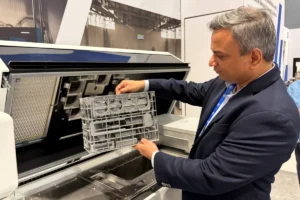
South Korea’s additive manufacturing (AM) firm, Lincsolution, is rapidly expanding its footprint in the aerospace and defense sectors, a strategic move that is gaining significant traction. Following its announcement of establishing one of the largest AM facilities in South Korea, a sprawling over 200,000 square foot complex slated for a December opening, the company has now secured a crucial supply contract with Hanwha Aerospace, South Korea’s premier defense contractor. This development is particularly noteworthy given the broader context of rising AM adoption in South Korea and the nation’s complex position within the ongoing US-China trade war.
The recent contract, while light on specific technical details, centers on the production of lunar lander engines and thrusters. This focus on lunar propulsion systems is significant for several reasons. Firstly, South Korea’s space industry, despite the nation’s prowess in high-tech manufacturing like semiconductor production, has historically been less prominent than its other industrial sectors. The government has identified the commercial space industry as a key growth area, aiming to more than quadruple its global market share from a modest 0.7% to 3.0% by 2030. This contract with Hanwha Aerospace directly aligns with and supports these national aspirations, signaling a tangible step towards greater involvement in advanced space technologies.
The financial scope of the contract, approximately 1.4 billion South Korean Won (around $1 million USD), may appear modest in isolation. However, Lincsolution highlights that this figure represents just under 11% of its reported 2025 revenue. This suggests that while Lincsolution is currently operating on a relatively small scale, its growth trajectory is steep and projected to continue. The company has forecast a near doubling of its 2026 revenue year-over-year, with expectations of another similar surge in 2027. This rapid expansion indicates a strong market demand for Lincsolution’s AM capabilities and a confidence in its ability to scale sustainably in the coming years.
Hanwha Aerospace’s position as South Korea’s largest defense contractor further underscores the strategic importance of this partnership. Lincsolution has indicated that it has fulfilled similar contracts with Hanwha Aerospace for the past three years, suggesting a deep-seated and evolving relationship. The specifics of whether this refers to the type of AM work, contractual terms, or both, remain undisclosed. However, the fact that Lincsolution explicitly mentioned this prior experience highlights the established trust and proven track record between the two entities. The short three-month contract timeframe, spanning from September 30th to December 31st, also suggests a focused, potentially iterative, project phase.
Hanwha’s Expanding Global Footprint and US Investments
The implications of Lincsolution’s contract with Hanwha Aerospace are amplified by Hanwha Defense USA’s significant strategic investments in the United States. Hanwha Defense USA, the American subsidiary of the South Korean conglomerate, is undertaking a monumental $2.2 billion investment in Arkansas. This project involves relocating its headquarters and constructing a state-of-the-art advanced manufacturing campus within the U.S. Army’s Pine Bluff Arsenal. The ambitious construction is slated for completion by 2030, with operations expected to commence the following year. This investment, initially projected at $1.3 billion, saw a substantial increase, reportedly influenced by customer feedback and evolving market demands.
This Arkansas venture is not without precedent for Hanwha. In August, Hanwha Defense USA secured a lucrative contract with the U.S. Army, potentially valued at up to $263 million over four years, for the production and testing of up to 18 prototypes of Self-Propelled Howitzers. The operations at the Pine Bluff Arsenal are set to focus on producing propellant charges for 155mm artillery and base-bleed units, with a strong emphasis on incorporating advanced automation and stringent safety protocols into its manufacturing processes.
Strategic Synergies and Global AM Integration
The timing of Lincsolution’s lunar engine contract announcement, closely following Hanwha’s substantial U.S. investment, is particularly compelling. While Lincsolution’s current contract with Hanwha Aerospace is for the South Korean market, the underlying capabilities are highly relevant to Hanwha’s burgeoning U.S. operations. Lincsolution’s expertise extends to both polymer and metal additive manufacturing, and critically, the company also designs and produces its own Selective Laser Sintering (SLS) 3D printers. Furthermore, its development of expeditionary systems, previously reported, adds another layer of strategic alignment.

Lincsolution’s commitment to meeting the stringent requirements of the defense sector is further evidenced by its pursuit of the U.S. Pentagon’s Cybersecurity Maturity Model Certification (CMMC) program. While Phase 2 of this program is currently in a state of flux, Lincsolution’s proactive engagement signals its ambition to be a key player in the international defense supply chain, not solely confined to the South Korean domestic market.
Adding another layer to this intricate web of strategic alliances and expansions, Hanwha Defense USA also made a significant offer in August to acquire Austal’s U.S. business. Austal USA is a notable entity in its own right, actively involved in the U.S. Navy’s additive manufacturing initiatives. Given that South Korea stands as the world’s second-largest shipbuilding nation, this potential acquisition by Hanwha further highlights the interconnectedness of global defense manufacturing and the increasing role of AM in these critical industries.
Broader Implications for South Korea’s AM Landscape
The confluence of these developments—Lincsolution’s ambitious expansion, its strategic contract with a major defense player, and Hanwha’s significant international investments—paints a vivid picture of South Korea’s rapidly evolving additive manufacturing landscape. The nation is clearly leveraging its technological prowess to carve out a stronger position in high-value sectors like aerospace and defense.
The context of the ongoing US-China trade war adds another critical dimension. South Korea, caught in the geopolitical and economic crosscurrents between these two global powers, is actively seeking to strengthen its indigenous defense and technological capabilities. By fostering domestic AM leaders like Lincsolution and solidifying partnerships with major conglomerates like Hanwha, South Korea aims to enhance its industrial resilience and strategic autonomy. The development of advanced manufacturing hubs and the pursuit of cutting-edge technologies such as those for space exploration and defense are vital components of this strategy.
The increasing adoption of AM technologies within South Korea, as evidenced by Lincsolution’s growth and diversification, signifies a broader industrial shift. AM offers the potential for reduced lead times, greater design freedom, lighter and stronger components, and more agile production capabilities—all critical advantages in the fast-paced aerospace and defense sectors. As Lincsolution continues to build its state-of-the-art facility and forge strategic alliances, its role in shaping the future of South Korean advanced manufacturing is set to become increasingly prominent.
The partnership with Hanwha Aerospace, especially in the context of lunar exploration and advanced defense systems, demonstrates Lincsolution’s growing technical sophistication and its ability to meet the demanding specifications of these critical industries. The company’s proactive engagement with international defense standards like CMMC further signals its global aspirations.
Ultimately, the unfolding narrative of Lincsolution and its collaborations with entities like Hanwha Aerospace serves as a compelling indicator that the South Korean additive manufacturing market warrants closer and more sustained attention. The nation’s strategic investments in AM infrastructure, coupled with its ambition to lead in advanced technological sectors, are positioning it as a significant player on the global stage. The success of these initiatives will not only bolster South Korea’s economic standing but also contribute to its geopolitical resilience in an increasingly complex international environment.