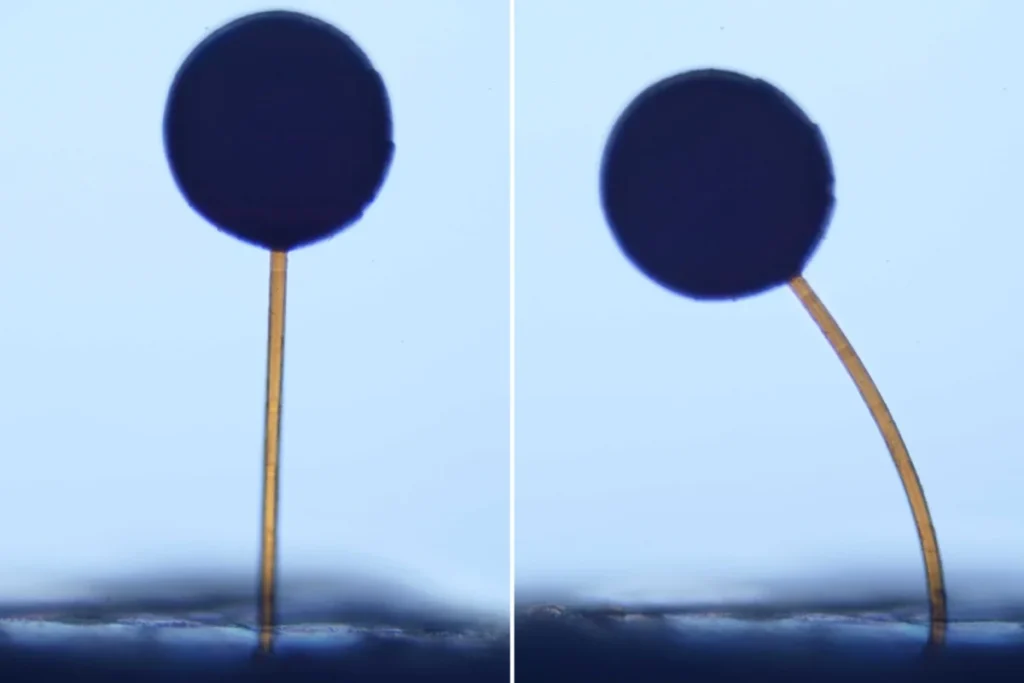
Under the focused gaze of a microscope, a delicate dance unfolds. A cluster of lollipop-shaped structures, each minuscule – smaller than a grain of sand – sway gently within a petri dish brimming with liquid. Then, with an almost imperceptible shift, they snap together, reminiscent of the swift closure of a Venus flytrap. This dramatic transformation from passive components to an active robotic gripper is orchestrated by a scientist artfully maneuvering a small magnet above the dish. This captivating demonstration is a tangible outcome of a groundbreaking new soft magnetic hydrogel, developed by a collaborative effort between engineers at the Massachusetts Institute of Technology (MIT) and their esteemed colleagues at the École Polytechnique Fédérale de Lausanne (EPFL) in Switzerland and the University of Cincinnati. The findings of this pioneering research were recently unveiled in the prestigious journal Matter, detailing a novel method for fabricating complex, three-dimensional structures with magnetic responsiveness at the microscopic scale.
This innovative hydrogel holds the potential to serve as the foundational material for a new generation of soft, microscopic, and magnetically actuated robots and materials. The implications for fields such as medicine are particularly profound. Imagine microscopic magno-bots, guided by external magnetic fields, navigating the human body to precisely deliver therapeutic drugs to targeted cells or to expertly capture minute tissue samples for biopsies, all without invasive surgical procedures. This breakthrough represents a significant leap forward in the burgeoning field of micro-robotics and smart materials.
The principle of using magnets to induce movement is not a novel concept. On a macroscopic scale, it’s a familiar phenomenon: a refrigerator magnet effortlessly drawing a trail of paper clips. Even at the microscale, scientists have previously engineered various magnetic "micro-swimmers" – components less than a millimeter in size that can be remotely steered by magnets to traverse confined spaces. Typically, these existing designs involve embedding magnetic particles within a printable resin, and then applying an external magnetic field to pull the entire structure. However, the material developed by the MIT-led team offers a distinct advantage: the ability to create even more intricate and deformable structures with micron-scale precision. This enhanced capability could empower magnetic millibots to manipulate individual features and execute far more sophisticated maneuvers than previously possible.
"We can now construct soft, intricate three-dimensional architectures with components that possess the ability to move and deform in complex ways, all within the same microscopic structure," explained Carlos Portela, the Robert N. Noyce Career Development Associate Professor of Mechanical Engineering at MIT and a lead author on the study. "For the development of soft microscopic robotics, or stimuli-responsive matter, this represents a truly game-changing capability."
The study’s co-authors from MIT include graduate students Rachel Sun and Andrew Chen. They were joined by Yiming Ji and Daryl Yee from EPFL and Eric Stewart from the University of Cincinnati, underscoring the international and interdisciplinary nature of this significant research endeavor.
A Swift and Precise Response
At MIT, Professor Portela’s research group has been at the forefront of developing novel metamaterials – materials engineered with unique microscopic architectures that endow them with properties beyond those found in conventional materials. His previous work has yielded a diverse array of these advanced materials, including architectures exhibiting exceptional toughness and stretchability, as well as designs capable of manipulating sound waves and withstanding extreme impacts.
More recently, Portela has expanded his research focus to encompass "programmable" materials, materials that can be engineered to alter their properties in response to specific external stimuli, such as particular chemicals, light, or electric and magnetic fields. From the research team’s perspective, magnetic stimuli offer a particularly compelling advantage due to their inherent characteristics.
"With a magnetically responsive material, we achieve control from a distance, and the response is virtually instantaneous," stated Andrew Chen, a co-lead author on the paper. "We don’t have to wait for a slow chemical reaction or physical process to occur. Furthermore, we can manipulate the material without any physical contact." This immediacy and non-contact control are critical factors for applications demanding rapid actuation and precise manipulation at the microscale.
For the current study, the team’s objective was to engineer a magnetically responsive metamaterial capable of being fabricated into structures smaller than one millimeter. The prevailing technique for fabricating such microstructures is two-photon lithography, a high-resolution 3D printing method that utilizes a focused laser to solidify a liquid resin. The laser meticulously traces a microscopic pattern within the resin, solidifying it layer by layer to construct the tiny, three-dimensional object.
However, applying this established 3D resin printing technique to create magnetic structures has presented considerable challenges. A common approach involves mixing magnetic nanoparticles directly into the resin before printing. This method, however, encounters significant hurdles. Magnetic particles, being metallic, tend to scatter light, which can impede the laser’s ability to precisely cure the resin. Moreover, these particles can inadvertently clump together or settle out of the mixture, compromising the uniformity and structural integrity of the final product. The presence of magnetic particles can also diminish the laser’s effective power at a given spot, weakening the resulting structure or even preventing its successful printing altogether.
"Directly 3D printing deformable, micron-scale structures that contain a high proportion of magnetic particles is exceptionally difficult," observed Rachel Sun, another co-lead author of the study. "There is often a fundamental trade-off between achieving robust magnetic functionality and maintaining structural integrity." This inherent difficulty has limited the complexity and precision of magnetically actuated microstructures that can be reliably fabricated.
A Novel Two-Step Fabrication Process
The researchers at MIT, in collaboration with their international partners, have devised a novel and elegant solution to this fabrication conundrum. Their innovative approach combines conventional 3D resin printing with a subsequent two-step "dipping" process. Initially, they employ standard resin printing techniques to construct a microstructure using a standard polymer gel, deliberately omitting any magnetic particles at this stage.
Following the initial printing, the precisely formed gel structure is immersed in a solution containing iron ions. The porous nature of the hydrogel allows it to absorb these iron ions. In the second step of the dipping process, the iron-infused structure is then submerged in a second solution containing hydroxide ions. Within the gel matrix, the absorbed iron ions react with the hydroxide ions, leading to the in-situ formation of iron-oxide nanoparticles. These iron-oxide nanoparticles are inherently magnetic, effectively imbuing the pre-formed structure with magnetic properties.
This ingenious two-step fabrication method offers several critical advantages. Firstly, it circumvents the difficulties associated with directly printing magnetic materials. By printing the structural components first and then introducing magnetism, the researchers can achieve intricate designs with high fidelity. Secondly, and perhaps most significantly, this process allows for precise control over the magnetic properties of individual features within a structure. The team discovered that by strategically adjusting the laser’s power during the initial printing phase for specific features, they can control the degree of cross-linking, or "tightness," of the polymer gel. A more tightly cross-linked gel structure will inherently accommodate fewer magnetic particles during the subsequent dipping process. This fine-tuning capability enables the researchers to dictate the magnetic strength of each microscopic component within the overall structure.
"This approach provides an unprecedented level of design freedom for fabricating multifunctional structures and materials at the microscale," Sun emphasized. This ability to spatially tune magnetic properties within a single microscopic object opens up a vast landscape of possibilities for advanced applications.
As a compelling demonstration of their new fabrication method, the team engineered ball-and-stick structures, strikingly resembling miniature lollipops. These structures, standing less than a millimeter tall, featured spherical "lolly" heads smaller than a grain of sand. The researchers printed the lollipop stems from a standard polymer gel and then infused the spherical heads with varying concentrations of magnetic particles, thereby imparting distinct magnetic strengths to each. Under microscopic observation, when an ordinary refrigerator magnet was brought near these structures, the lollipop heads exhibited a clear attraction, pulling towards the magnet with varying degrees of force. Crucially, their arrangement mimicked the coordinated action of gripping fingers, showcasing their potential as active manipulators.
"One can envision a magnetic architecture like this functioning as a miniature robot that could be guided through the body using an external magnet," Portela elaborated. "It could then latch onto a specific target, for instance, to obtain a biopsy sample. This is a vision that we believe others can now pursue and realize based on this foundational work." The potential for minimally invasive diagnostics and targeted therapies is immense.
Bistable Switches and Future Applications
Beyond the gripper demonstration, the researchers also successfully fabricated a magnetically responsive, "bistable" switch. This device consisted of a small, millimeter-long rectangle of polymer gel, to which four tiny, oar-like magnetic structures were attached to either side. Each of these "oars" measured approximately 8 microns in thickness – a dimension comparable to the diameter of a red blood cell. When a magnet was applied to one end of the rectangular base, the oars on that side flipped towards the magnet, pulling the rectangle in the same direction and effectively locking it into that position. Subsequently, applying the magnet to the opposite side caused the oars to flip again, drawing the rectangle in the opposing direction, thus functioning like a precisely controlled switch.
"We believe this represents a novel type of bistable mechanism that could be employed, for instance, in microfluidic devices as a magnetic valve to control the flow of liquids, either opening or shutting off passage," Portela suggested. "For now, we have successfully demonstrated how to fabricate complex magnetic architectures at the microscale and, importantly, how to spatially tune their properties. This breakthrough opens up a wealth of exciting possibilities for the future development of soft miniature robots."
The implications of this research extend far beyond medical applications. These magnetically responsive microstructures could find utility in a wide array of fields, including advanced manufacturing, environmental remediation, and even as components in sophisticated micro-electromechanical systems (MEMS). The ability to precisely control and actuate structures at such small scales could lead to the development of microscopic assembly lines, highly efficient filtration systems, or novel sensors capable of detecting minute changes in their environment.
The research was made possible through the support of various funding agencies, including the National Science Foundation and a seed grant program from MathWorks. Furthermore, the critical fabrication and characterization work was conducted, in part, within the state-of-the-art MIT.nano facilities, highlighting the collaborative and resource-intensive nature of cutting-edge scientific discovery. This achievement marks a significant milestone in the quest to engineer microscopic machines that can interact with and manipulate the physical world with unprecedented precision and control. The era of sophisticated, magnetically guided micro-robots is drawing ever closer, promising transformative advancements across numerous scientific and technological domains.