For decades, astrophysicists have been haunted by a cosmic accounting error that suggests the universe is hiding a significant portion of its contents. While stars, planets, and nebulae are the most visible components of the cosmos, they represent only a small fraction of the "ordinary" matter that should exist according to cosmological models. This discrepancy, often referred to as the "Missing Baryon Problem," has finally met a formidable adversary in the form of fast radio bursts (FRBs)—ultrabright, millisecond-long flashes of energy from the distant reaches of space. A team of researchers from the Massachusetts Institute of Technology (MIT), working as part of the CHIME/FRB Collaboration, has successfully used these enigmatic signals to locate this missing matter, revealing that it exists in massive, diffuse clouds extending far beyond the boundaries of known galaxies.
The findings, published in the journal Physical Review Letters, provide more than just a location for the universe’s lost material; they offer a window into the violent processes that shape the evolution of galaxies. By analyzing the "smearing" of radio signals as they travel across the void, the MIT-led team has determined that energetic phenomena, such as black hole jets and supernovae, are significantly more powerful than previously estimated, acting as cosmic fountains that propel matter millions of light-years into intergalactic space.
The Missing Baryon Problem: A Cosmological Discrepancy
To understand the significance of this discovery, one must look back to the origins of the universe. Shortly after the Big Bang, the composition of the universe was established through a process known as Big Bang nucleosynthesis. Based on observations of the Cosmic Microwave Background (CMB)—the afterglow of the Big Bang—physicists have a highly accurate estimate of the early universe’s inventory. Approximately 83 percent of all matter was dark matter, a mysterious substance that does not interact with light but exerts a gravitational pull. The remaining 17 percent was "baryonic matter," the ordinary matter composed of protons and neutrons that forms atoms, people, planets, and stars.
However, when astronomers add up all the observable baryonic matter in the modern universe—everything found in stars, gas clouds, and galaxies—the total only accounts for about one-tenth of what should be there. For over thirty years, the question has remained: Where is the other 90 percent of the baryonic matter?
Scientists have long suspected that this missing matter resides in the vast, seemingly empty spaces between galaxies, known as the intergalactic medium (IGM). However, the density of this gas is incredibly low—roughly equivalent to a single proton per cubic meter. Such a sparse distribution makes the matter nearly impossible to detect using traditional telescopes, which rely on light emission or absorption.
Fast Radio Bursts as Cosmic Probes
The breakthrough came with the discovery of fast radio bursts. First identified in 2007, FRBs are intense pulses of radio waves that last only a few thousandths of a second. Despite their brevity, they carry an immense amount of energy, often originating from galaxies billions of light-years away. As these pulses travel through the universe, they interact with the free electrons in the intergalactic medium.
"What makes FRBs good to probe missing matter is that they have a special property," explains Haochen Wang, a graduate student at MIT’s Kavli Institute for Astrophysics and Space Research and a co-author of the study. "They start out as a very quick flash, and as they pass through matter, they smear out in time."
This "smearing" is a result of dispersion. High-energy "blue" radio waves travel slightly faster through ionized gas than lower-energy "red" waves. By the time the signal reaches Earth-based telescopes, the pulse has been stretched. The degree of this stretching, or dispersion measure, is directly proportional to the total amount of matter the signal encountered during its journey. By measuring this smear, scientists can calculate the total column density of baryons between the source of the FRB and the detector on Earth.
A Synergy of Instruments: CHIME and DESI
To turn these individual measurements into a comprehensive map of the universe’s missing matter, the MIT team required a massive dataset. They turned to two of the most powerful tools in modern astronomy: the Canadian Hydrogen Intensity Mapping Experiment (CHIME) and the Dark Energy Spectroscopic Instrument (DESI).
CHIME, located at the Dominion Radio Astrophysical Observatory in British Columbia, Canada, is a unique radio telescope with no moving parts. It consists of four 100-meter-long cylindrical reflectors that scan the entire northern sky as the Earth rotates. Since it began full operations, CHIME has detected thousands of FRBs, providing the largest catalog of these events in history. For this study, the researchers analyzed 2,870 specific FRB signals.
However, knowing how much matter an FRB passed through is only half the battle; scientists also need to know where that matter is located. This is where DESI comes in. Mounted on the Mayall Telescope in Arizona, DESI is designed to measure the effect of dark energy on the expansion of the universe by mapping the positions of tens of millions of galaxies.
By cross-referencing the smearing data from CHIME with the galaxy maps from DESI, the MIT team could determine if the FRB signals were experiencing more smearing when they passed near known galaxies. This allowed them to distinguish between matter contained within galaxies and the missing matter surrounding them.
Mapping the "Diffuse Puff" of the Intergalactic Medium
The results of the analysis were startling. The team found a clear correlation: where there are more galaxies, there is more missing matter. However, the distribution of this matter was not what traditional models had predicted.
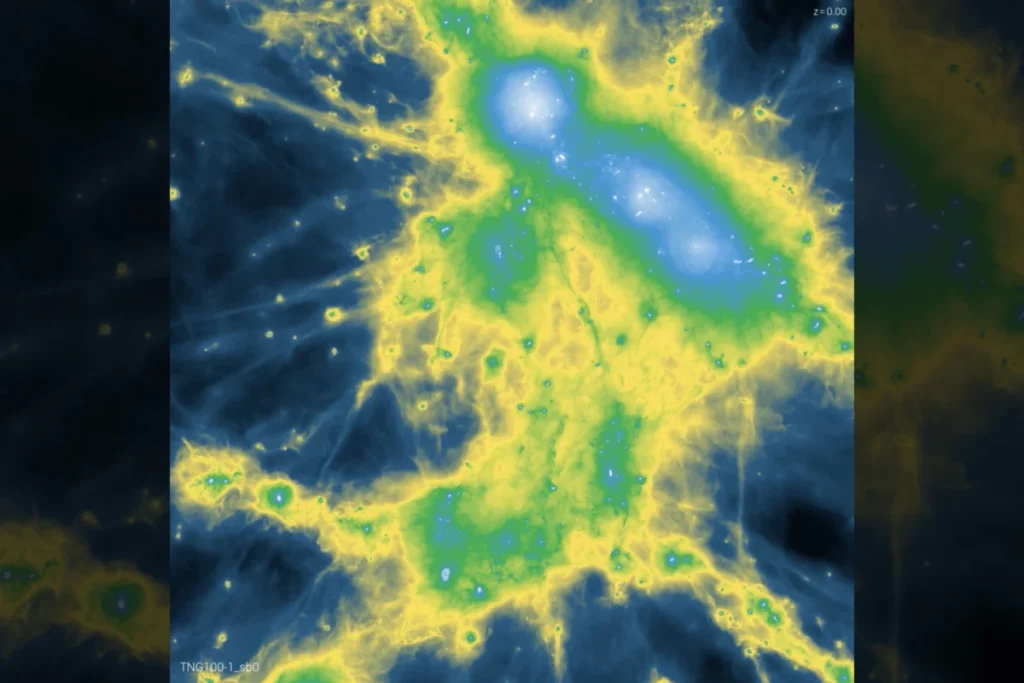
In many simulations, baryonic matter is expected to cluster relatively closely to the gravitational centers of galaxies or galaxy clusters. Instead, the MIT team discovered that the missing matter exists in incredibly diffuse clouds that extend far beyond the visible edges of galaxies.
"A galaxy is maybe a few 100,000 light years across, and we found missing matter out to about 4 million light years," says Kiyoshi Masui, an associate professor of physics at MIT. "That’s further than the simulations predict, by quite a bit."
This "diffuse puff" of matter suggests that the space between galaxies is not an empty void but is instead filled with a complex web of ionized gas. This discovery effectively accounts for the "missing" baryons, confirming that the matter predicted by Big Bang models is indeed present, just spread out so thinly that it had previously evaded detection.
Galactic Fountains and Violent Feedback
The discovery of matter four million light-years away from galaxy centers has profound implications for our understanding of galactic evolution. It suggests that galaxies are not closed systems that simply pull in gas to form stars; they are "messy" and "violent" engines that actively expel matter.
The researchers attribute this wide distribution to "galactic feedback." Within a galaxy, several highly energetic processes occur simultaneously. Supermassive black holes at the centers of galaxies can produce powerful jets of plasma that blast gas into intergalactic space. Simultaneously, the deaths of massive stars—supernovae—create shockwaves that push surrounding gas outward.
"We are finding that the activity in galaxies is messier than we thought," Wang noted. "They’re more like fountains, and really push out gas to very large distances."
The fact that this matter is found so far from the galactic centers indicates that these feedback mechanisms are significantly more powerful than current astrophysical models suggest. This "stronger and much more violent" activity plays a crucial role in regulating star formation. By blowing gas out of the galaxy, these processes prevent the galaxy from turning all of its available material into stars too quickly, essentially "throttling" the galaxy’s growth and extending its lifespan.
Chronology of the Discovery
The resolution of the Missing Baryon Problem is the culmination of years of technological and theoretical progress:
- 1990s: Theoretical cosmologists first identify the discrepancy between the amount of matter produced in the Big Bang and the amount of matter observed in the local universe.
- 2007: The first Fast Radio Burst (the "Lorimer Burst") is discovered in archival data, though its origin and utility remain a mystery.
- 2018: The CHIME telescope begins its first light observations, quickly becoming the world’s most prolific hunter of FRBs.
- 2020: Early studies using a small handful of FRBs (specifically FRB 181112) provide the first hints that the "missing" matter could be detected via signal dispersion.
- 2021-2023: The DESI survey begins providing high-precision coordinates for millions of galaxies, allowing for the first large-scale cross-correlation studies.
- 2024: The MIT-led team publishes their findings in Physical Review Letters, using nearly 3,000 FRBs to map the shape and extent of the missing baryonic matter.
Broader Implications for Cosmology
The ability to map the distribution of baryons has a ripple effect across the field of cosmology. By understanding where ordinary matter is located, scientists can better calibrate their models of dark matter. Since dark matter and baryonic matter interact gravitationally, the "clumpiness" of one affects the other.
Furthermore, this research provides a new tool for studying the "Cosmic Web"—the large-scale structure of the universe consisting of long filaments of matter that connect galaxy clusters. The diffuse clouds detected by the MIT team likely represent the material within these filaments.
As CHIME continues to operate and as new telescopes like the Square Kilometre Array (SKA) come online, the precision of these measurements will only increase. Future studies may be able to determine the temperature and ionization state of this missing matter, providing even deeper insights into the thermal history of the universe.
Conclusion: A New Era of Radio Astronomy
The work of the CHIME/FRB Collaboration marks a transition in how astronomers view the "empty" spaces of the universe. What was once thought to be a vacuum is now known to be a repository for the majority of the universe’s ordinary matter, held in a delicate balance by the violent energy of black holes and dying stars.
"We got it to work for the first time, and will get it to work even more precisely as data gets better," says Masui.
By turning mysterious flashes of radio light into precision probes, MIT researchers have not only solved a decades-old mystery but have also opened a new frontier in "mapping the invisible." The universe, it seems, is far more connected and dynamic than our eyes—even when aided by the most powerful optical telescopes—could ever have imagined.