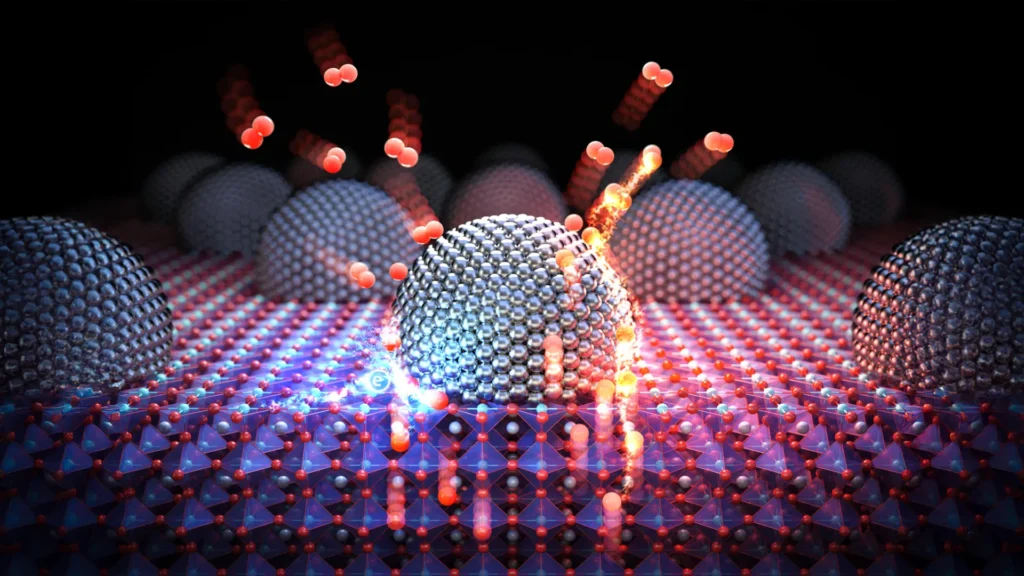
In a landmark study that redefines the architectural principles of next-generation energy conversion devices, a multi-institutional research team in South Korea has demonstrated that silver (Ag) nanocatalysts exhibit a "chameleon-like" behavior, shifting their active reaction sites depending on whether a system is generating electricity or producing hydrogen. This discovery, led by Professors WooChul Jung and Jeong Woo Han of Seoul National University (SNU) in collaboration with the Korea Advanced Institute of Science and Technology (KAIST) and the Korea Basic Science Institute (KBSI), provides the first quantitative evidence that the fundamental mechanism of a catalyst is not static but dynamic, governed by the operational mode of the solid oxide cell (SOC).
The findings, published as a cover article in the prestigious journal Energy & Environmental Science, address a long-standing mystery in materials science: the precise location of catalytic activity on complex electrode surfaces. By pinpointing how silver nanoparticles transition from interface-driven reactions during electricity generation to surface-driven reactions during hydrogen production, the team has unlocked a new pathway for engineering high-efficiency, reversible energy systems that could anchor the future of the global green hydrogen economy.
The Evolution of Solid Oxide Technology
Solid oxide cells represent a pinnacle of electrochemical engineering, offering a versatile platform for both power generation and chemical synthesis. These devices operate by transporting oxygen ions through a solid ceramic electrolyte at high temperatures, typically ranging from 500 to 1,000 degrees Celsius. When configured as a Solid Oxide Fuel Cell (SOFC), the system consumes hydrogen or hydrocarbons to produce electricity and water. Conversely, when operated as a Solid Oxide Electrolysis Cell (SOEC), the device uses electricity to split water molecules, generating high-purity "green" hydrogen.
Despite their potential, the widespread commercialization of SOCs has been hindered by the slow kinetics of the oxygen reactions occurring at the air electrode. While researchers have known for decades that adding metal nanocatalysts can accelerate these reactions, the "black box" nature of electrode surfaces made it nearly impossible to determine where the chemistry actually happens. In traditional, porous electrodes, the chaotic arrangement of particles prevents scientists from distinguishing whether a reaction occurs on the catalyst’s exposed surface, at the boundary where the catalyst meets the electrode, or on the electrode itself.
This lack of clarity has led to a "trial and error" approach in catalyst design. The SNU-led team sought to replace this ambiguity with precision, utilizing advanced nanofabrication and synchrotron-based analysis to map the atomic-level movements of oxygen and electrons.
A Novel Experimental Platform: The Model Electrode
To isolate the variables governing catalytic activity, the research team departed from conventional electrode structures. Instead, they developed a "model electrode" featuring a thin-film perovskite oxide base. Using sophisticated lithography and deposition techniques provided by Professor Sang Ouk Kim’s team at KAIST, the researchers arranged silver nanoparticles in highly ordered, uniform patterns with controlled sizes and spacing.
This structured approach allowed the team to mathematically correlate the reaction rates with specific physical parameters, such as the total surface area of the silver or the total length of the "triple-phase boundary"—the microscopic line where the silver catalyst, the oxide electrode, and the air meet.
Before focusing on silver, the researchers conducted a comparative screening of several noble and transition metals, including cobalt (Co), palladium (Pd), and platinum (Pt). While all provided some level of enhancement, silver emerged as the superior candidate, demonstrating the highest catalytic boost for both the Oxygen Reduction Reaction (ORR) and the Oxygen Evolution Reaction (OER). This performance, combined with silver’s relatively lower cost compared to platinum-group metals, made it the ideal subject for deeper mechanistic investigation.
The Discovery of Site-Switching Mechanisms
The core of the study’s impact lies in the discovery that the "active site" of the silver catalyst is not a fixed location. Through rigorous testing, the researchers observed two distinct behaviors based on the direction of the electrochemical current.
1. Electricity Generation (Oxygen Reduction Reaction)
When the cell operates in fuel cell mode, it performs the Oxygen Reduction Reaction (ORR), where oxygen molecules from the air are reduced into ions. The team found that the rate of this reaction was directly proportional to the length of the interface between the silver nanoparticles and the perovskite electrode. This indicates that during electricity generation, the catalyst works primarily at its "edges" or boundaries. In this mode, the silver serves as an electronic bridge, facilitating the transfer of electrons to oxygen atoms at the junction point, which then migrate into the electrolyte.
2. Hydrogen Production (Oxygen Evolution Reaction)
The mechanism shifted entirely when the cell was switched to electrolysis mode for hydrogen production. During the Oxygen Evolution Reaction (OER), oxygen ions are pulled from the electrolyte to form oxygen gas. The researchers discovered that the reaction rate in this mode was proportional to the total surface area of the silver nanoparticles, rather than the interface length. Here, the silver surface itself acts as the primary stage for the chemical drama, helping oxygen atoms recombine into O2 molecules and supporting their efficient release into the atmosphere.
This "site-switching" phenomenon suggests that a catalyst optimized for a fuel cell might not be naturally optimized for an electrolyzer, even if the same material is used.
Atomic-Scale Insights via Synchrotron Analysis
To validate these observations, the team utilized the 8A2 AP-XPS beamline at the Pohang Accelerator Laboratory, supported by Dr. Beomgyun Jeong’s team at the Korea Basic Science Institute. Ambient Pressure X-ray Photoelectron Spectroscopy (AP-XPS) allowed the researchers to monitor the chemical state of the electrode surface in real-time under actual operating conditions.
Combined with theoretical calculations at the atomic scale, the analysis revealed that the presence of silver significantly alters the electronic structure of the perovskite surface. During oxygen reduction, the silver nanoparticles lower the energy barrier for electron transfer. During oxygen evolution, they create a chemical environment that prevents the "poisoning" of the electrode surface by intermediate oxygen species, effectively speeding up the recombination process.
These insights provide a molecular-level explanation for why silver is so effective: it doesn’t just provide a path for electrons; it actively reshapes the thermodynamic landscape of the electrode surface to favor the specific reaction required by the operating mode.
Implications for the Global Energy Landscape
The discovery of the dual-action mechanism introduces a transformative design strategy for clean energy devices. Traditionally, engineers have treated the air electrode and its catalyst as a single, homogenous component. The SNU research suggests that for maximum efficiency, the catalyst surface and the catalyst-electrode interface must be engineered as separate, functional entities.
Advancing Reversible Solid Oxide Cells (RSOCs)
One of the most promising applications for this research is in Reversible Solid Oxide Cells (RSOCs). These systems are "energy balancers": they can produce hydrogen when renewable energy (like solar or wind) is abundant and then switch to fuel cell mode to generate electricity when the sun isn’t shining or the wind isn’t blowing. By understanding how silver functions in both modes, researchers can now design RSOCs that are equally efficient in both directions, a feat that has previously been difficult to achieve.
Impact on Distributed Energy and Green Hydrogen
For industrial facilities and high-rise buildings, this technology supports the deployment of distributed combined heat and power (CHP) systems. Such systems generate electricity on-site while utilizing the byproduct heat for climate control, significantly reducing carbon footprints. Furthermore, by lowering the "overpotential" (the extra voltage required to drive a reaction), the silver-enhanced electrodes can reduce the electricity costs associated with water electrolysis, making green hydrogen more price-competitive with fossil-fuel-based "gray" hydrogen.
Institutional Perspectives and Future Directions
Professor WooChul Jung, the lead author of the study, emphasized the broader scientific value of the work. "This research is significant because it quantitatively evaluates the performance of nanocatalysts while also identifying their actual reaction sites and operating mechanisms," Jung stated. "We plan to further establish this as a new design principle that can be applied to various energy conversion materials and catalytic systems."
The study also highlights the successful trajectory of South Korea’s scientific talent. Dr. Jinwook Kim, who spearheaded the experimental work, is currently continuing his research at Northwestern University in the United States. He is slated to join the University of Seoul as an assistant professor, where he intends to expand this platform to study other electrochemical systems, including oxygen separation membranes and high-efficiency CO2 electrolysis.
The research was a collaborative effort funded by the Ministry of Science and ICT and the National Research Foundation of Korea. The use of the Pohang Accelerator Laboratory underscores the importance of large-scale national infrastructure in achieving breakthroughs in materials science.
Conclusion
As the world pivots toward a carbon-neutral future, the efficiency of electrochemical energy conversion will be a deciding factor in the success of the energy transition. The discovery that silver nanocatalysts switch their operational logic between electricity and hydrogen modes provides the scientific community with a precise "map" for future development. By moving away from generalized catalyst applications and toward site-specific engineering, the path to high-performance, durable, and cost-effective solid oxide technology has become significantly clearer. The "silver bullet" for clean energy may not be the material itself, but the newfound understanding of how it moves, reacts, and adapts to the needs of the grid.