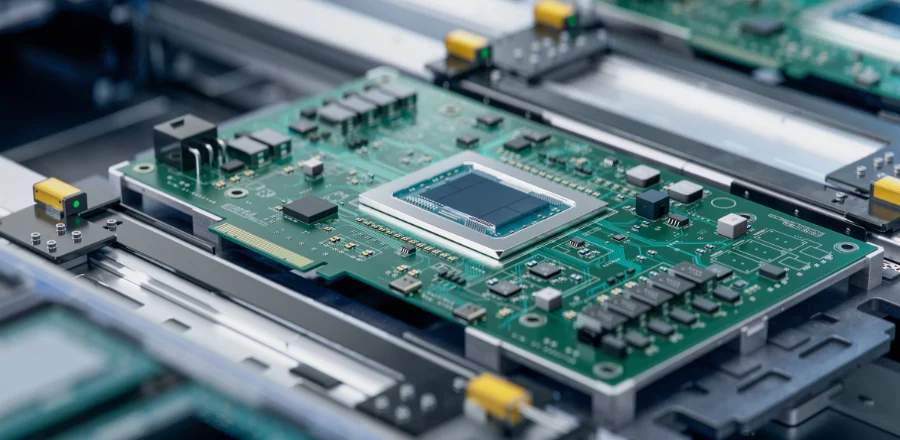
BANNOCKBURN, Ill. – The North American printed circuit board (PCB) manufacturing sector experienced a complex market dynamic in August 2026, characterized by a significant surge in product shipments contrasted sharply by a substantial pullback in new orders. According to the Global Electronics Association (GEA), manufacturers shipped 23.5% more product in August compared to the same month last year, alongside a 5.2% increase from July 2026. This robust shipping activity contributed to an impressive 15.5% year-to-date growth through the first eight months of 2026 when benchmarked against the corresponding period in the previous year. However, this positive momentum on the shipment front was tempered by a dramatic decline in new orders, or bookings, which plummeted by 35% from August 2025 and a striking 78.1% from the preceding month of July. Despite this monthly contraction, year-to-date bookings maintained a strong position, remaining 38.7% higher than during the same period in 2025, suggesting a broader trend of sustained demand preceding the August dip.
August 2026 Performance Overview: A Mixed Signal
The latest data from the GEA paints a nuanced picture of the North American PCB market. On one hand, the consistent growth in shipments underscores a healthy operational output and a capacity to meet existing demand. The year-over-year shipment increase of 23.5% in August is particularly noteworthy, indicating strong market absorption and possibly the clearing of backlogs built up during periods of high demand or supply chain constraints. The sequential growth from July to August further solidifies the trend of increasing production and delivery. These figures are critical for evaluating the manufacturing sector’s health, often reflecting confidence in the economy and robust demand from downstream electronics industries such as automotive, consumer electronics, telecommunications, medical devices, and industrial automation.
Conversely, the sharp decline in new orders raises questions about the immediate future demand trajectory. While Shawn DuBravac, chief economist for the Global Electronics Association, characterized the August order data as a "quick pause after several months of strong order flow," the magnitude of the pullback – 78.1% from July – is significant. Such volatility can sometimes be attributed to several factors, including inventory adjustments by customers, the front-loading of orders in previous months (like July’s surge), or a temporary dip in broader economic confidence influencing purchasing decisions. Understanding the underlying causes of this specific month’s booking performance is crucial for industry stakeholders planning production schedules and inventory levels.
Deep Dive into Shipment Trends
The sustained growth in PCB shipments reflects the industry’s resilience and its pivotal role in the global electronics supply chain. Printed circuit boards are the foundational components for nearly all electronic devices, acting as the nervous system that connects and powers everything from smartphones and laptops to advanced industrial machinery and critical defense systems. The 15.5% year-to-date shipment growth through August 2026 signifies a robust recovery and expansion phase for North American manufacturers, potentially driven by a combination of factors. These include ongoing efforts to onshore or nearshore critical manufacturing capabilities in response to past geopolitical tensions and supply chain disruptions, increased domestic demand across various sectors, and technological advancements necessitating more complex and higher-value PCBs.
This upward trend in shipments also suggests that manufacturers have successfully navigated challenges such as labor availability, raw material costs, and logistics, enabling them to convert orders into delivered products efficiently. For the North American market, strengthening domestic PCB production is strategically important, not only for economic reasons but also for national security and technological independence. The ability to produce sophisticated PCBs locally reduces reliance on foreign supply chains, mitigating risks associated with geopolitical instability, trade disputes, and natural disasters that can impact global manufacturing hubs.
Analyzing the Order Pullback and Chronology
The narrative of August 2026 bookings presents a stark contrast to the positive shipment figures. The 35% year-over-year decrease in new orders and the dramatic 78.1% month-over-month drop from July indicate a significant shift in immediate purchasing behavior. To fully comprehend this, it’s essential to consider the chronology. July’s "surge" in orders, as noted by DuBravac, might have been an anomaly or a period where customers rushed to secure inventory, potentially anticipating price increases, lead time extensions, or simply replenishing stocks that were low. Following such a surge, a subsequent month of reduced orders is not uncommon, as customers may have temporarily satisfied their immediate needs.
However, the extent of the August pullback warrants closer scrutiny. It could signal a period of inventory correction where downstream manufacturers are absorbing previously ordered components before placing new orders. Alternatively, it might reflect broader economic uncertainties influencing capital expenditure and product development cycles. Despite this monthly fluctuation, the year-to-date bookings remaining 38.7% higher than the previous year is a critical piece of context. This cumulative growth suggests that the underlying demand for North American PCBs remains strong over a longer horizon, and the August dip might be an isolated event rather than the start of a prolonged downturn. Economist Shawn DuBravac’s assessment of it being a "quick pause" leans into this interpretation, implying that the fundamental drivers of demand are still intact, and the market is simply experiencing a temporary recalibration.
The Significance of the Book-to-Bill Ratio
A key economic indicator for the electronics industry, particularly for printed circuit boards, is the book-to-bill ratio. For August 2026, the industry’s three-month book-to-bill ratio stood at 1.29. This metric signifies that for every $1 of product shipped and billed by manufacturers during the three-month period ending in August, they received $1.29 in new orders. A ratio above 1 is generally considered a positive sign, as it indicates that orders are outpacing shipments, often signaling future sales growth and a healthy backlog for manufacturers.
The 1.29 ratio, while still robust and indicating growth potential, needs to be interpreted in light of the sharp August order decline. It is a three-month rolling average, meaning it smooths out monthly volatility. The high bookings from July and potentially strong performance in June would have significantly contributed to this elevated ratio, somewhat masking the August contraction. Had August’s booking figures been the norm for the entire three-month period, the book-to-bill ratio would likely be considerably lower, possibly even below 1. Therefore, while 1.29 remains a positive indicator, future months’ book-to-bill ratios will be crucial in determining if the August order contraction was indeed a temporary "pause" or the beginning of a more sustained trend. Historically, a ratio consistently above 1.05 or 1.10 is seen as a strong indicator of expansion, and 1.29 suggests substantial forward momentum, assuming the dip was an outlier.
The Indispensable Role of Printed Circuit Boards

To fully appreciate the significance of these market trends, it’s vital to understand the fundamental role of printed circuit boards. PCBs are not merely components; they are the backbone of virtually every electronic device in existence. From simple single-layer boards in remote controls to complex multi-layer boards found in supercomputers, aerospace systems, and advanced medical imaging equipment, PCBs provide the mechanical support and electrical connections for electronic components. They facilitate the intricate dance of electrons that powers our digital world.
The manufacturing process of a PCB is itself a complex symphony of design, material science, chemical processes, and precision engineering. It involves etching conductive pathways from copper sheets onto non-conductive substrates (like fiberglass), drilling thousands of microscopic holes, and layering multiple circuits together. The demand for higher performance, smaller form factors, and increased reliability in electronics drives continuous innovation in PCB technology, including advancements in materials, fabrication techniques, and thermal management. As technologies like 5G, artificial intelligence (AI), the Internet of Things (IoT), and autonomous vehicles continue to evolve, the demand for sophisticated, high-density interconnect (HDI) PCBs and flexible PCBs will only intensify, making the health of the PCB manufacturing sector a bellwether for the broader tech industry.
North American PCB Manufacturing in a Global Context
The North American PCB market operates within a highly competitive global landscape, where Asia, particularly China, Taiwan, South Korea, and Japan, has historically dominated production. However, recent years have seen a renewed focus on strengthening domestic manufacturing capabilities in North America and Europe. This strategic shift is largely driven by lessons learned from the COVID-19 pandemic, which exposed vulnerabilities in global supply chains, and by geopolitical considerations that emphasize the importance of secure and localized production of critical technologies.
Governments in North America have initiated various incentives and policies aimed at boosting semiconductor and electronics manufacturing, of which PCBs are an integral part. The 15.5% year-to-date growth in North American shipments suggests these efforts may be yielding results, leading to increased market share or at least robust growth within the region. While specific global figures for August 2026 are not available for direct comparison, the overall global PCB market is projected to continue its expansion, fueled by digital transformation across industries. North American manufacturers are positioning themselves to capture a larger share of this growth, particularly in high-reliability and advanced technology applications, where their expertise and quality control often provide a competitive edge.
Economic Implications and Future Outlook
The mixed signals from August – strong shipments but weak orders – present a complex scenario for economic forecasters and industry planners. The continued strength in shipments is a positive indicator for manufacturing output, employment, and capital utilization within the sector. It suggests that companies are actively producing and delivering goods, contributing to economic activity. However, the sharp decline in bookings, if sustained, could eventually impact future shipment volumes.
For manufacturers, the immediate implication is a need for careful inventory management and production planning. While the high book-to-bill ratio provides some buffer, a prolonged period of declining new orders would necessitate adjustments to capacity and workforce. For the broader electronics industry, the PCB market serves as an early indicator. A slowdown in PCB orders can cascade through the supply chain, affecting component suppliers upstream and finished product assemblers downstream.
Looking ahead, several factors will influence the trajectory of the North American PCB market. Technological innovation, particularly in areas requiring advanced packaging and high-frequency capabilities, will continue to drive demand. The push for greater supply chain resilience and regionalization will likely sustain investment in domestic manufacturing. However, macroeconomic headwinds such as inflation, interest rate policies, and global economic slowdowns could dampen overall demand for electronics, thus impacting PCB orders. The coming months’ data, particularly the book-to-bill ratio and subsequent booking figures, will be critical in discerning whether August’s order pullback was an isolated blip or a harbinger of changing market conditions.
The Global Electronics Association’s Perspective
The Global Electronics Association, as the authoritative source for this data, plays a crucial role in providing transparency and insights into the electronics manufacturing sector. Shawn DuBravac’s commentary, characterizing the August order decline as a "quick pause," suggests that the GEA views this event within the context of normal market fluctuations rather than as a systemic issue. Economists often look for patterns and trends over several months or quarters to confirm a shift in market direction. A single month’s sharp decline, especially following a surge, can be attributed to tactical purchasing decisions by customers rather than a fundamental weakening of demand.
The GEA’s role extends beyond data reporting; it also involves advocacy and providing a platform for industry collaboration. Their analysis helps member companies make informed decisions regarding investment, R&D, and market strategy. Understanding the nuances of their statements is key to interpreting the data correctly. If the GEA were to signal deeper concerns, their language would likely be more cautious, hinting at potential challenges rather than framing the situation as a temporary "pause."
Challenges and Opportunities Ahead
The North American PCB industry faces both challenges and opportunities. Challenges include intense global competition, the need for continuous technological upgrades, skilled labor shortages, and environmental regulations associated with manufacturing. Opportunities, however, are substantial. The increasing complexity of modern electronics demands higher-value, specialized PCBs, which often play to the strengths of North American manufacturers known for their quality and innovation. Emerging technologies like quantum computing, advanced medical diagnostics, and enhanced defense systems will create new niches for highly specialized PCB fabrication. Furthermore, government initiatives to bolster domestic manufacturing and reduce reliance on overseas production will continue to provide tailwinds. The industry’s ability to adapt to rapid technological change, invest in automation, and cultivate a skilled workforce will be paramount to sustaining the growth seen in shipments and overcoming the temporary dips in orders. The August 2026 data serves as a reminder of the dynamic nature of the electronics market, where agility and strategic foresight are essential for long-term success.