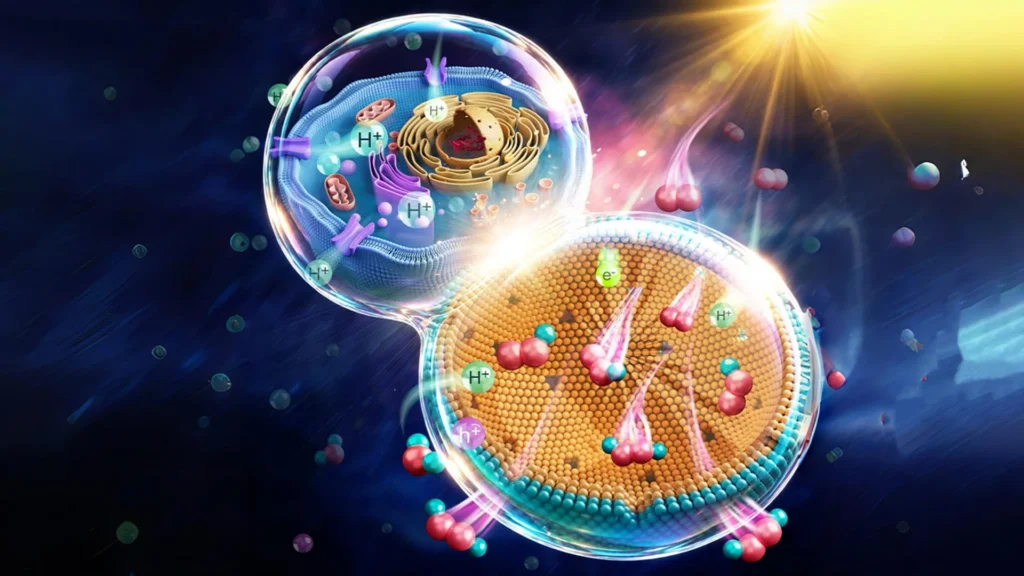
In a significant leap for the field of artificial photosynthesis and nanocell engineering, a collaborative research team has successfully developed a hollow CdS@polydopamine nanoreactor that replicates two fundamental regulatory mechanisms of living cells. The study, published in the Journal of the American Chemical Society, represents a sophisticated approach to solving the kinetic bottlenecks that have long hindered the efficient production of green chemicals. Led by Professor LI Can from the Dalian Institute of Chemical Physics (DICP) of the Chinese Academy of Sciences (CAS), in partnership with Professor Jian Liu’s team at Inner Mongolia University, the research provides a blueprint for creating synthetic materials that function with the precision of biological organisms.
Living cells are the most efficient chemical factories in existence, performing complex biochemical transformations with nearly 100% selectivity and minimal energy waste. They achieve this through compartmentalization—the separation of different chemical environments within organelles—and specialized transport mechanisms like proton pumps and relays. By translating these biological principles into a synthetic nanoreactor, the researchers have managed to bridge the gap between soft matter biology and hard matter nanotechnology, specifically for the production of hydrogen peroxide (H2O2) using only sunlight, water, and oxygen.
The Challenge of Artificial Photosynthesis
Hydrogen peroxide is a critical industrial chemical used extensively in water treatment, paper bleaching, and as a disinfectant. However, the traditional industrial method for its production, the anthraquinone process, is energy-intensive and involves significant environmental risks due to the use of organic solvents and the generation of waste. Consequently, the scientific community has sought a "green" alternative: the direct photosynthesis of H2O2 from water and oxygen.
The primary hurdle in this endeavor is the synchronization of two distinct half-reactions. To produce H2O2, the system must simultaneously facilitate oxygen reduction (ORR) and water oxidation (WOR). These reactions occur at different speeds and require the coordinated movement of both electrons and protons. In most synthetic catalysts, these processes are uncoordinated, leading to low efficiency and the rapid recombination of charge carriers. The DICP-led team hypothesized that by mimicking the spatial and functional organization of a cell, they could manage these reactions more effectively.
Engineering the Biomimetic Nanoreactor
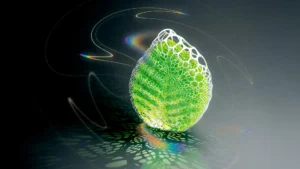
The researchers designed a hollow nanostructure consisting of a cadmium sulfide (CdS) core and a polydopamine (PDA) shell. The choice of materials was deliberate. CdS is a well-known semiconductor capable of absorbing visible light, but it often suffers from instability and low efficiency when used alone. Polydopamine, a bio-inspired polymer derived from the neurotransmitter dopamine, serves as a protective and functional coating that mimics the properties of melanin found in natural systems.
The first major biomimetic feature of this nanoreactor is its dynamic catechol/o-benzoquinone redox pair located within the polydopamine shell. In biological systems, proton pumps move protons across membranes to create gradients that drive energy production. While the nanoreactor does not function as an active pump, the catechol/o-benzoquinone pair acts as a highly efficient "proton relay." This chemical group can repeatedly accept and release protons, facilitating Proton-Coupled Electron Transfer (PCET). By ensuring that protons are available exactly when and where electrons are moving, the relay significantly reduces the energy barrier for the reaction, speeding up the overall process.
The second feature is the nanoreactor’s physical architecture. The hollow cavity creates a confined environment, effectively acting like a cellular organelle. This compartmentalization allows reactants to accumulate to higher concentrations than in the bulk solution, a phenomenon known as the "confinement effect." Furthermore, the porous shell regulates the diffusion of molecules in and out of the reactor, while the hollow interior traps incoming photons through internal reflections, maximizing light absorption.
Chronology of the Research Development
The development of the CdS@polydopamine nanoreactor followed a multi-stage research trajectory that began with the fundamental study of PCET in biological systems.
- Conceptualization (2021-2022): The research team sought to address the sluggish kinetics of the water oxidation half-reaction. They identified that the primary issue was not just electron movement, but the lack of synchronized proton transfer.
- Material Synthesis and Optimization (Late 2022): The team experimented with various shell thicknesses and core sizes. They found that a specific ratio of CdS to polydopamine was necessary to maintain structural integrity while allowing for maximum light penetration and proton relay activity.
- Mechanism Clarification (2023): Using advanced in situ spectroscopy, the team observed the transition between catechol and o-benzoquinone in real-time. This confirmed that the polydopamine shell was not just a passive container but an active participant in the catalytic cycle.
- Performance Testing and Application (Early 2024): After optimizing the nanoreactor in a liquid suspension, the researchers moved toward practical application by embedding the reactors in a hydrogel matrix to test recyclability and performance under natural sunlight.
Analyzing the Performance Data
The results of the study were highly encouraging, placing the CdS@polydopamine nanoreactor among the top-performing artificial photosynthetic systems. Under visible-light illumination in an aqueous solution, the nanoreactor achieved an H2O2 photosynthesis rate of 3.24 mmol gcat.-1 h-1.
More importantly, the system reached a solar-to-chemical (STC) conversion efficiency of 1.2%. While 1.2% may seem modest compared to photovoltaic panels, in the context of photocatalytic chemical synthesis, it is a significant milestone. For comparison, the average efficiency of natural photosynthesis in most plants is approximately 1%, and many synthetic photocatalysts struggle to exceed 0.5% STC efficiency without the use of expensive noble metal co-catalysts.
The researchers utilized a suite of analytical tools to verify these results. Finite element simulations were used to model the light-harvesting capabilities of the hollow structure, showing that the cavity increased the light path length within the catalyst. Photochemical analysis and theoretical calculations further clarified the Z-scheme heterojunction mechanism, which describes how the electrons move between the CdS and the PDA shell to maintain high reducing and oxidizing power.
Practical Implementation: The Hydrogel Matrix
One of the most significant barriers to the industrial adoption of nanotechnology is the "recovery problem." Fine catalytic powders are difficult to separate from liquid products, leading to potential contamination and material loss. To solve this, the DICP and Inner Mongolia University team embedded their nanoreactors into a sodium alginate hydrogel.
Sodium alginate is a naturally occurring, environmentally benign polymer derived from seaweed. By trapping the nanoreactors within this gel, the researchers created a solid-state photocatalytic "sheet" or "bead." This composite material could be easily placed into a body of water and removed once the reaction was complete.
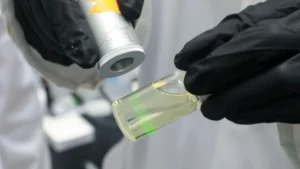
Tests conducted under natural sunlight—mimicking real-world conditions rather than controlled laboratory lighting—demonstrated that the hydrogel-embedded nanoreactors maintained stable performance over multiple cycles. This recyclability is crucial for the economic viability of green H2O2 production.
Official Responses and Scientific Significance
The research community has noted the significance of this "biomimetic" approach. Professor LI Can, the lead researcher, emphasized that the goal was not just to create a better catalyst, but to rethink the design of synthetic materials.
"Our study provides a new strategy for engineering biomimetic nanoreactors that increasingly replicate the sophisticated functions of living cells," stated Prof. Li. "This is not merely about H2O2 production; it is about opening new opportunities in artificial photosynthesis, energy catalysis, and synthetic chemistry. We are learning how to organize chemical space at the nanoscale."
Collaborating researchers from Inner Mongolia University added that the success of the polydopamine shell highlights the potential of bio-derived polymers in industrial chemistry. They noted that the catechol-based proton relay is a versatile mechanism that could likely be applied to other difficult chemical transformations, such as carbon dioxide reduction or nitrogen fixation.
Broader Implications and Future Outlook
The implications of this research extend far beyond the laboratory. By demonstrating that cellular organization can be successfully mimicked in a synthetic nanoreactor, the DICP team has provided a roadmap for the next generation of "smart" catalysts.
From an environmental perspective, the ability to produce hydrogen peroxide on-site using only sunlight and water could revolutionize decentralized water purification. In remote or developing areas where chemical supply chains are unreliable, a "solar-H2O2" hydrogel could provide a sustainable way to treat drinking water and maintain hygiene.
In the broader context of the global energy transition, this research contributes to the "hydrogen economy" and the push for carbon neutrality. As industries move away from fossil-fuel-based chemical synthesis, the demand for efficient, light-driven catalysts will grow. The use of a Z-scheme heterojunction and PCET mechanisms represents the cutting edge of this transition.
Moving forward, the research team plans to explore whether this nanoreactor design can be scaled up for industrial-scale solar chemical farms. They are also investigating other bio-inspired functional groups that could be integrated into the shell to catalyze different types of reactions. The ultimate goal is to create a fully synthetic "nanocell" that can perform multiple sequential reactions, much like a living cell performs metabolic pathways, to produce complex molecules from simple, abundant starting materials.
The success of the CdS@polydopamine nanoreactor underscores a growing trend in science: the most effective solutions to our modern energy and chemical challenges may already exist in the natural world, waiting to be decoded and recreated at the nanoscale.