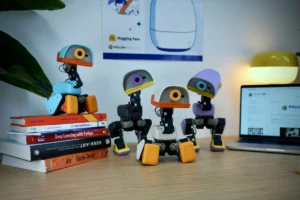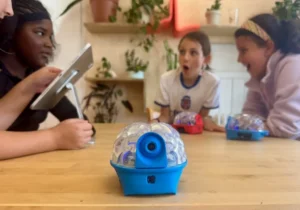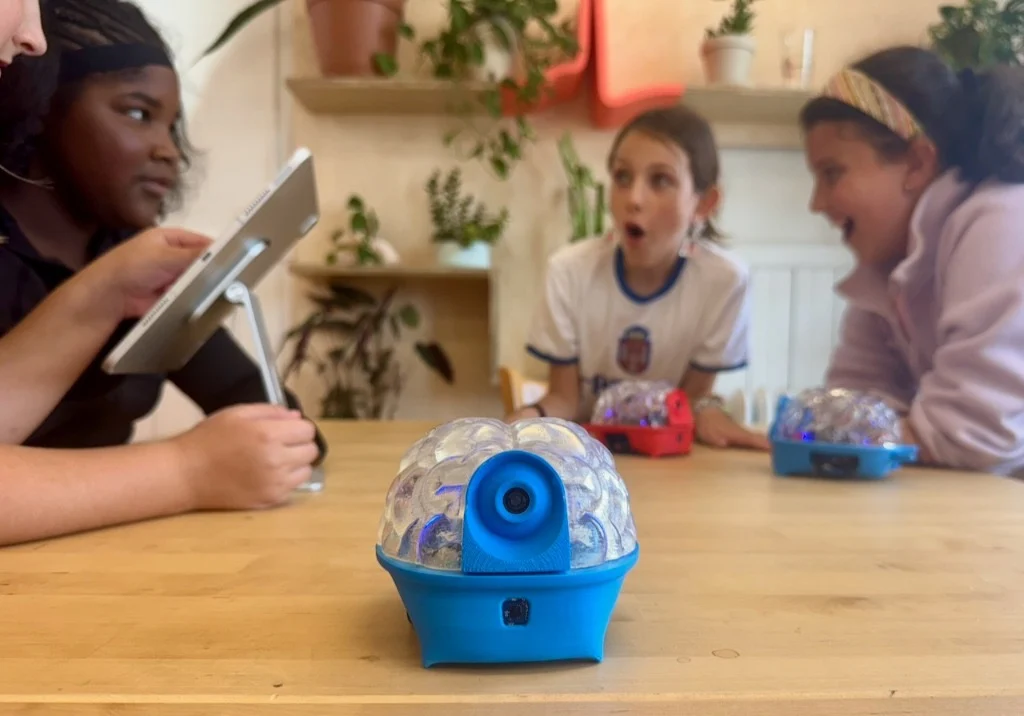
Backyard Brains, a company renowned for its innovative approach to neuroscience education, has unveiled SpikerBot, a groundbreaking robotic platform designed to democratize access to the complex world of robotics and neural science. This new bot, which allows users to program life-like behaviors using virtual neurons rather than traditional code, aims to make engineering and neuroscience engaging and accessible for learners of all ages. Co-Founder & CEO Greg Gage and Designer Alex Hatch introduced SpikerBot as a pioneering tool poised to bridge significant gaps in STEM education by offering an intuitive, hands-on experience in understanding how brains work and how intelligence can emerge from simple circuits.
Redefining Robotics Education
Traditional robotics education often begins with the formidable task of learning programming languages, syntax, and complex logical structures like if-then statements. While essential for advanced development, this initial hurdle can frequently deter newcomers and diminish the inherent excitement of bringing a robot to life. SpikerBot offers a radically different entry point. Its accompanying application replaces lines of code with a visual interface where users manipulate virtual neurons and synapses to construct "sketches" that define the robot’s behavior. This innovative approach simplifies the learning curve, allowing aspiring engineers and neuroscientists to experiment with complex behaviors without the frustration of debugging code. As stated by the creators, "there’s no code, no LLMs, just neurons, synapses, and behavior emerging from a circuit a kid designed." This philosophy aligns with the growing trend of visual programming interfaces in educational technology, which have proven effective in making abstract concepts more concrete and interactive for learners.
The core philosophy behind SpikerBot draws inspiration from Valentino Braitenberg’s seminal 1984 book, Vehicles: Experiments in Synthetic Psychology. Braitenberg’s work explored how remarkably complex, seemingly intelligent behaviors could emerge from surprisingly simple sensorimotor connections in hypothetical vehicles. For instance, a "fear" vehicle might have a light sensor on its left side connected to its left wheel and a sensor on its right side connected to its right wheel, both with inhibitory connections. When light hits the left sensor, it slows the left wheel, causing the vehicle to turn away from the light. SpikerBot embodies this principle, allowing users to design neural circuits where the bot responds directly to its environment through sensors, resulting in emergent, lifelike behaviors. This foundational understanding is crucial for students to grasp that complex systems don’t necessarily require complex programming, a concept that resonates deeply with both biological and artificial intelligence research.

Bridging the Neuroscience Knowledge Gap
Beyond robotics, SpikerBot addresses a critical deficiency in mainstream science education: the significant gap in neuroscience understanding between elementary school and higher education. Typically, students might learn about the basic structure and function of a single neuron early on, but the progression often halts until college, where advanced students delve into the intricate workings of millions of interconnected neurons. This creates a vast chasm in foundational knowledge, akin to learning about a transistor and then being expected to program in Python without any intermediate understanding of circuit design or digital logic. Backyard Brains aims to fill this void, combating what they term "neuroscience illiteracy" by providing an accessible platform for exploring how neural networks function at an intermediate level. By engaging with SpikerBot, students can begin to understand how small groups of neurons interact to produce observable behaviors, laying a stronger groundwork for future studies in biology, psychology, and computer science.
The development of SpikerBot involved extensive collaboration with both child educators and professional neuroscientists. This interdisciplinary approach ensures that the educational content is both engaging for young learners and scientifically accurate, introducing users to real neuroscience principles. Students can explore fundamental neurological patterns such as recurrent pairs, which are critical for memory and rhythm generation, and lateral inhibition, a mechanism that enhances sensory contrast and precision. Furthermore, the platform allows for experimentation with concepts like working memory, providing a tangible model for abstract cognitive functions. This hands-on exploration of neural circuits moves beyond theoretical learning, offering a dynamic environment where scientific principles are discovered through active experimentation and observation.
A Paradigm Shift in Programming: Visualizing Neural Networks
The most revolutionary aspect of SpikerBot lies in its programming interface. Instead of text-based coding, users interact with a visual representation of a brain on screen, dragging and connecting virtual neurons and axons. This graphical approach resembles the patching of a modular synthesizer, where components are connected to create a desired output. The beauty of this system is its immediacy and holistic view: all connections are visible at once, allowing users to comprehend the entire circuit’s logic in a single glance. This visual paradigm significantly reduces the cognitive load associated with traditional coding, where understanding often requires scrolling through multiple files and deciphering lines of abstract text.
This neuron-based programming introduces an intriguing inversion of typical programming challenges. Behaviors traditionally considered complex in beginner robotics, such as a robot following a person or chasing an object, become remarkably simple to implement. For instance, creating a creature that pursues objects can be achieved with just two virtual neurons. Conversely, tasks that are trivial in conventional computer logic, such as making a robot count in binary, transform into intricate webs of neural connections within the SpikerBot environment. This contrast highlights the fundamental differences between computer logic, which excels at precise sequential operations, and biological intelligence, which is adept at parallel processing and emergent behaviors. The focus on natural, intuitive behaviors is expected to maintain user engagement longer than bots requiring extensive foundational programming knowledge. Learners can begin by creating a robot that mimics simple animal behaviors and then gradually build in more sophisticated responses at their own pace.

Intuitive Design for Complex Tasks
Another crucial design decision that enhances the learning experience is the instantaneous nature of changes within the SpikerBot app. There is no compilation process, no waiting for code to upload; every modification, such as changing a neuron from excitatory to inhibitory, takes effect immediately. This real-time feedback loop fosters a rapid pace of thought and experimentation, allowing users to quickly test hypotheses and observe the direct consequences of their neural circuit designs. This immediate gratification is a powerful motivator for learning and exploration, mirroring the iterative process of scientific discovery.
The app itself is a testament to meticulous development and refinement. Its polished interface and intuitive functionality ensure that the groundbreaking concept is delivered with a user experience that is both beautiful and highly functional. This attention to design is critical for the adoption of novel educational tools; often, innovative concepts struggle to gain traction if their implementation is clunky or unintuitive. Backyard Brains has clearly invested significant effort in crafting a platform that is not only revolutionary in its approach but also a pleasure to use. The app also includes a comprehensive library of sample brain models, allowing users to deconstruct, modify, and learn from pre-built circuits, further accelerating their understanding of neural patterns and techniques applicable to real neuroscience.
A Robot Built for Discovery: Hardware and Design
The physical manifestation of this innovative programming paradigm is the SpikerBot itself. Modeled after Backyard Brains’ distinct brain-shaped logo, the robot is designed to be both functional and engaging. It features a suite of sensors crucial for interacting with its environment, including a camera for visual input, a microphone for auditory cues, and a distance sensor for spatial awareness. Beyond mere functionality, the robot’s design incorporates aesthetic and interactive elements, such as lights that "pop on and fade out like bioluminescent cells" and charming, quirky sound effects, enhancing its lifelike persona.
Customization is also a key feature. Connection points on the chassis allow users to attach 3D-printed accessories, enabling them to personalize their bot and give it a unique personality or specific functional enhancements. This encourages creativity and further engagement with the engineering aspects of robotics. Moreover, SpikerBot is designed to integrate with Backyard Brains’ existing peripherals, such as their Spiker:bit board. This compatibility opens up exciting possibilities, allowing users to control their SpikerBot with muscle signals from their own arm, directly linking human physiology to robotic action and providing an even deeper, more personal connection to neuroscience.

Fostering Neuroscience Literacy and Broader Impact
The educational value of SpikerBot extends beyond traditional STEM applications. With approximately one in five people experiencing a neurological condition, there is a pressing societal need for greater understanding of brain function. By providing a shared language and understanding of fundamental brain patterns, SpikerBot can help demystify various neurological conditions, fostering empathy and informed discussion. This grassroots approach to neuroscience literacy has the potential to empower individuals to better understand themselves and those around them, promoting a more informed public discourse on brain health and mental well-being.
The thoughtful design philosophy extends to the robot’s long-term usability and sustainability. The SpikerBot app is freely available and does not require cloud-based authentication, ensuring accessibility and independence from proprietary servers. The robot itself operates on easily swappable AA batteries, eschewing the trend of non-replaceable, constantly decaying lithium-ion cells. Backyard Brains further supports this sustainable approach by offering custom, high-performance NiMH AA batteries, promoting reusability and reducing electronic waste. These decisions reflect a commitment to product longevity and user empowerment, aligning with the "maker" ethos of repairability and open exploration.
From Concept to Crowdfunding Success: Availability and Future Outlook
The SpikerBot project successfully launched its crowdfunding campaign on Kickstarter, garnering significant interest from educators, hobbyists, and parents. The campaign is slated to conclude on June 14, offering early bird pledges at $219, a substantial discount from the eventual retail price of $299. Backyard Brains has a well-established track record of delivering innovative and high-quality educational tools through crowdfunding, which instills confidence in their ability to bring SpikerBot to fruition. Their previous successful projects demonstrate a commitment to product development and fulfillment, mitigating some of the inherent risks associated with crowdfunding initiatives.
The company anticipates continued development of SpikerBot, with plans for additional features and capabilities based on community feedback. Alex Hatch aptly articulated this collaborative vision, stating that "a lot we haven’t seen because you guys haven’t built anything yet." This open-ended approach encourages users to become co-creators, pushing the boundaries of what SpikerBot can achieve and collectively discovering new emergent behaviors and educational applications. This iterative development model, driven by user engagement, promises a dynamic future for SpikerBot, ensuring it remains a relevant and evolving tool for learning and innovation.

In conclusion, SpikerBot represents a significant leap forward in making complex scientific and engineering concepts accessible. By reimagining robot programming through the lens of neuroscience, Backyard Brains has created a platform that not only educates but also inspires. It empowers a new generation of learners to engage with the fundamental principles of intelligence and behavior, fostering both technical skills and a deeper appreciation for the intricate workings of the brain. As it rolls out, SpikerBot is poised to become an invaluable tool for educators and an exciting gateway for anyone curious about the intersection of biology, robotics, and artificial intelligence.