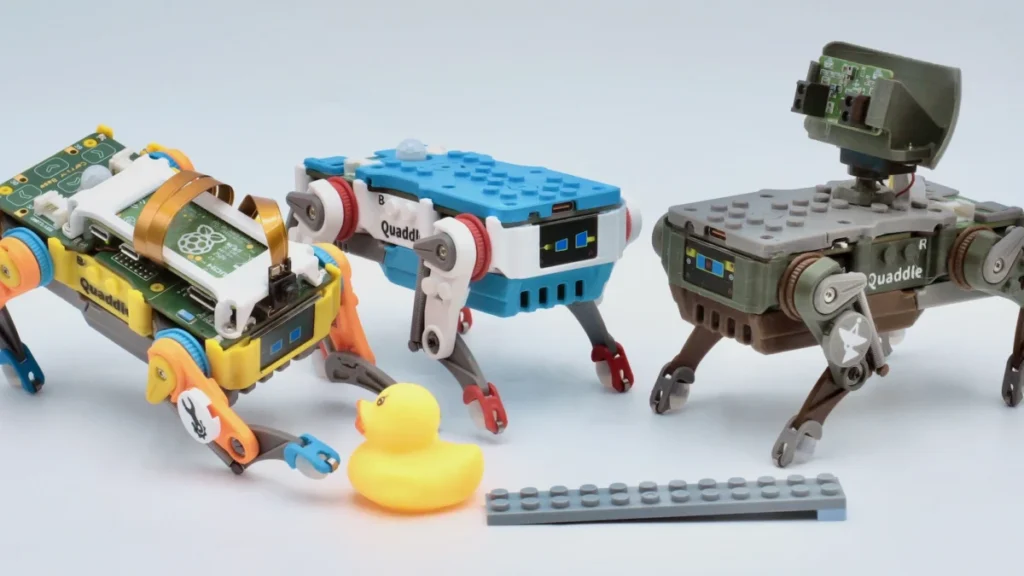
Petoi, a name synonymous with accessible and engaging robotic pets, has officially launched Quaddle, its latest innovation designed to be smarter, more durable, and more approachable than any of its predecessors. This new entry-level robotic companion builds upon the legacy of the beloved plywood Nybble and the more recent Bittle X and Nybble Q, aiming to establish itself as the definitive starting point for enthusiasts venturing into the dynamic world of walking robotics. Quaddle arrives in three distinct versions—Builder, Buddy, and Scout—each featuring significant upgrades, most notably a sophisticated OLED screen that replaces the traditional plastic face, offering nuanced expressions and critical diagnostic data. The integration of sensors directly into the robot’s structure, moving away from individual bone-shaped boards, further streamlines its design and enhances overall robustness.
The Evolution of Petoi’s Robotic Ecosystem: A Journey Towards Accessibility
The story of Petoi’s commitment to democratizing robotics began with the Nybble, a charming, open-source robotic cat crafted from plywood, which famously graced the cover of Make: Volume 70. This initial offering captivated the maker community with its blend of hands-on assembly, programmability, and delightful feline movements. Nybble wasn’t just a toy; it was an educational platform, inviting users to delve into mechanics, electronics, and coding. Its success paved the way for subsequent iterations like the Bittle X and Nybble Q, which refined the design, improved performance, and further solidified Petoi’s reputation for creating endearing and programmable robot pets. These earlier models, known for their expressive movements and compact designs, offered an engaging experience that combined the joy of pet ownership with the intellectual stimulation of robotics.
Petoi’s overarching mission, championed by its founder Dr. Rongzhong Li, has consistently revolved around making advanced robotics accessible to a broader audience. This ethos is deeply embedded in the OpenCat software, the proprietary open-source framework that powers all Petoi robots. OpenCat provides a unified platform where users can share behaviors, develop custom programs, and contribute to a growing community knowledge base. This open-source approach fosters collaboration, accelerates learning, and ensures that the robots are not merely static products but evolving platforms for creativity and education. The continuous development of the OpenCat ecosystem underscores Petoi’s dedication to creating not just robots, but a vibrant community of innovators.
Quaddle’s Design Philosophy and Groundbreaking Innovations
Quaddle represents a significant leap forward in Petoi’s product line, embodying years of dedicated research and development focused on enhancing user experience, durability, and affordability. The design philosophy behind Quaddle centers on simplifying complex robotics without compromising functionality or educational value.
One of the most striking innovations is the OLED screen, which replaces the fixed plastic faces of previous models. This high-resolution display serves a dual purpose: it allows Quaddle to exhibit a wider range of nuanced "emotions" and expressions, making it a more engaging companion, and it provides real-time diagnostic data. This data can be crucial for users learning about robotics, offering immediate feedback on the robot’s status, sensor readings, or operational parameters. This integration of expressive capability with practical information elevates Quaddle from a mere programmable object to an interactive and informative entity.

Perhaps the most remarkable engineering feat in Quaddle’s development is the streamlined leg mechanism. Previous Petoi robots typically employed two servos per leg to achieve complex movements. For Quaddle, Dr. Li and his team faced the challenge of reducing this to a single servo per leg to significantly lower manufacturing costs and increase durability, without sacrificing agility. The ingenious solution involved developing a novel leg mechanism that incorporates springs and clever mechanical linkages. This allows Quaddle to perform intricate maneuvers, including walking and even impressive backflips, using only one servo per leg. This innovation is not merely an aesthetic choice; it’s a fundamental re-engineering that impacts the robot’s cost-effectiveness, ease of maintenance, and resilience to wear and tear.
The dedication to this innovation is epitomized by Dr. Rongzhong Li himself, who reportedly spent two years living at the servo factory, meticulously overseeing the development of both the robot and its custom servos. This intensive, hands-on approach ensured that the hardware and software were co-developed in perfect synergy, resulting in a more integrated and optimized system. The outcome is a robot that is not only more durable but also significantly more affordable, making advanced walking robotics accessible to a broader demographic.
Further enhancing Quaddle’s robust design, the sensors have been integrated directly into the robot’s body, departing from the individual "bone-shaped boards" seen in earlier models. This integration simplifies the assembly process, reduces potential points of failure, and creates a cleaner, more resilient overall structure. For educational purposes, this means less time spent troubleshooting individual sensor connections and more time focused on programming and interaction.
Beyond its physical design, Quaddle introduces several user-friendly control and programming features that significantly lower the barrier to entry. Users can now enjoy built-in object-tracking behavior, allowing the robot to follow specific items or individuals, adding a layer of interactive engagement. A new "sliding trick" showcases the robot’s enhanced agility and refined motion capabilities. Crucially, Quaddle empowers users to record new motions and calibrate its servos without the need for a computer. This feature is a game-changer for beginners and educators, enabling intuitive, on-the-fly customization and maintenance directly through the robot’s interface, greatly simplifying the learning curve for robotics. While early samples experienced some finessing requirements for demo behaviors due to initial firmware, Petoi has since deployed new features and polish, ensuring a smoother and more robust user experience for current and future units.
The Vision for Entry-Level Robotics: Fostering a New Generation of Innovators
Petoi’s ambition for Quaddle is clear: to make it the definitive "go-to robot for anyone just starting out in the world of walking robotics." This vision extends beyond mere entertainment, positioning Quaddle as a vital tool for Science, Technology, Engineering, and Mathematics (STEM) education. By simplifying the mechanics and enhancing user accessibility, Petoi aims to inspire a new generation of roboticists, engineers, and programmers.
A spokesperson for Petoi, echoing Dr. Li’s long-held philosophy, emphasized the importance of fostering curiosity and hands-on learning from an early age. "With Quaddle, we’ve taken deliberate steps to remove common barriers to entry in robotics," the spokesperson stated. "Our goal is not just to provide a robot, but to ignite a passion for creation and problem-solving. The ability to record new motions without a computer, for instance, empowers even young learners to immediately see the results of their creativity and understand fundamental principles of motion and control."
The OpenCat community plays a pivotal role in this educational ecosystem. By providing an open-source platform, Petoi encourages users to share their custom behaviors, programming scripts, and innovative modifications. This collaborative environment transforms individual learning into a collective journey, where novices can draw inspiration from experienced makers, and experts can contribute to the growth of the platform. This community-driven approach is critical in sustaining engagement and ensuring that Quaddle remains a relevant and evolving educational tool.

Market Context and Educational Impact: Broadening the Reach of Robotics
The launch of Quaddle comes at a time of significant growth in the educational robotics market. According to recent market analyses, the global educational robotics market is projected to grow substantially, driven by increasing awareness of STEM education’s importance and government initiatives to integrate robotics into school curricula. Products like Quaddle are ideally positioned to meet this demand, offering a blend of affordability, educational depth, and engaging interaction.
Open-source hardware and software, a cornerstone of Petoi’s strategy, offers distinct advantages in this market. Unlike proprietary systems that limit customization and deeper understanding, open-source platforms encourage users to peek under the hood, modify code, and even design their own hardware extensions. This transparency is invaluable for true learning, as it moves beyond rote instruction to genuine exploration and innovation. Furthermore, the cost-effectiveness achieved through simplified design and shared resources makes open-source robots a more viable option for schools and individual learners with budget constraints.
Quaddle’s integrated approach to design and its focus on affordability position it competitively within the landscape of accessible educational robots. While there are numerous programmable robot kits available, few combine the expressive capabilities of an OLED screen with the advanced, yet simplified, walking mechanics of Quaddle at its price point. This makes it an attractive option for parents seeking engaging educational toys, educators looking for robust classroom tools, and hobbyists eager to explore advanced robotics without a prohibitive financial investment.
The broader maker movement also stands to benefit significantly from Quaddle. The movement, which champions DIY culture, hands-on learning, and community collaboration, aligns perfectly with Petoi’s philosophy. Quaddle, as a kit that encourages assembly, programming, and customization, provides makers with a versatile platform for experimentation. The ability to share and iterate on designs and behaviors within the OpenCat community further strengthens the maker ethos of collective innovation.
Engagement and Availability: Experiencing Quaddle Today
Petoi has ensured multiple avenues for prospective users to engage with and acquire Quaddle. For those eager to explore its capabilities from anywhere, an online simulator is available, allowing users to virtually interact with Quaddle and experiment with its behaviors. This simulator serves as an excellent preliminary tool for educators and students to get a feel for the robot’s potential before committing to a purchase.
The primary launch vehicle for Quaddle is a Kickstarter campaign, a platform that Petoi has successfully leveraged for previous product launches. Crowdfunding not only secures the necessary capital for mass production but also builds a passionate community around the product, allowing early adopters to contribute feedback and feel a sense of ownership in the development process. The Kickstarter model also provides backers with early access and often exclusive pricing, rewarding their support.

For those who prefer a hands-on experience, Petoi is making Quaddle available for public demonstration at prominent maker events. Enthusiasts and curious individuals will have the opportunity to see Quaddle in action at the upcoming Maker Faire Bay Area, a flagship event for the maker community. Following this, Quaddle will also be showcased at Maker Faire Shenzhen, further extending its reach to a global audience and reinforcing Petoi’s international presence in the robotics and maker spheres. These public appearances are crucial for demonstrating the robot’s capabilities in person and engaging directly with the community that will drive its adoption.
Future Outlook and Broader Implications: A Catalyst for Innovation
The introduction of Quaddle signifies more than just another product launch; it represents a strategic advancement in making sophisticated robotics more accessible and integrated into daily life and education. Its innovative design, particularly the single-servo leg mechanism and the interactive OLED screen, sets a new benchmark for entry-level robotic companions.
Looking ahead, Quaddle’s open-source foundation promises a continuous evolution of its capabilities. The active OpenCat community is expected to develop new behaviors, integrate additional sensors, and explore novel applications, ensuring that Quaddle remains at the forefront of educational robotics. This collaborative ecosystem has the potential to push the boundaries of what is possible with affordable, desktop-sized robots, fostering innovation from the ground up.
The long-term implications for STEM literacy are profound. By providing an intuitive and engaging platform, Quaddle can significantly improve digital skills development, computational thinking, and problem-solving abilities among students of all ages. It transforms abstract concepts into tangible, interactive experiences, making learning about coding, mechanics, and artificial intelligence both fun and accessible. As technology continues to permeate every aspect of modern life, tools like Quaddle are indispensable for preparing the next generation for a future driven by innovation and automation.
In conclusion, Petoi’s Quaddle emerges as a compelling new contender in the educational and consumer robotics market. With its enhanced intelligence, robust design, and unwavering commitment to accessibility, Quaddle is poised to bridge the gap between complex robotics and everyday users, cementing Petoi’s position as a leader in fostering a global community of creators and innovators. Its launch marks a significant step forward in the journey to democratize robotics, making the thrill of building, programming, and interacting with intelligent machines available to everyone.