Researchers at the University of Chicago Pritzker School of Molecular Engineering (UChicago PME) have identified a previously unknown electronic state in a specialized magnetic material, a discovery that could fundamentally reshape the development of next-generation quantum technologies and high-density memory storage. The study, published in the journal Science Advances, details the observation of a "charge-ordered" state within the material $Fe_5GeTe_2$, where millions of electrons abandon their typical individualistic movements to travel together in a highly synchronized, albeit incredibly slow, collective.
This phenomenon, described as a "quantum version of slow motion," occurs within what physicists call a "flat electronic band." In such a state, the traditional rules of electron transport are rewritten. Instead of zipping through the atomic lattice, electrons become "heavy" and move with extreme lethargy while maintaining quantum coherence—a state where the quantum phases of the particles remain synchronized over a significant distance. The discovery, led by Assistant Professor Shuolong Yang, not only contradicts existing theoretical models of $Fe_5GeTe_2$ but also suggests that the magnetic interactions within van der Waals materials are far more complex than previously understood.
The Rise of Two-Dimensional Quantum Materials
The discovery is situated within a broader decadelong revolution in materials science. Since the isolation of graphene in 2004, scientists have pivoted toward two-dimensional (2D) materials—substances consisting of a single layer of atoms. These materials often exhibit properties that their bulk, three-dimensional counterparts do not, such as high-temperature superconductivity, where electricity flows with zero resistance, or exotic magnetic phases.
Among these, van der Waals magnets have emerged as a primary focus. Named after the weak intermolecular forces that hold their layers together, these materials can be "exfoliated"—peeled apart like layers of scotch tape—down to an atomic thickness. $Fe_5GeTe_2$, an iron-rich member of this family discovered roughly seven years ago, has been of particular interest because it remains magnetic at relatively high temperatures compared to other 2D magnets.
Prior to the UChicago study, $Fe_5GeTe_2$ was largely viewed through the lens of its magnetic potential. However, Yang’s team shifted the focus to its electronic structure, uncovering a hidden complexity that suggests the material’s electrons are engaged in a sophisticated "many-body" dance that influences its magnetic and conductive properties.
Mapping the Electronic Landscape: The Role of ARPES
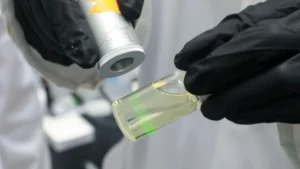
To uncover this behavior, the research team employed a high-precision technique known as angle-resolved photoemission spectroscopy (ARPES). This method involves directing a high-energy ultraviolet laser at the material’s surface. When the photons strike the material, they eject electrons through the photoelectric effect. By measuring the kinetic energy and the exit angle of these displaced electrons, researchers can reconstruct a detailed map of the material’s electronic structure, effectively "seeing" how electrons move and interact within the crystal lattice.
The team, which included postdoctoral scholars Gabriele Berruto and Qiang Gao, focused their laser on a microscopic area just 10 micrometers wide. This precision allowed them to isolate the electronic signatures of $Fe_5GeTe_2$ with unprecedented clarity. What they found was a "flat band"—a region in the energy-momentum spectrum where the energy of the electrons remains nearly constant regardless of their momentum.
In a typical conductor, the energy-momentum relationship is steep, much like a fast-moving river descending a mountain. In $Fe_5GeTe_2$, however, the team found a "plateau." This flatness indicates that the electrons’ kinetic energy is suppressed, forcing them to interact more strongly with one another. "We’re not measuring one electron," Yang explained. "We’re measuring the interaction of thousands or millions of electrons, and they are all moving together in a coherent way. That’s a quantum many-body phenomenon, and it’s actually a very weird thing."
Collective Motion: A Quantum Symphony in Slow Motion
The significance of collective electron motion cannot be overstated in the field of condensed matter physics. When electrons move independently, they behave according to "single-particle" physics, which explains the behavior of standard semiconductors and metals. However, when they move collectively, they enter the realm of "many-body" physics, where the interactions between particles become the dominant force.
In the case of $Fe_5GeTe_2$, this collective behavior results in a charge-ordered state. Charge ordering occurs when electrons, which usually repel each other and move randomly, settle into a rigid, patterned arrangement across the material’s lattice. While charge ordering has been seen in other materials, its appearance in a van der Waals magnet like $Fe_5GeTe_2$ in tandem with a flat band is a significant anomaly.
This "slow-motion" transport is particularly intriguing because, despite the low velocity, the electrons remain "coherent." In quantum mechanics, coherence is the backbone of technology like quantum computing; it allows particles to exist in a superposition of states. Finding a material that maintains this coherence while electrons are moving slowly and interacting strongly provides a new playground for physicists to study the origins of magnetism and electronic order.
Implications for Future Memory Technology
The practical applications of this discovery lie in the realm of data storage and spintronics. Modern hard drives and memory devices rely on the orientation of magnetic domains to store bits of information (0s and 1s). As technology demands smaller and faster devices, conventional magnetic materials are reaching their physical limits.
Van der Waals magnets like $Fe_5GeTe_2$ offer a solution because they can be made atomically thin, allowing for much higher storage density. The discovery of a charge-ordered, many-body phase adds another layer of utility. Yang and his colleagues found evidence that it might be possible to use a focused laser to "switch" the material between this quantum phase and a standard magnetic phase.
"This leads to new possibilities in using this material for new kinds of memory devices," Yang said. If the transition between these electronic states can be controlled precisely, it could lead to non-volatile memory that is faster and requires significantly less power than current silicon-based technologies.
Bridging the Thermal Gap
One of the greatest hurdles in quantum material research is the "temperature problem." Most exotic quantum states, such as those found in many superconductors, only exist at cryogenic temperatures near absolute zero (-459.67°F). Maintaining these temperatures requires expensive and bulky cooling systems, making room-temperature applications a distant dream.
However, the UChicago team found that the coherent behavior in $Fe_5GeTe_2$ persisted up to 100 Kelvin (-280°F). While this is still quite cold, it is significantly higher than the temperatures required for many other quantum phenomena. This "high" temperature threshold suggests that with further chemical "tuning" or by applying external pressure, the effect might eventually be pushed toward room temperature.
"If we eventually want to use it in a memory device, it needs to work at room temperature," noted Qiang Gao, a former UChicago postdoctoral scholar now at Lawrence Berkeley National Laboratory. The team is currently investigating whether the material retains these properties when stripped down to a single atomic layer, a critical step for integrating the material into nano-electronic circuits.
A Paradigm Shift in Theoretical Physics
The experimental results have sent theorists back to the drawing board. Current models used to predict the behavior of van der Waals magnets did not foresee the existence of a flat band or a charge-ordered state in $Fe_5GeTe_2$.
"From a scientific perspective, it suggests that the magnetic interactions within the material are totally different from what theory predicts," said Gabriele Berruto. The discrepancy suggests that the "exchange interactions"—the quantum forces that cause electron spins to align—are more intricately linked to the electrons’ spatial arrangement than previously assumed. This discovery will likely spark a wave of new theoretical studies aimed at reconciling the observed "slow-motion" quantum behavior with the material’s known magnetic properties.
Honoring the Legacy of Peter Littlewood
The publication of this research carries a poignant weight for the University of Chicago community. The study was one of the final projects involving the late Peter Littlewood, a world-renowned theoretical physicist and former Director of Argonne National Laboratory. Littlewood, who passed away on June 15, was a towering figure in quantum materials research and a key collaborator on the project.
"He was a great theoretical physicist and a leader of quantum materials research at UChicago," Yang said. "We dedicate this paper to him." Littlewood’s contributions to the understanding of collective phenomena in solids were instrumental in framing the team’s approach to the $Fe_5GeTe_2$ data, and his influence continues to resonate through the findings.
Conclusion and Next Steps
The discovery of a charge-ordered, many-body state in $Fe_5GeTe_2$ marks a turning point in the study of 2D magnetic materials. By demonstrating that millions of electrons can move in a coherent, slow-motion collective at relatively high temperatures, the UChicago PME team has opened a new door for both fundamental physics and applied engineering.
The research was a collaborative effort, featuring contributions from institutions including the University of Washington and Lawrence Berkeley National Laboratory. Funding was provided by the U.S. Department of Energy and the Gordon and Betty Moore Foundation.
Moving forward, the team aims to explore the "exfoliation limit" of the material. By testing how these quantum properties change as the material is thinned to its absolute limit, they hope to unlock the final secrets of $Fe_5GeTe_2$ and move one step closer to a new era of quantum-based electronics. As the boundaries of Moore’s Law continue to loom, materials like these offer a promising path toward a future where memory is denser, faster, and governed by the strange but powerful laws of quantum mechanics.