The European Space Agency’s Jupiter Icy Moons Explorer (Juice) executed a meticulously planned gravitational slingshot maneuver around Earth on September 28th, a critical phase in its multi-year journey to the gas giant Jupiter. The spacecraft gracefully skimmed the outer reaches of Earth’s atmosphere, leveraging our planet’s gravitational pull to precisely reshape its trajectory and accelerate its onward path toward the Jovian system, all while expending a remarkably minimal amount of its onboard propellant. This "gravity assist" is a cornerstone of deep-space navigation, allowing spacecraft to achieve significant velocity and directional changes without the continuous, fuel-intensive firing of thrusters.
The precisely orchestrated maneuver altered Juice’s trajectory by a significant 20 degrees relative to its previous course and boosted its velocity by an impressive 3.5 kilometers per second. This critical adjustment was achieved with exceptional accuracy; in the four weeks leading up to the encounter, mission controllers found it necessary to implement only one minor course correction out of six pre-planned opportunities. This level of precision underscores the sophisticated planning and execution that underpins such complex interplanetary missions. The period of intensive monitoring for Juice began on August 17th and is slated to continue through October 10th, encompassing the critical flyby window.
A Precisely Timed Celestial Dance
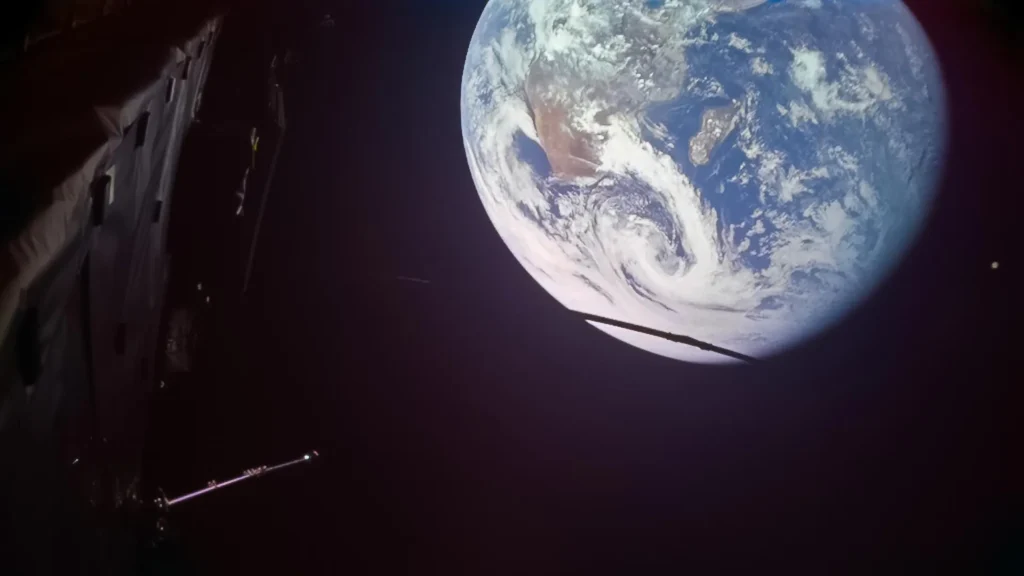
Juice reached its closest point to Earth at 13:45 Central European Summer Time (11:45 UTC) on September 28th. At this apex of its near-Earth passage, the spacecraft traversed a mere 8,640 kilometers above the vast expanse of the Indian Ocean. During this close encounter, the spacecraft’s onboard monitoring cameras were actively engaged, capturing a sequence of images of our home planet.
"The flyby required ultra-precise navigation in real time," stated Angela Dietz, Juice’s Spacecraft Operations Manager. "Thanks to our very careful planning, we used only a small amount of the propellant reserved for this flyby. This gives us more to use at Jupiter to carry out observations of the planet’s icy moons." The conservation of fuel is paramount for Juice, as its mission profile demands substantial propulsive maneuvers and precise orbital adjustments once it reaches the Jovian system and begins its extensive scientific campaign around Jupiter and its moons.
Earth as a Crucial Calibration Ground
While the primary objective of the Earth flyby was to alter Juice’s trajectory, the encounter also served as an invaluable opportunity for the mission team to rigorously test and calibrate the spacecraft’s sophisticated suite of scientific instruments. This terrestrial sojourn provided a real-world planetary target against which the instruments could be evaluated, ensuring their optimal performance for the challenging environment of Jupiter.
This Earth flyby represented the third such significant opportunity for instrument calibration during Juice’s mission. The first occurred during a lunar-Earth gravity assist in 2024, followed by the spacecraft’s observations of Comet 3I/ATLAS in 2025. Teams from ESA’s spacecraft operations, science operations, and technical centers dedicated months to coordinating with external groups responsible for Juice’s ten scientific instruments. The intricate task involved carefully scheduling when each instrument could operate and maximizing the extraction of valuable science and calibration time within the spacecraft’s limited operational resources.
"Juice’s journey to Jupiter provides only a few opportunities to calibrate and validate the instruments under well-understood environmental conditions," explained Claire Vallat, Juice’s Project Scientist, who spearheaded this crucial coordination effort. "Given the limited time available and operational constraints, instrument activities sometimes have to be prioritized, for example when Juice was in Earth’s shadow this morning, and relying on battery power alone. During this flyby, calibration activities were prioritized based on their relevance to preparing the instruments for their work at Jupiter, while also considering whether an opportunity is unique or can be scheduled later in the journey."
A Rehearsal for Jovian Spectacles
Although the Earth encounter demanded extensive preparation, it serves as a critical, albeit relatively simpler, rehearsal for the much more scientifically demanding operations that await Juice at Jupiter. The spacecraft is slated to perform an ambitious 35 flybys of Jupiter’s large moons: Ganymede, Callisto, and Europa. These extensive reconnaissance missions are designed to thoroughly characterize these potentially ocean-bearing worlds.
The planning for these Jovian moon encounters began years in advance. For the Europa flybys, in particular, discussions regarding instrument operations commenced approximately a decade ago and are projected to continue until Juice completes its final passes of the moon in the early 2030s. Therefore, Earth’s gravity assist served as an essential preliminary step, allowing scientists to calibrate instruments, observe their behavior in the operational space environment – which often differs from terrestrial laboratory conditions – and refine the data analysis tools that will be employed for the forthcoming Jovian observations. By the time Juice reaches Jupiter, it must be fully prepared to capture the highest quality scientific data during each fleeting flyby.
Traversing Earth’s Magnetotail: A Scientific Bonus
Beyond its navigational and calibration benefits, Juice also spent several days traversing Earth’s magnetotail during its close approach. The magnetotail is the elongated region of Earth’s magnetic field that stretches away from the Sun, sculpted by the solar wind. This passage provided Juice with a unique opportunity to measure magnetic fields and electrically charged particles in this distant region of Earth’s influence.
Coincidentally, the European-Chinese Smile mission was simultaneously observing Earth’s aurora borealis (northern lights) while measuring magnetic fields and particles much closer to the planet. The synergy between Juice’s measurements from the magnetotail and Smile’s observations near the poles offers scientists a rare opportunity to establish a direct link between activity occurring deep within Earth’s magnetotail and phenomena observed in the planet’s polar regions. This combined data set could provide unprecedented insights into the complex dynamics of Earth’s space environment.
Scientists anticipate the release of images and spectral data from some of Juice’s instruments in the coming weeks. This release will occur after the data have been transmitted to Earth and thoroughly evaluated by the respective instrument teams. Among the highly anticipated results are high-resolution images of Earth and its Moon, captured by JANUS, Juice’s primary scientific camera.
A Final Earthly Rendezvous
Juice’s interactions with Earth are not yet concluded. The spacecraft is scheduled for a third and final flyby of our planet in January 2029. This subsequent encounter will be instrumental in positioning Juice on its final trajectory, setting the stage for its arrival at Jupiter in 2031. This last Earth-based maneuver is crucial for fine-tuning its path for the complex orbital insertions and science operations within the Jovian system.
About the Juice Mission
ESA’s Jupiter Icy Moons Explorer, affectionately known as Juice, represents humanity’s latest ambitious endeavor into the outer reaches of the Solar System. The mission is dedicated to conducting detailed observations of the gas giant Jupiter and its three large, ocean-bearing moons: Ganymede, Callisto, and Europa. This groundbreaking mission aims to comprehensively characterize these moons, employing a powerful array of remote sensing, geophysical, and in situ instruments. The ultimate goal is to uncover more about these compelling worlds as potential cradles for past or present life.
Juice will also meticulously monitor Jupiter’s intricate magnetic, radiation, and plasma environment, investigating its complex interplay with the moons. By studying the Jovian system, scientists aim to gain a deeper understanding of gas giant systems across the universe.
Juice was launched aboard an Ariane 5 rocket from Europe’s Spaceport in Kourou in April 2023. The spacecraft is undertaking an eight-year cruise to Jupiter, which includes strategically planned flybys of Earth and Venus to gain the necessary velocity through gravitational assists. Upon reaching Jupiter, Juice will perform 35 flybys of the three large moons while orbiting the gas giant, before transitioning into a dedicated orbit around Ganymede, the largest moon in the Solar System. This extended mission profile underscores the immense scale and complexity of exploring the outer Solar System.