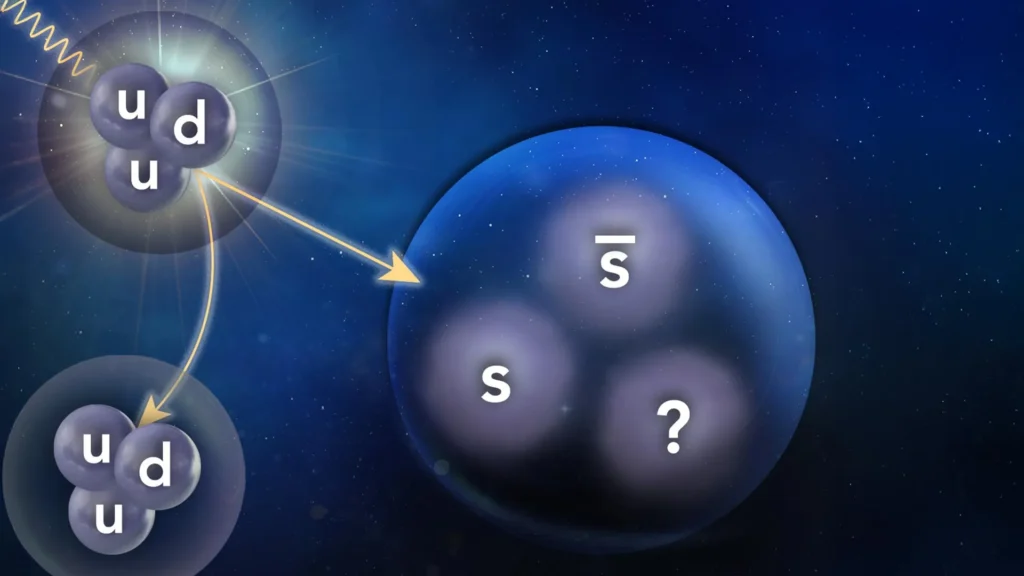
Physicists have spent the better part of the last century attempting to map the infinitesimal world of subatomic particles, yet the universe continues to reveal structures that defy traditional categorization. In a significant development for the field of nuclear physics, researchers at the U.S. Department of Energy’s Thomas Jefferson National Accelerator Facility (Jefferson Lab) have identified evidence of two unexpected particle structures. These signals, detected through the Gluonic Excitations (GlueX) Collaboration, may provide the missing link in understanding a mysterious class of matter known as "XYZ states." Published recently in the journal Physical Review Letters, the findings challenge existing models of how quarks and gluons—the fundamental building blocks of the visible universe—interact to form matter.
The discovery occurred while the GlueX team was searching for a specific, previously theorized particle. Instead of confirming the expected candidate, the experiment revealed two entirely new signals produced when high-energy photons interacted with a proton target. This breakthrough suggests that the "particle zoo," a term coined in the mid-20th century to describe the sudden influx of discovered subatomic particles, is entering a complex new chapter.
The Historical Context of the Particle Zoo
To understand the significance of the Jefferson Lab discovery, one must look back at the evolution of hadronic physics. In the 1950s, the advent of high-energy particle accelerators led to the discovery of a staggering variety of subatomic particles. These particles, categorized as hadrons, are composite objects held together by the strong nuclear force. Protons and neutrons are the most stable and well-known hadrons, but they are far from the only ones.
By 1964, Murray Gell-Mann and George Zweig independently proposed the quark model to bring order to this growing collection. They suggested that hadrons are composed of smaller entities called quarks. Initially, the model included three "flavors": up, down, and strange. This framework successfully categorized the majority of known particles at the time, such as baryons (containing three quarks, like protons) and mesons (containing a quark and an antiquark).
The landscape shifted again in 1974 during the "November Revolution," when the discovery of the J/psi particle confirmed the existence of the charm quark. This discovery was pivotal in the development of the Standard Model of particle physics, which now recognizes six quark flavors: up, down, strange, charm, bottom, and top. As technology advanced, physicists began to observe particles that did not fit the simple two- or three-quark configurations. These anomalies became known as "exotic" states, or XYZ states.
Deciphering the XYZ States and Strangeonium
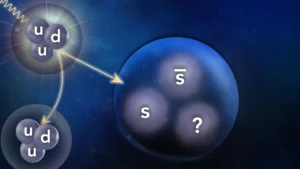
The term "XYZ states" serves as a placeholder for a variety of particles that exhibit properties inconsistent with conventional mesons or baryons. Some are believed to be tetraquarks (four quarks), pentaquarks (five quarks), or even "hadronic molecules" consisting of two mesons bound together. Others are theorized to be "hybrids," where the gluons—the particles responsible for carrying the strong force—play a more active role in the particle’s internal structure than they do in ordinary matter.
A specific area of interest for the GlueX Collaboration is the "strangeonium" sector. These are hadrons composed of a strange quark and its antimatter counterpart, the anti-strange quark. In 2006, the BaBar experiment at the SLAC National Accelerator Laboratory identified a potential strangeonium state with a mass of approximately 2.175 billion electron volts (GeV), designated as Y(2175).
While Y(2175) was subsequently observed in experiments in China (BES) and Japan (Belle), it had only ever been seen through a process called electron-positron (e+e-) annihilation. The Jefferson Lab team sought to observe Y(2175) through a different mechanism—photoproduction—to see if the particle’s nature could be better understood. However, the results of the GlueX experiment took an unexpected turn.
The GlueX Experiment: A Unique Methodology
The GlueX experiment, located in Experimental Hall D at Jefferson Lab, is uniquely equipped to hunt for exotic matter. Unlike many other accelerators that rely on colliding beams of electrons and positrons, GlueX utilizes a high-energy photon beam.
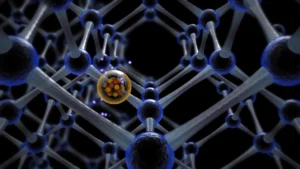
The process begins with the Continuous Electron Beam Accelerator Facility (CEBAF), a massive underground accelerator that pushes electrons to nearly the speed of light. These electrons are then directed through an ultrathin diamond wafer. Through a process known as coherent bremsstrahlung, the electrons produce a beam of high-energy, polarized photons. These photons are then slammed into a liquid hydrogen target containing protons.
When a high-energy photon strikes a proton, the energy of the interaction can create new particles. A large-acceptance spectrometer, which surrounds the target, detects the "spray" of particles resulting from these collisions. This setup allows researchers to reconstruct the properties of the short-lived particles produced in the interaction.
"No other experiment has a facility with a photon beam of this intensity at the energy we have available," said Malte Albrecht, a staff scientist at Jefferson Lab and a lead researcher on the project. This intensity is crucial because exotic states are incredibly rare and short-lived, requiring massive amounts of data to identify.
The Discovery of Y(2240) and X(1830)
The primary goal of the recent GlueX run was to find evidence of Y(2175) through photoproduction. If the particle appeared, it would provide a new "angle" from which to study its internal structure. However, the data did not show the Y(2175) signal. Instead, the researchers identified two distinct, unexpected structures at different mass points.
The first signal, designated Y(2240), appeared at a mass of approximately 2.24 GeV. This structure is particularly significant because it was detected with a statistical certainty of five sigma (5σ). In the world of particle physics, five sigma is the "gold standard" for a discovery, representing a 99.9994% confidence level. This means the probability that the signal is a mere statistical fluke is less than one in a million.
The second signal, labeled X(1830), was found at a lower mass of approximately 1.82 GeV. While the signal for X(1830) was not as strong as Y(2240), it reached a significance of three sigma (3σ), which corresponds to a 99.7% confidence level. While not yet a "confirmed discovery" by the strictest physics standards, it is a highly notable signal that warrants further investigation.
"One of the interesting things about this result is that we didn’t observe Y(2175) at the place we were searching," Albrecht noted. "We found something new using a completely different physics process."
Implications for Quantum Chromodynamics (QCD)
The discovery of these new states has profound implications for Quantum Chromodynamics (QCD), the theory that describes the strong nuclear force. QCD explains how quarks are bound by gluons, but the mathematics of the theory is notoriously difficult to solve at the energy levels where hadrons form.
One of the most elusive predictions of QCD is the existence of "hybrid mesons." In a typical meson, the gluons act simply as the "glue" holding the quark and antiquark together. In a hybrid meson, the gluonic field is "excited," meaning the gluons themselves contribute to the particle’s quantum numbers, such as its spin and parity.
"Excited gluonic fields are what could be in these mesons where you have more than just the quark-antiquark pair," explained Justin Stevens, a William & Mary physics professor and spokesperson for GlueX. The Y(2240) and X(1830) signals could potentially represent these hybrid states, or they could be new forms of multi-quark configurations. By identifying these states through photoproduction—a process that interacts with the internal structure of the proton differently than electron collisions—scientists can better map the "spectrum" of possible hadronic matter.
Global Collaboration and Future Research
The findings at Jefferson Lab are the result of a massive international effort. The GlueX Collaboration involves more than 1,700 physicists from around the world, including researchers from Germany’s GSI Helmholtz Centre for Heavy Ion Research and Goethe University Frankfurt.
The task of reconciling these new signals with previous discoveries is a complex global puzzle. Klaus Goetzen, a GSI physicist involved in the research, emphasized the difficulty of reaching a scientific consensus. "It’s more complicated than it sounds, because there are states that are close by in mass and might or might not be the same thing," Goetzen said.
The fact that Y(2175) was not seen in photoproduction actually provides valuable data for theorists. It allows them to set an "upper limit" on the production cross-section of that particle, helping to rule out certain models of its internal structure. If Y(2175) were a simple quark-antiquark pair, it should have appeared more readily in the GlueX data. Its absence, combined with the presence of Y(2240), suggests that the internal dynamics of these particles are far more exotic than previously thought.
A New Era of Subatomic Exploration
The identification of Y(2240) and X(1830) marks the beginning of a new phase for GlueX and the broader physics community. The experiment generates enormous quantities of data—enough to fill a standard laptop’s hard drive every few minutes. As the collaboration continues to analyze the petabytes of information collected during their experimental runs, more signals are expected to emerge.
The next step for the research team is to determine the specific quantum properties of these new structures, such as their spin and parity. This will allow theorists to refine their models and determine whether nature has realized tetraquarks, hybrids, or something else entirely.
Frank Nerling, a Jefferson Lab collaborator, summarized the current state of the field: "We are in a new era here, similar to 70-odd years ago. First, a zoo of hadrons was discovered. Now, we’re facing a zoo of so-called exotic states."
As Jefferson Lab continues to push the boundaries of the known subatomic world, the discovery of Y(2240) and X(1830) stands as a testament to the fact that even the most fundamental building blocks of reality still hold many secrets. These two new signals have not only expanded the particle catalog but have also provided a new lens through which to view the mysterious force that holds the universe together.