A groundbreaking development from Massachusetts Institute of Technology (MIT) engineers has demonstrated that even a single, ultra-thin layer of muscle cells can generate sufficient power to propel a robot through water. This innovation introduces a novel design for a muscle-powered swimming robot, detailed in a paper published today in the journal Advanced Functional Materials, which could pave the way for a new generation of soft, adaptable machines.
The newly engineered "aquabot" represents a significant leap in biohybrid robotics, featuring a skeleton crafted from a gel film approximately the size and shape of a stick of gum. This film is divided into two halves, forming the robot’s "fins." Each fin is meticulously coated with a layer of live muscle cells, astonishingly thinner than a single strand of human hair. These specialized cells have been genetically engineered to twitch precisely in response to light stimulation.
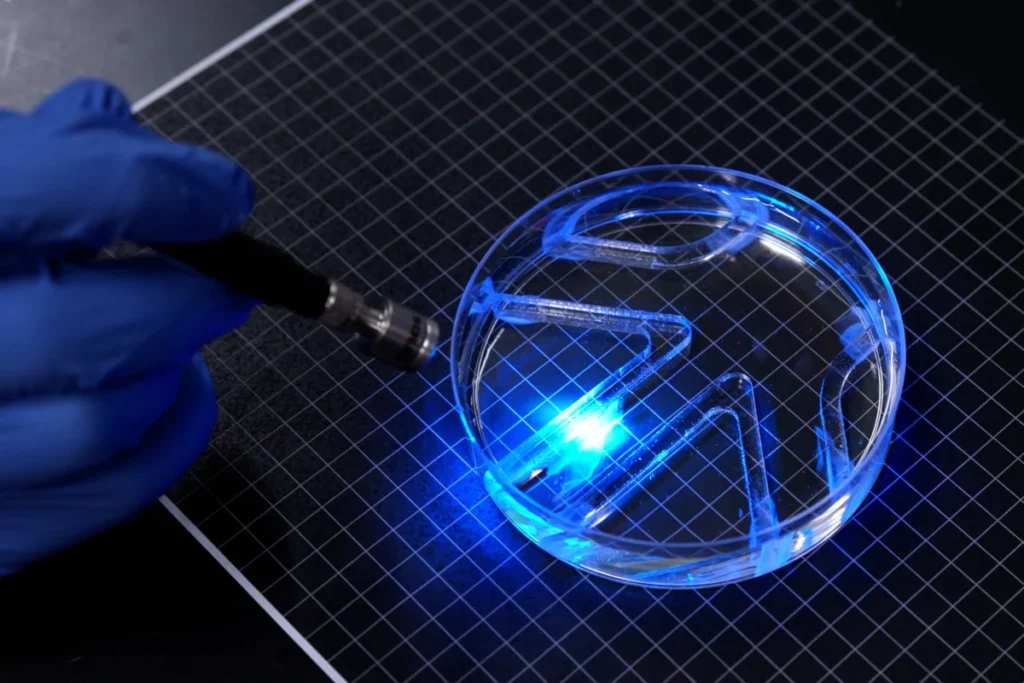
The operational mechanism is elegantly simple yet remarkably effective: when researchers direct light onto one of the robot’s fins, the muscle cells on its surface contract in unison, causing the fin to flap with enough force to propel the robot through water. By strategically flashing light onto either fin at varying intervals, the team can precisely control the swimming robot’s direction and speed. This optogenetic control system offers unprecedented dexterity for biohybrid systems of this scale.
Demonstrating its capabilities, the paper-thin robot successfully navigated and swiveled through a rudimentary watery maze. At its peak performance, the robot achieved a swimming speed of approximately four times its body length per minute. While this pace is modest when compared to the blistering speeds of Olympic swimmers, who can cover up to 65 body lengths per minute, it is comparable to the more leisurely aquatic exploration of creatures like the cow shark, which navigates ocean environments at a similar rate.
Ritu Raman, an associate professor of mechanical engineering at MIT and a lead author on the study, commented on the robot’s surprising robustness. "It takes a lot of force to move through water versus air," Raman stated. "The robot’s quite strong, given its size." This strength, derived from a remarkably minimal biological component, underscores the efficiency of the design.
The Dawn of Biohybrid Robotics: A New Paradigm in Locomotion
The development of the muscle-powered aquabot marks a crucial milestone, as it is the first instance of a very thin, two-dimensional, muscle-powered robot capable of sustained locomotion. Biohybrid robotics, a burgeoning field at the intersection of biology and engineering, seeks to integrate living biological components with synthetic materials to create robots that leverage the unique properties of life, such as self-healing, adaptability, and inherent responsiveness to environmental cues.
Traditional micro-robotics often face significant challenges in scaling down, particularly concerning power sources, flexibility, and biocompatibility. Conventional actuators, such as electric motors or pneumatic systems, can be bulky, rigid, and complex to miniaturize effectively, especially for applications requiring interaction with delicate biological systems or sensitive environments. The prospect of using living muscle tissue as an actuator offers an elegant solution to many of these limitations, providing inherent compliance, high energy density, and the potential for autonomous repair.
Historically, biohybrid robots developed by Raman’s group and others have relied on "bulky, 3D chunks of lab-grown skeletal muscle that require millions of cells to fabricate," as Raman noted. These earlier designs, while demonstrating the feasibility of muscle-driven locomotion, were often less efficient and more complex to manufacture. The new thin, less bulky design represents a significant advancement in cost-effectiveness and operational efficiency. The vision for these soft, living machines extends to "delicate jobs like exploring environments too fragile or unpredictable for conventional hardware," an aspiration rooted in the intrinsic properties of living tissue – its softness, responsiveness, and remarkable capacity for self-healing. This inherent biological resilience offers a distinct advantage over purely synthetic systems, which typically suffer irreversible damage from mechanical stress or environmental degradation.
Engineering Life: The Mechanics of the Aquabot
The meticulous engineering behind the aquabot is a testament to the interdisciplinary nature of biohybrid robotics. The core of the robot’s structure, its "skeleton," is a film of gelatin methacrylate (GelMA). GelMA is a biocompatible hydrogel widely used in tissue engineering due to its tunable mechanical properties and excellent cellular compatibility. The choice of GelMA over previous materials like fibrin, an ultrasoft gel used in earlier experiments, was critical. Fibrin, while suitable for cell growth, was found to shrivel quickly under the forces generated by contracting muscles, limiting the overall movement.
The MIT team systematically optimized three key properties of the underlying gel: its composition, stiffness, and the geometry of the grooves stamped into its surface. These "knobs," as Raman refers to them, are fundamental parameters in tissue engineering that dictate how cells grow and exert force. Through rigorous experimentation, the researchers identified that stiffer GelMA formulations provided better support for muscle cell growth, leading to improved alignment and increased force generation.
Equally crucial was the design of the micro-grooves on the gel’s surface. The team experimented with various groove geometries, including skinny square troughs and long curved valleys. They discovered that muscle cells exhibited superior alignment within grooves that were more square-shaped. This enhanced alignment is vital because highly aligned cells tend to fuse into stronger, more coordinated muscle fibers, forming a cohesive and powerful muscle tissue.
The muscle cells themselves are a marvel of bioengineering. They are genetically modified to express light-sensitive proteins, a technique known as optogenetics. This allows researchers to precisely control muscle contraction using specific wavelengths of light. By shining light, the cells receive a signal to twitch, translating biochemical energy into mechanical force. The thinness of the muscle layer, much less than a hair’s width, minimizes bulk while maximizing the surface area for light absorption and efficient contraction.
The final structural optimization involved the gel’s thickness. A half-millimeter-thin film of GelMA proved ideal, offering robust support for the single layer of muscle cells while remaining light enough to prevent the cells from peeling away during contraction. This delicate balance ensures that the generated forces are effectively transmitted into mechanical movement of the fins.
Before deployment, the muscles underwent a unique "training" regimen. Using a routine of flashing lights, akin to physical exercise for biological tissues, the researchers strengthened the muscle cells. This process, likely promoting better myofibril development and cellular connectivity, further enhanced the force-generating capacity of the bio-actuators. The result was a robust, aligned muscle tissue capable of significant contractile force. The two independent muscle-covered fins, when selectively illuminated, allow for differential flapping, enabling the robot to steer and adjust its speed with remarkable precision.
A Chronology of Innovation: From Iris to Aquabot
The development of this swimming robot is not an isolated breakthrough but rather a logical progression in Raman’s group’s ongoing research into biohybrid systems. Last year, the same team unveiled an "iris-inspired disk of artificial muscle tissue." In that earlier work, they created a disk of gel stamped with a pattern of concentric and radial grooves. Live muscle cells were then deposited onto this surface, forming a thin layer that grew along the intricate patterns. When stimulated with light, these cells exhibited movements that stretched and squeezed the disk, mimicking the way a human iris dilates and constricts the eye’s pupil.
That pioneering work was instrumental in demonstrating several key concepts: firstly, that muscle cells could be grown effectively in very thin layers; and secondly, that they could be patterned in complex geometries to produce multi-directional and controllable movements upon stimulation. Raman highlighted the novelty of this earlier achievement, noting, "People hadn’t seen this muscle architecture engineered from scratch before." However, she also acknowledged a critical limitation: "And the cells were moving in multiple directions. But they only moved about 100 microns. From a robotics perspective, their movements were tiny."
This prior research, while foundational, revealed the need to maximize muscle movements to generate greater force – enough, specifically, to power a functional swimming robot. The primary objective shifted from demonstrating complex, multi-directional micro-movements to achieving substantial locomotion. This led directly to the intensive optimization efforts detailed in the current study, focusing on refining the underlying skeleton and enhancing muscle force output. The transition from fibrin to GelMA, the detailed tuning of gel stiffness and groove geometry, and the muscle training protocol were all direct responses to the lessons learned from the iris-inspired disk, aiming to overcome the limitation of minimal displacement and achieve robust, macroscopic movement.
Performance and Potential: A Snail’s Pace with Giant Implications
The performance metrics of the new biohybrid aquabot, while modest by human-engineered standards, are highly significant in the context of micro-scale biohybrid robotics. Swimming at approximately four body lengths per minute means a robot roughly 1 cm long could cover 4 cm in a minute. While a cow shark might average speeds of around 0.5 to 1 meter per second (or 30-60 meters per minute), its body length is significantly greater, often several meters. Therefore, a cow shark’s speed in body lengths per minute might indeed be comparable, emphasizing the efficiency of the robot’s design given its minuscule scale and the inherent challenges of moving through water, which is far more viscous than air.
The ability of the paper-thin bot to swim and swivel through a watery maze is a crucial demonstration of its controlled locomotion. This navigational capability, achieved solely through light-activated muscle contractions, opens doors for a wide array of applications where precise, adaptable movement in confined or delicate aquatic environments is required.
The advantages of this thin, 2D biohybrid robot design are multifaceted. Firstly, the reduced bulk significantly lowers the material requirements, potentially making these robots cheaper and more efficient to build compared to their 3D counterparts that necessitate millions of cells. Secondly, the inherent softness and flexibility of living tissue, combined with the hydrogel skeleton, make these robots uniquely suited for interacting with fragile biological systems without causing damage. This is a critical factor for potential medical applications, such as navigating within blood vessels or other bodily fluids.
Furthermore, the responsiveness of living tissue to its surroundings and its capacity for self-healing offer distinct long-term benefits. A conventional robot damaged in a harsh environment might require costly repair or replacement, whereas a biohybrid robot, theoretically, could repair minor damage to its biological components over time, extending its operational lifespan and reducing maintenance needs in inaccessible locations. Raman’s vision of using these robots for "delicate jobs" in "fragile or unpredictable" environments underscores these unique attributes. Imagine a biohybrid robot gently navigating a coral reef to monitor its health, or exploring the internal structures of a human organ without causing trauma.
The Broader Landscape: Challenges and the Road Ahead
Despite these promising advancements, the field of biohybrid robotics, and this new aquabot specifically, still faces significant challenges before widespread application. One primary concern is the lifespan and stability of the living muscle cells. While these cells are robust in a controlled laboratory environment, maintaining their viability and functionality over extended periods in diverse, real-world conditions presents complex biological and engineering hurdles. Issues such as nutrient supply, waste removal, and maintaining optimal temperature and pH for cell survival need to be addressed for autonomous, long-term operation.
Another critical area for development is the integration of on-board power sources and control systems. The current robot relies on external light for activation. For true autonomy, future iterations would need miniaturized, self-contained power units and sophisticated internal control mechanisms, perhaps leveraging miniaturized optical emitters or even integrated neural interfaces. Scalability and manufacturing consistency are also important considerations, moving from laboratory prototypes to mass-producible units.
However, the potential applications are vast and compelling, driving continued research in this interdisciplinary field. In the medical domain, these soft, biocompatible robots could revolutionize targeted drug delivery, navigating complex vascular networks to deliver therapies directly to disease sites, minimizing systemic side effects. They could also serve as minimally invasive surgical tools or highly sensitive diagnostic probes, exploring internal organs with unprecedented gentleness.
Environmentally, biohybrid robots could be deployed for micro-pollutant detection in aquatic ecosystems, monitoring water quality in sensitive habitats, or even assisting in localized bio-remediation efforts. Their ability to explore environments too fragile for conventional hardware makes them ideal candidates for deep-sea exploration or studying delicate marine life without disturbance. In fundamental research, these robots provide invaluable platforms for studying muscle mechanics, cellular behavior in dynamic environments, and the principles of biological locomotion.
The research embodies a powerful convergence of biology, mechanical engineering, and materials science. The long-term vision for biohybrid systems extends to creating truly autonomous, self-sustaining robots that can not only move and interact with their environment but also adapt, grow, and even reproduce, blurring the lines between machine and organism. This new aquabot represents a tangible and significant step towards realizing that ambitious future.
Acknowledgments and Scientific Contributions
The groundbreaking work published in Advanced Functional Materials was led by Ritu Raman, with Maheera Bawa as the first author. Critical contributions were also made by co-authors Arielle Berman, Laura Schwendeman, Ferdows Afghah, and Seanbiron Johnson, all affiliated with MIT. Their collaborative efforts underscore the complex, multi-faceted nature of modern scientific inquiry, bringing together diverse expertise to push the boundaries of what is possible in robotics and bioengineering.
Professor Raman’s insights consistently highlight the pragmatic yet visionary aspects of this research. Her emphasis on the robot’s strength relative to its size, and her articulation of the broader implications for biohybrid robots in performing "delicate jobs," effectively encapsulate the immediate impact and the long-term promise of this scientific advancement. This research does not just demonstrate a new type of robot; it offers a compelling glimpse into a future where machines are not merely tools but living extensions, capable of interacting with the world in fundamentally new ways.
The MIT team’s success in creating a thin, robust, and controllable muscle-powered swimmer is a powerful indicator of the transformative potential of biohybrid robotics. By leveraging the inherent capabilities of living cells, they are crafting machines that are soft, responsive, and ultimately, more harmoniously integrated with the natural world. This innovation opens numerous avenues for exploration, challenging our conventional understanding of robotics and pointing towards a future where the lines between biology and engineering become increasingly blurred.