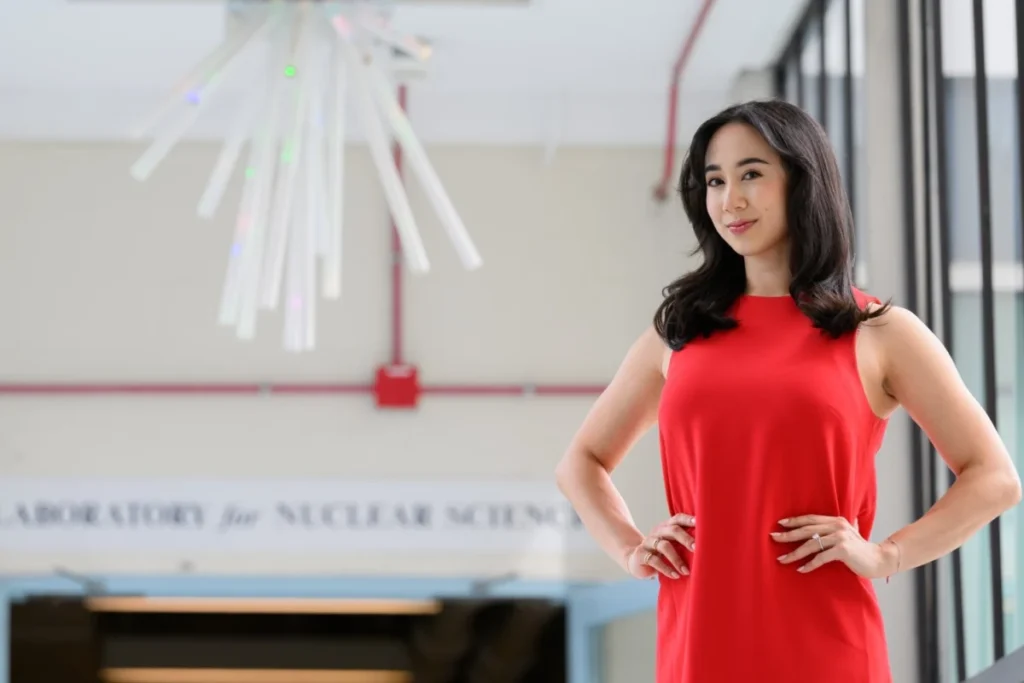
In the high-pressure world of particle physics, the search for the invisible governs the lives of the world’s most elite researchers. Among them is Jessica Fry, a fifth-year PhD candidate at the Massachusetts Institute of Technology (MIT) Laboratory for Nuclear Science (LNS), whose path to the frontiers of astrophysics began not in a laboratory, but on the stages of Broadway. Fry is currently at the center of a global effort to detect dark matter, a substance that constitutes approximately 85 percent of the matter in the known universe but has evaded direct detection for nearly a century. Her work focuses on a theoretical particle known as the axion, a candidate that many believe holds the key to unlocking the mysteries of the cosmos.
Fry’s journey represents a unique intersection of high-stakes performance art and rigorous scientific inquiry. A native of the San Francisco Bay Area, she grew up in the shadow of the SLAC National Accelerator Laboratory, an environment that fostered an early curiosity about the fundamental building blocks of reality. However, her first discipline was dance. By the age of three, she was immersed in ballet and contemporary movement, eventually competing at a national level. This early commitment to excellence—symbolized by a childhood photo on her desk of her performing in a ham costume—established a lifelong ethos of "all-in" dedication that she now applies to her doctoral research.
The Formative Years: From Detectors to Stanford
The transition from a student of dance to a serious student of physics was catalyzed during Fry’s high school years. When her physics teacher provided her with a pair of decommissioned detectors from SLAC, Fry did not merely treat them as curiosities. She located a research paper from the 1960s that utilized similar instrumentation, replicated the original experiment, and produced a comprehensive project report. This experience provided her with a realization that would define her career: the ability to use physical, tangible tools to answer profound philosophical questions about the nature of space and time.
Upon enrolling at Stanford University, Fry refused to choose between her two passions, opting to double major in physics and theater and performance studies. This dual track required a high degree of discipline, which was put to the ultimate test during her sophomore year. A talent agent invited her to audition for a Broadway revival of David Henry Hwang’s "M. Butterfly." Navigating the grueling schedule of Stanford’s midterm season, Fry flew to New York for the audition and returned immediately to sit for her exams.
After a month of silence, Fry assumed her theatrical aspirations had reached a dead end. She secured a prestigious summer research fellowship at CERN, the European Organization for Nuclear Research, in Geneva, Switzerland. It was only after she arrived in Europe that she received the call confirming her casting in the Broadway production. After completing her research at the world’s largest particle physics laboratory, she transitioned directly to the rehearsal halls of New York City, beginning a two-year hiatus from her academic studies.
The Broadway Interlude and the Return to MIT
During her time on Broadway, Fry underwent intensive training in a diverse array of disciplines, including Peking opera-style movement, stage combat, and traditional Māori dance. While she excelled in the performance world, the "occupational hazards" of the theater began to weigh on her. She noted that the constant cycle of auditions and external validation often forced performers to trust the opinions of strangers over their own self-perception. This internal conflict led to a period of deep reflection, eventually prompting her to return to Stanford to complete her degrees.
Her return to academia was marked by a renewed focus. When applying for graduate programs, MIT stood out due to the sheer scale and "scientific energy" of its Laboratory for Nuclear Science. Fry remarked that the atmosphere at MIT mirrored the "buzz" she had experienced at CERN, providing a collaborative environment that was essential for tackling the complex problem of dark matter.
The Hunt for the Axion: Searching for the Unseen
At MIT, Fry joined the Neutrino and Dark Matter Group under the leadership of Professor Lindley Winslow. Her research targets the axion, a hypothetical ultralight particle. Unlike the more commonly discussed Weakly Interacting Massive Particles (WIMPs), axions are so light that they behave more like waves than discrete particles. These waves are thought to permeate the galaxy, clustering gravitationally around visible matter.
The search for dark matter is necessitated by the "missing mass" problem in astrophysics. Since the 1930s, when Fritz Zwicky first observed that galaxy clusters were moving too fast to be held together by visible matter alone, and the 1970s, when Vera Rubin provided evidence of flat rotation curves in galaxies, scientists have known that an invisible substance must exist to provide the necessary gravitational pull. If the axion exists, it would not only explain dark matter but also solve the "strong CP problem" in quantum chromodynamics, which concerns the unexpected symmetry of the strong nuclear force.
Fry is currently involved in two primary experimental efforts:
- ABRACADABRA (A Broadband/Resonant Approach to Cosmic Axion Detection with a Bayesian B-Ring Apparatus): This MIT-based experiment uses a toroidal magnet to create a high-intensity magnetic field. If axions pass through this field, they are predicted to create a tiny, oscillating magnetic field that can be detected by a superconducting quantum interference device (SQUID).
- DMRadio (Dark Matter Radio): A collaboration between Stanford and MIT, this project operates on a similar principle, functioning essentially like a highly sensitive radio. Researchers tune the detector to different frequencies, searching for the specific "station" or frequency that corresponds to the mass of the axion.
Technical Challenges and Signal Analysis
The primary difficulty in Fry’s work is the signal-to-noise ratio. The electric current produced by an axion interaction is incredibly faint—far weaker than the thermal noise generated by the equipment itself or the environmental interference from the surrounding world. To mitigate this, the experiments are conducted at cryogenic temperatures, near absolute zero, and utilize quantum amplifiers to boost the potential signal.
"Think about two waves in the ocean—when they collide, they create a rip current. We are looking for that rip current," Fry explained. Because the exact mass of the axion is unknown, the research team must systematically scan a wide range of frequencies. While the search is exhaustive, Fry remains optimistic because the theoretical shape of an axion signal is highly distinctive. Once a signal is found that matches the predicted wave-like signature, it would be virtually impossible to mistake it for background noise.
Institutional Support and Broader Implications
Professor Lindley Winslow, Fry’s advisor, has noted that Fry’s background in performance contributes to her success as a physicist. Winslow observed that Fry possesses a "fearlessness to deliver" when the metaphorical curtain rises, combined with a relentless drive for feedback and improvement. This blend of artistic discipline and scientific rigor is a hallmark of the MIT LNS, which functions as a collaborative hub for over 400 researchers.
Fry’s contributions to the field have already garnered significant recognition; she was named to the Forbes 30 Under 30 Science list for 2026. As she enters the final stretch of her PhD program, her focus remains on the data analysis for DMRadio and the completion of the detector’s current run.
The implications of Fry’s research extend far beyond the laboratory. A successful detection of the axion would constitute one of the greatest discoveries in the history of science, providing a definitive answer to what makes up the majority of the universe’s mass. It would pave the way for a "New Standard Model" of physics and potentially open doors to new technologies based on the manipulation of dark matter waves.
Conclusion: The Inevitability of Discovery
For Jessica Fry, the search for dark matter is not a matter of "if," but "when." Her transition from the stages of Broadway to the cleanrooms of MIT and Stanford reflects a broader trend of interdisciplinary thinkers entering the STEM fields, bringing with them unique perspectives on problem-solving and persistence.
As she continues to "tune the radio" of her detectors, Fry remains grounded by her love for the physical world. She still dances at a studio near Harvard, finding that the physical exertion provides a necessary balance to the mental demands of particle physics. With a clear vision for her future—which may include a postdoctoral fellowship or the development of her own independent detector—Fry is prepared for the long haul. "I realized that doing physics is going to make me happy and allow me to make the impact I want to," she says. In the quiet, cold depths of the detectors she helps build, the universe’s most elusive secret may finally be ready for its debut.