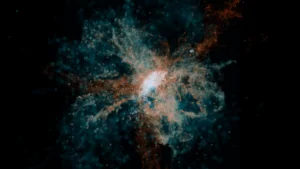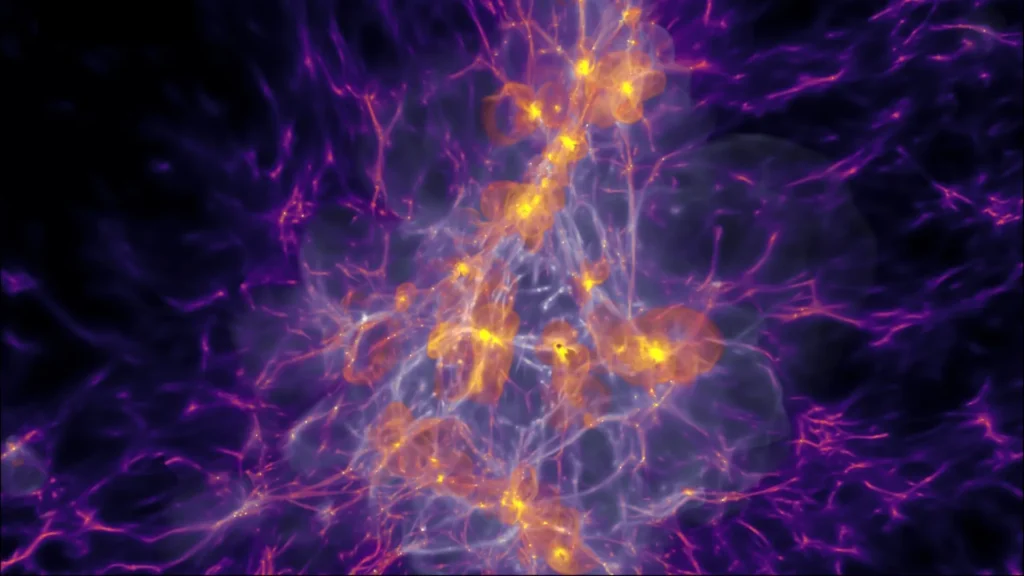
Researchers are leveraging extraordinarily detailed computer simulations to reconstruct one of the most transformative periods in cosmic history: the era when the first stars and galaxies began to emerge. This ambitious undertaking, known as the MEGATRON project, promises to bridge the gap between cutting-edge observational data and our fundamental understanding of the Universe’s origins, particularly the genesis of the chemical elements that form the bedrock of planets and life itself.
The Dawn of Cosmic Illumination
The MEGATRON project, a collaborative effort spearheaded by scientists at the University of Bath in the United Kingdom, with crucial contributions from the University of Chicago in the United States and the Institut d’Astrophysique de Paris in France, is dedicated to unraveling how the Universe transitioned from a dark, primordial state to one filled with the light of nascent stars and galaxies. This period, often referred to as the "Cosmic Dawn" and the subsequent "Epoch of Reionization," was a pivotal moment, initiating the cosmic chemical evolution that eventually led to the formation of everything we observe today, from the smallest atom to the grandest celestial structures.
The project’s initial findings, detailed in four studies published in the Open Journal of Astrophysics, represent a significant milestone. These publications showcase the integration of sophisticated cosmological simulations with intricate models that account for radiation, complex chemical reactions, and the fundamental processes of galaxy formation. This comprehensive approach is designed to provide a holistic view of this formative epoch, offering insights that were previously unattainable. The MEGATRON collaboration anticipates releasing further studies in the future, building upon this foundational work.
Bridging Observational Frontiers: JWST and Ancient Stellar Relics
A core objective of MEGATRON is to harmonize two distinct yet complementary lines of evidence from the early Universe: the direct observations of infant galaxies captured by the James Webb Space Telescope (JWST) and the chemical signatures imprinted within some of the oldest stars in our own Milky Way galaxy.
The JWST, launched in December 2021, has revolutionized our ability to peer back in time. Its unprecedented infrared capabilities allow astronomers to detect light that has traveled for billions of years, providing a direct window into the Universe as it was just a few hundred million years after the Big Bang. These observations offer snapshots of the earliest galaxies, revealing their sizes, compositions, and the rates at which they were forming stars.
Complementing these distant glimpses are the ancient stars found within and around the Milky Way. These stellar relics, some of which formed within the first billion years of the Universe’s existence, act as cosmic time capsules. By analyzing the abundance of different elements in their atmospheres – a process known as stellar spectroscopy – scientists can infer the conditions under which these stars formed and the chemical enrichment that occurred in their immediate cosmic neighborhood. This "stellar archaeology" allows researchers to reconstruct the nucleosynthetic processes of the first stellar generations.
The challenge, as highlighted by the MEGATRON findings, lies in accurately modeling the complex interplay between starlight, the surrounding interstellar gas, and the newly synthesized elements. Without a precise understanding of these interactions, it becomes difficult to reconcile the information gleaned from JWST’s distant observations with the chemical fingerprints found in our local ancient stars. MEGATRON aims to provide this crucial physical link, enabling a more cohesive interpretation of both datasets.
The Power of High-Resolution Simulation
The MEGATRON simulations meticulously track the evolution of a young galaxy from its nascent stages, progressing towards a system comparable in mass to our own Milky Way. This evolutionary journey spans billions of years, during which the simulations simultaneously monitor the dynamics of gas accretion and outflow, the propagation of starlight through space, and the dynamic changes in the concentrations of various chemical elements.
This granular approach allows researchers to investigate the profound impact of successive stellar generations on the gas within and surrounding galaxies. As stars are born, live, and die, they forge heavier elements through nuclear fusion and supernova explosions, dispersing these elements into the interstellar medium. This enriched material then serves as the building blocks for subsequent generations of stars and planets. MEGATRON’s detailed simulations enable scientists to witness this cyclical process unfold over cosmic timescales.
Limitations of Simpler Models
A significant implication of the MEGATRON results is the potential for less detailed cosmological models to underestimate the impact of stellar radiation and intricate chemical processes on the circumgalactic medium – the gas surrounding galaxies. These simpler models, often constrained by computational limitations, may not fully capture the complex physical phenomena at play.
By simulating these effects at exceptionally high resolutions, the MEGATRON team has been able to resolve fine-grained structures within the gas that are often smoothed over or missed entirely by less sophisticated approaches. This enhanced detail is crucial for accurately predicting observable phenomena and for interpreting the ever-increasing volume of data being collected by current and future astronomical instruments. The ability to resolve these subtle structures is key to understanding how the early Universe was shaped and reionized.
A Direct Glimpse and a Physical Bridge
Dr. Martin Rey, a lead contributor to the MEGATRON collaboration from the Department of Physics at the University of Bath, articulated the project’s significance: "The James Webb Space Telescope gives us a direct glimpse of the infant cosmos, while stellar archaeology allows us to study the relics of those earliest times in our own Galactic neighborhood. MEGATRON provides a physical bridge between the two." This statement encapsulates the project’s dual focus: capturing the fleeting moments of cosmic dawn through observation and reconstructing the past through theoretical modeling.
The simulations commence with a representation of pristine gas, devoid of heavy elements, mirroring the conditions that prevailed in the Universe shortly after the Big Bang. From this primordial state, the models meticulously follow the formation of the very first stars, the intense radiation they emit, the cataclysmic supernova explosions that mark the end of their lives, and the subsequent dispersal of newly synthesized elements that seed future generations of stars and galaxies.
This comprehensive reconstruction is poised to address one of astronomy’s most profound and enduring questions: the origin of the elements that constitute the modern Universe. The elements essential for life as we know it – carbon, oxygen, iron, and countless others – were not present at the dawn of creation. They were forged in the fiery furnaces of stars. Understanding their origins necessitates a deep comprehension of how the first stars formed, evolved, and enriched their surroundings. MEGATRON offers a powerful tool for testing these hypotheses by directly comparing the results of its detailed simulations with observational data from JWST and the chemical evidence preserved in ancient stars.
Tracing the Origins of Cosmic Elements: A Timeline of Discovery
The journey of the MEGATRON project began in 2023, with a projected completion date of 2030. This multi-year endeavor is strategically designed to capitalize on the rapidly evolving landscape of astronomical observations.
- Early Universe (Post-Big Bang): The simulations start with a Universe composed primarily of hydrogen and helium, with trace amounts of lithium. No heavier elements exist.
- Formation of First Stars (Population III Stars): The initial gravitational collapse of gas clouds leads to the formation of the very first stars. These are theorized to be massive, short-lived, and composed solely of primordial elements. Their intense ultraviolet radiation begins to ionize the surrounding neutral hydrogen, marking the beginning of the Epoch of Reionization.
- First Supernovae and Element Dispersal: The explosive deaths of these first stars (supernovae) are crucial events. They forge heavier elements (metals, in astronomical terms) through nucleosynthesis and eject them into the interstellar medium.
- Formation of First Galaxies: The enriched gas begins to accumulate under gravity, leading to the formation of the first small galaxies. These galaxies host subsequent generations of stars, which are now born with a small fraction of heavier elements.
- JWST Era Observations (Present): The James Webb Space Telescope is currently observing these early galaxies, providing direct evidence of their existence, properties, and star formation rates in the Universe’s infancy.
- Stellar Archaeology (Ongoing): Astronomers continue to identify and analyze the chemical composition of ancient stars within and around the Milky Way, providing a "fossil record" of the chemical enrichment history of our galaxy.
- MEGATRON Simulations (2023-2030): The project utilizes supercomputing power to model these processes in detail, aiming to connect the JWST observations with the stellar archaeology data.
As the project progresses, researchers plan to refine their simulations to establish even stronger correlations between theoretical predictions and the burgeoning observational datasets. The JWST continues to unveil new details about the earliest known galaxies, pushing the boundaries of our knowledge. Simultaneously, extensive stellar surveys are generating increasingly precise measurements of ancient stars, offering a more detailed chemical inventory of the past. The synergy between these two distinct observational avenues, when combined with the insights from MEGATRON, holds the potential to paint a remarkably clear picture of the first generations of stars and their impact on the cosmos.
Computational Power and Future Prospects
The MEGATRON project has been allocated a substantial 40 million processor hours on the United Kingdom’s national supercomputing infrastructure. To put this into perspective, this equates to the computational power of approximately five million laptops running concurrently for an entire year. This immense computing capacity is indispensable for running simulations with the requisite resolution and physical complexity.
These advanced resources will enable the team to construct simulations with even finer detail and more comprehensive physical models. This will allow for increasingly direct and robust comparisons between the simulated cosmic evolution, the observations from JWST, and the chemical fossil record preserved in ancient stars.
Dr. Rey emphasized the project’s unique position: "MEGATRON provides a common physical framework for interpreting two of astronomy’s most exciting new datasets: JWST’s view of the earliest galaxies and the stellar fossil record. Together, these complementary observations allow us to test competing models of the first stars in ways that weren’t previously possible." This integrated approach is critical for moving beyond isolated discoveries and building a cohesive narrative of cosmic origins.
Broader Impact and Implications
The findings from the MEGATRON project have far-reaching implications for our understanding of the Universe. By precisely modeling the formation and evolution of the first stars and galaxies, scientists can shed light on fundamental questions about:
- The Reionization of the Universe: Understanding when and how the neutral hydrogen that pervaded the early Universe was reionized by ultraviolet radiation from the first stars and galaxies is a key goal. MEGATRON simulations can help pinpoint the sources and mechanisms responsible for this transformative process.
- The Origin of Supermassive Black Holes: The seeds of the supermassive black holes found at the centers of galaxies today are thought to have originated in the early Universe. The conditions and processes simulated by MEGATRON could provide clues about their formation.
- The Chemical Enrichment of Galaxies: The project directly addresses how heavy elements were first produced and distributed, which is crucial for understanding the subsequent formation of stars, planets, and potentially life throughout the cosmos. The abundance of elements like carbon and oxygen, vital for life on Earth, can be traced back to these early stellar furnaces.
- The Evolution of Galaxy Structure: By simulating the detailed interactions of gas, stars, and radiation, MEGATRON can offer insights into how the first protogalaxies assembled and evolved into the more complex structures observed today.
The success of MEGATRON hinges on its ability to connect theoretical frameworks with observational evidence. As JWST continues its mission and stellar surveys provide ever-more detailed chemical analyses, the project’s simulations will become increasingly valuable for interpreting this data and for guiding future observational strategies. The ongoing collaboration between theoretical astrophysicists and observational astronomers, facilitated by projects like MEGATRON, is essential for pushing the frontiers of our cosmic knowledge and answering humanity’s oldest questions about our place in the Universe. The sustained investment in high-performance computing and international scientific collaboration underscores the profound scientific value of unraveling the earliest chapters of cosmic history.