A groundbreaking advancement in additive manufacturing promises to overcome the limitations of current 3D printing technologies, enabling the creation of exceptionally strong, intricate, and precisely shaped metal and ceramic objects. Researchers at the École Polytechnique Fédérale de Lausanne (EPFL) have developed a novel process that decouples material selection from the initial 3D printing step, opening up unprecedented possibilities for high-performance applications across various industries. This innovative approach, detailed in a recent publication in the prestigious journal Advanced Materials, addresses critical challenges of porosity, shrinkage, and material limitations that have plagued previous attempts to translate light-sensitive polymer printing into robust metallic and ceramic components.
The Genesis of a New Paradigm in Additive Manufacturing
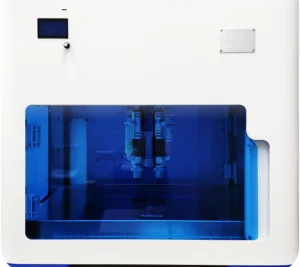
The foundational technology in question, vat photopolymerization, is a widely recognized 3D printing technique. It operates by filling a vat with a light-sensitive liquid resin. Subsequently, a laser or ultraviolet light source precisely solidifies specific areas of this resin, layer by layer, to construct a three-dimensional object. While this method offers remarkable precision and the ability to create complex geometries, its utility has been historically constrained by the inherent properties of photopolymer resins. These materials, by their very nature, are limited to polymers that react to light, thereby restricting the range of end-use materials that can be directly fabricated.
For years, scientists have sought to bridge this gap by transforming these printed polymer structures into more durable materials such as metals and ceramics. However, these existing methods have encountered significant hurdles. Daryl Yee, who leads the Laboratory for the Chemistry of Materials and Manufacturing at EPFL’s School of Engineering, articulates these persistent challenges. "These materials tend to be porous, which significantly reduces their strength, and the parts suffer from excessive shrinkage, which causes warping," he explains. Porosity, the presence of voids within the material, fundamentally compromises its structural integrity, making it brittle and prone to failure under stress. Excessive shrinkage, a common byproduct of the post-processing transformations required to convert polymers to metals or ceramics, leads to dimensional inaccuracies and distortion, rendering the printed parts unsuitable for applications demanding tight tolerances.
A Two-Stage Approach: Printing the Framework, Then Infusing the Material
The EPFL team’s innovative solution ingeniously sidesteps these limitations by adopting a fundamentally different strategy. Instead of attempting to incorporate metal or ceramic precursors directly into the light-curable resin, they first 3D print a structural scaffold using a readily available and benign water-based gel known as a hydrogel. This hydrogel serves as a versatile "blank" template, offering excellent printability and biocompatibility, making it ideal for the initial fabrication of intricate shapes.
Following the printing of this hydrogel framework, the crucial material infusion process begins. The "blank" structure is then immersed in a solution containing metal salts. Through a carefully controlled chemical conversion process, these metal salts are transformed into minute, metal-containing nanoparticles. These nanoparticles are then chemically anchored and spread uniformly throughout the porous hydrogel matrix. This process is not a one-time event; it is repeated multiple times in a cyclical manner, referred to as "growth cycles." Each cycle progressively increases the concentration of metal within the hydrogel, gradually building up a dense composite material.
From Gel to Metal: The Power of Repeated Growth Cycles
The efficacy of this iterative "growth cycle" approach is a cornerstone of the EPFL team’s success. After approximately five to ten of these cycles, the hydrogel framework, having served its purpose as a precise mold and nanoparticle delivery system, is no longer needed. It is then removed through a controlled heating process, a step that effectively evaporates the water and breaks down the polymer structure of the hydrogel. What remains is a solid, dense object composed entirely of the desired metal or ceramic material. Crucially, this final object precisely replicates the intricate shape of the original printed hydrogel, maintaining the dimensional fidelity and complex geometry that was initially defined.
A significant advantage of this post-printing material infusion strategy is its inherent flexibility. Because the metal salts are introduced after the 3D printing of the hydrogel template, the same initial gel structure can be utilized to produce a diverse array of materials. This means that a single hydrogel print can be transformed into objects made from iron, silver, copper, or even various ceramic compounds, simply by changing the metal salt solution used in the immersion steps. This adaptability dramatically expands the material palette available to designers and engineers working with 3D printed components.
A New Era of Material Selection in Additive Manufacturing
Daryl Yee emphasizes the paradigm shift this research represents. "Our work not only enables the fabrication of high-quality metals and ceramics with an accessible, low-cost 3D printing process; it also highlights a new paradigm in additive manufacturing where material selection occurs after 3D printing, rather than before," Yee states. This is a fundamental departure from conventional additive manufacturing, where the material properties are largely dictated by the feedstock material used in the printing process itself. The EPFL method empowers users to define the geometry first and then select the material, offering unparalleled design freedom and material optimization possibilities.
Demonstrating Precision and Strength: The Gyroid Lattice Experiment
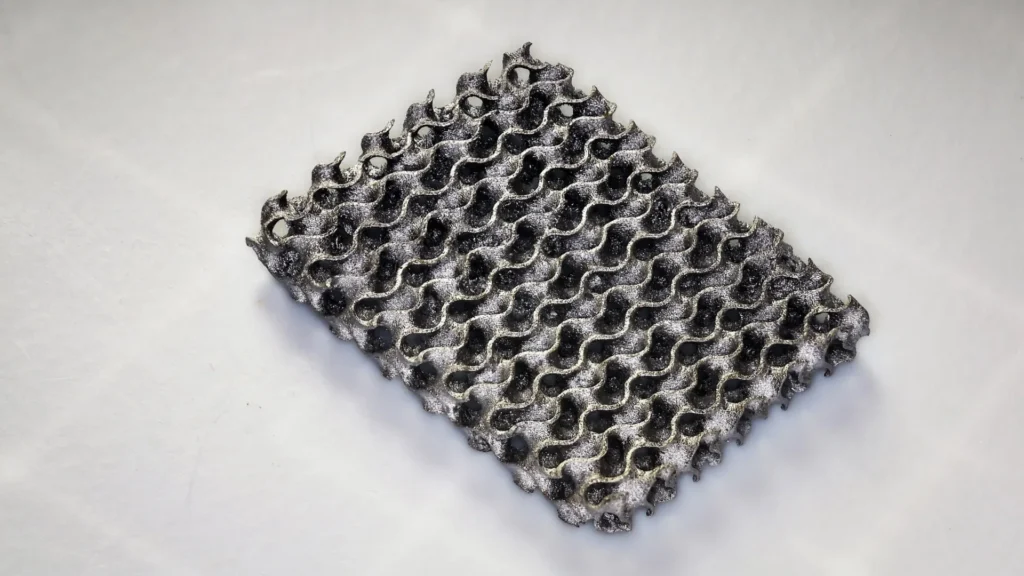
To rigorously validate their technique, the EPFL researchers undertook a series of experiments designed to showcase its capability in producing complex and robust structures. They focused on fabricating intricate mathematical lattice shapes known as gyroids. Gyroids are highly efficient structures that exhibit exceptional strength-to-weight ratios and are found in various natural phenomena. The team successfully printed these gyroid lattices using iron, silver, and copper, demonstrating the versatility of their method across different metallic elements.
The strength of these newly fabricated gyroid structures was then subjected to stringent testing. Using a sophisticated device called a universal testing machine, the researchers applied increasing levels of pressure to the printed lattices. The results were remarkably impressive. Yiming Ji, a PhD student and the first author of the Advanced Materials paper, highlights the significant improvements. "Our materials could withstand 20 times more pressure compared to those produced with previous methods, while exhibiting only 20% shrinkage versus 60-90%," Ji reports. This data underscores the superior mechanical properties and dimensional stability achieved by the EPFL’s novel approach, far surpassing the performance of prior polymer-to-metal conversion techniques.
Targeting Advanced 3D Architectures for Cutting-Edge Applications
The implications of this research are profound, particularly for fields requiring advanced 3D architectures that demand a combination of strength, lightness, and intricate design. The scientists envision their technique being particularly valuable for the fabrication of components in several critical sectors.
- Sensors: Complex, high-surface-area structures are often required for sensitive detection mechanisms. The ability to create these with metallic properties opens doors for more efficient and robust sensor designs.
- Biomedical Devices: The biocompatibility of the initial hydrogel, combined with the potential to create precise metallic or ceramic implants and prosthetics with tailored mechanical properties, is a significant advantage.
- Energy Conversion and Storage: Devices like fuel cells, batteries, and catalysts rely on materials with specific surface characteristics and high conductivity. The EPFL method can produce metal structures with controlled porosity and high surface areas, ideal for optimizing energy conversion and storage processes. For instance, metal catalysts are indispensable for facilitating chemical reactions that convert chemical energy into electrical power. High-surface-area metals with advanced cooling properties are also crucial for next-generation energy technologies.
- Aerospace and Automotive: The demand for lightweight yet incredibly strong components is a constant in these industries. The ability to print complex metal geometries with superior mechanical performance could lead to significant weight reductions and performance enhancements.
- Microfluidics: The precise control over intricate channel designs offered by this method is ideal for creating sophisticated microfluidic devices used in research, diagnostics, and chemical synthesis.
Future Directions: Industrial Adoption and Process Optimization
While the current research represents a significant leap forward, the EPFL team is already looking towards the future with ambitious goals aimed at facilitating widespread industrial adoption. One key focus is on further enhancing the density of the printed materials. Achieving near-theoretical density in the final metallic or ceramic components would further augment their mechanical strength and performance.
Another critical area of development is speed. The iterative nature of the "growth cycles," while essential for achieving high material loading, currently makes the process more time-consuming compared to other 3D printing techniques, particularly those that directly print with metal powders or wires. To address this, Daryl Yee and his team are actively exploring ways to accelerate the infusion steps. "We are already working on bringing the total processing time down by using a robot to automate these steps," Yee reveals. Automation of the repetitive immersion and drying cycles is expected to significantly reduce the overall fabrication time, making the technology more competitive for industrial production timelines.
A Timeline of Innovation (Inferred Chronology)
The development of this novel 3D printing method likely follows a typical research and development trajectory:
- Early Stage Research (Hypothetical: 2-3 years prior): Initial conceptualization of a post-printing material infusion strategy, exploring the feasibility of using hydrogels as templates and the chemical processes for nanoparticle formation within a gel matrix. This would involve laboratory-scale experiments with small material samples.
- Proof of Concept (Hypothetical: 1-2 years prior): Successful demonstration of the core principle, printing simple shapes and achieving some level of metal incorporation. This stage would involve refining the chemical reactions and identifying optimal parameters for nanoparticle growth.
- Development and Optimization (Hypothetical: 1 year prior – present): Focus on refining the "growth cycle" process, increasing metal content, and addressing issues of porosity and shrinkage. This period would have seen the team experiment with different hydrogel formulations, metal salt solutions, and post-processing techniques. The successful fabrication of complex gyroid structures and their rigorous mechanical testing would fall within this phase.
- Publication and Dissemination (Present): The culmination of years of research with the publication of findings in Advanced Materials, signaling the official unveiling of the technology to the scientific and engineering communities.
- Future Development and Industrialization (Ongoing): Efforts to scale up the process, improve speed, and explore commercial applications, likely involving partnerships with industry leaders and further refinement of the automation strategies.
Expert Reactions and Broader Implications
While specific external reactions are not provided in the source material, the publication of such a significant advancement in a leading journal like Advanced Materials typically garners considerable attention within the scientific community. Experts in materials science, additive manufacturing, and chemical engineering would likely view this work as a major breakthrough.
- Materials Scientists: Would recognize the elegant solution to the long-standing challenge of creating dense, high-performance ceramic and metallic components via additive manufacturing. The ability to precisely control material composition and structure at the nanoscale within a macroscale printed object is a key innovation.
- Additive Manufacturing Engineers: Would see this as a potential game-changer, expanding the range of printable materials and opening up new design possibilities for high-value applications. The decoupling of geometry and material selection offers unprecedented design flexibility.
- Industry Leaders: Companies involved in aerospace, automotive, medical devices, and energy technologies would likely be keenly interested in the potential for producing lighter, stronger, and more functional components. The promise of lower costs compared to traditional subtractive manufacturing methods for complex parts would also be a significant draw.
The broader implications of this research extend beyond incremental improvements in 3D printing. It signifies a fundamental shift in how we approach the creation of advanced materials. By enabling the precise fabrication of complex geometries and then infusing them with high-performance materials, the EPFL team has not only solved a technical challenge but has also paved the way for entirely new design philosophies and manufacturing processes. This could accelerate innovation in fields where material properties are paramount, leading to the development of next-generation technologies that were previously confined to the realm of theoretical possibility. The ability to precisely engineer the structure and composition of metals and ceramics at the micro and nanoscale, within complex 3D architectures, holds the key to unlocking unprecedented levels of performance and functionality in a wide array of critical applications.