The construction industry, a cornerstone of global development and infrastructure, faces a critical challenge: its substantial environmental footprint. In 2022, the production of construction materials alone contributed over 7 percent of total global carbon emissions, according to the International Energy Agency (IEA). This staggering figure underscores the urgent need for innovative approaches to reduce material consumption without compromising structural integrity or functionality. Now, a team of researchers at the Massachusetts Institute of Technology (MIT) has developed a groundbreaking framework that promises to bridge the gap between theoretical material optimization and practical, large-scale construction, potentially leading to multi-gigaton reductions in building-related emissions.
For decades, the concept of topology optimization has offered a tantalizing solution to material waste. This computational technique allows engineers to design structures that use the absolute minimum amount of material necessary to achieve a desired strength and performance. In some theoretical applications, such as those explored in 3D printing, topology optimization has demonstrated the potential to reduce material usage by as much as 90 percent. However, its widespread adoption in the construction of buildings, bridges, and other large-scale infrastructure has been hindered by a fundamental disconnect: the designs generated by traditional topology optimization are often too complex and impractical for conventional construction methods, leading to significant delays and budget overruns.
The MIT researchers, led by Associate Professor Josephine Carstensen and doctoral student Zane Schemmer, have addressed this critical limitation head-on. Their novel framework, detailed in a recent publication in the journal Automation in Construction, introduces a sophisticated set of constraints that can be applied to algorithmically generated designs. These constraints empower engineers to limit the complexity of structures, ensuring that the optimized designs are not only materially efficient but also readily constructible within real-world project timelines and budgets.
"There’s an interplay between the materials you’re using, the constructability of designs, and the optimization of the structure," explained Professor Carstensen, who holds MIT’s Gilbert W. Winslow (1937) Career Development Professorship in Civil Engineering. "You need to be able to address all three at the same time. That’s what we tried to do here."
Bridging the Gap Between Theory and Practice
Topology optimization, a technique that has been explored for decades, works by distributing material within a defined space to achieve maximum structural efficiency. It essentially asks at each point within a design volume: "Should there be material here or not?" to create the strongest possible structure at the lowest possible weight. The resulting designs often resemble intricate, organic, or web-like forms that, while theoretically optimal, pose significant challenges for traditional construction practices.
"A big question Josephine and I were asking is why isn’t industry using it?" recalled Schemmer, the first author of the paper. "What are the obstacles that prevent industry from designing things more efficiently, and how can we fill the gaps between research and real life?"
The MIT team’s framework tackles this "usability gap" by introducing user-defined parameters that directly influence the complexity and buildability of the optimized designs. For instance, users can now specify constraints on:
- Component Connectivity: Limiting the number of individual components that can meet at a single junction point. This directly addresses the practical difficulties of assembling complex nodes in large-scale structures.
- Minimum Part Size: Setting a lower bound on the dimensions of individual structural elements, ensuring that components are of a manageable size for fabrication and assembly.
- Angle of Connections: Defining the minimum allowable angle between connected components, which can simplify joining processes and ensure structural stability.
Beyond these geometric constraints, the framework builds upon previous advancements by enabling the design of structures that incorporate multiple materials. This is a crucial step towards sustainable construction, as it allows for the strategic use of different materials based on their properties and carbon footprint. The algorithm considers material characteristics, such as a steel member’s ability to withstand compression versus a steel cable’s tensile strength, and specifies how parts should be connected, mimicking the distinct rules and procedures required for working with materials like timber versus steel.
"In 3D printing, the way things come together is easy," Professor Carstensen noted. "In construction, that’s not the case. If you’re building with timber there’s a certain rule set, versus steel has a different rule set." The MIT framework aims to incorporate these real-world construction nuances into the optimization process.
Multi-Material Design and Carbon Footprint Optimization
A significant aspect of the new framework is its ability to integrate multi-material design with constructability constraints. This is particularly relevant in the context of sustainability. As Schemmer articulated, "A big aspect of sustainability going forward will be not only using less material, but also implementing materials efficiently based on considerations like where you are in the world, your access to materials, and each of their associated carbon costs."
The researchers employed a class of algorithms known as mixed-integer programming, which are adept at making binary decisions crucial for design. These algorithms determine, for example, whether a specific structural element will be made of timber or steel, rather than attempting to create composite materials at a single point. "You can’t have a part that’s 72 percent timber and 28 percent steel," Schemmer explained. "Instead, it says, ‘This truss or cable is going to be made out of this,’ and then based on that decision, how do we make sure all of these connections meet their strength standards?"
The system’s ability to consider material properties and connection rules is a substantial leap forward. For instance, the model understands that steel is well-suited for compressive loads in struts but not for tensile loads in cables, and it can then design accordingly. This nuanced understanding of material behavior, coupled with realistic modeling of how parts connect, differentiates the MIT approach from earlier optimization methods that often oversimplified these critical aspects.
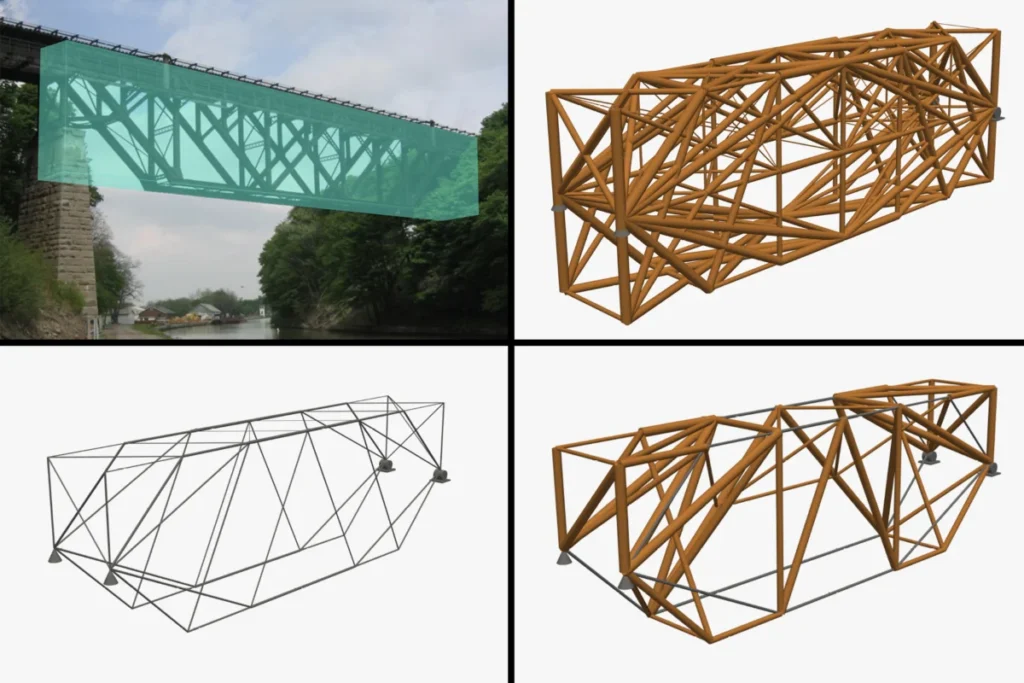
The researchers demonstrated the efficacy of their framework by designing various steel, wood, and multi-material truss structures. By applying different sets of constraints, they observed significant variations in the associated carbon emissions, highlighting the direct link between design choices, material selection, and environmental impact. For example, they analyzed truss designs for the Lockport "Upside-Down Bridge" near Buffalo, New York, applying individual constraints like minimum connection angles or minimum part sizes to understand their impact on the final design and its buildability.
The analysis revealed the trade-offs inherent in material selection. A bridge designed entirely of steel might offer robustness but carry a high carbon cost. Conversely, a timber bridge could offer significant carbon savings but might not always be the strongest option. The framework facilitates finding a balance, allowing for the use of timber where its carbon benefits are most impactful and steel in areas requiring enhanced strength, thereby optimizing both environmental performance and structural integrity.
From Research Labs to Construction Sites
While the computational demands of this advanced optimization are acknowledged, the MIT team has strived to make their approach practical for industry adoption. They successfully ran their experimental programs on a MacBook Pro, suggesting that the framework is feasible for most civil engineering firms, even those without access to high-performance computing clusters.
"It’s computationally a little tougher to solve, but there’s a lot of tools coming out nowadays that make these problems a lot more feasible," Schemmer stated. "This approach has been avoided by industry in the past, but now we think it’s a practical way to solve problems dealing with variable constraints."
The researchers envision their framework evolving to accommodate an even wider array of materials and to tackle the design of significantly larger and more complex structures, from skyscrapers to extensive transportation networks, given sufficient computational resources.
Looking ahead, Professor Carstensen and her team plan to move beyond simulations. They intend to construct scaled-down physical models based on their framework’s designs to rigorously validate their computational predictions against real-world performance. Furthermore, they aim to integrate additional constraints that will streamline the design process for civil engineers, making the incorporation of sustainability and constructability considerations more intuitive and seamless.
"As a structural engineer by training, I was never taught how to design for low-carbon," Schemmer reflected. "To tackle a problem as big as climate change, addressing the built environment is a great place to start. One of the most tangible things we can do is work at the layer of construction, at the design stage, because that’s a fundamental step that we can control. There’s a lot of decisions we make early on that lead us to use extra material we don’t need."
The research was supported by the MIT Morningside Academy for Design, underscoring the institution’s commitment to fostering innovation at the intersection of design, engineering, and sustainability.
Broader Implications for the Built Environment
The implications of this MIT research extend far beyond academic interest. The construction industry is a significant consumer of natural resources and a major contributor to greenhouse gas emissions. By making topology optimization a practical tool for engineers, this framework has the potential to:
- Dramatically Reduce Embodied Carbon: The carbon emissions associated with the extraction, manufacturing, and transportation of building materials represent a substantial portion of the built environment’s climate impact. Reducing material usage directly translates to lower embodied carbon.
- Lower Construction Costs: While not explicitly the primary focus, using less material can inherently lead to reduced material procurement costs, transportation expenses, and potentially lighter foundations, all of which can contribute to overall project savings.
- Enhance Structural Innovation: By overcoming the limitations of traditional design methods, topology optimization can lead to novel and more efficient structural forms that might not have been conceived otherwise.
- Promote Material Circularity: Designs that use materials more efficiently can also facilitate easier disassembly and reuse of components at the end of a structure’s life cycle, supporting the principles of a circular economy.
- Accelerate the Transition to Sustainable Infrastructure: As cities and nations grapple with climate change, the ability to build resilient and sustainable infrastructure more efficiently will be paramount. This framework offers a tangible pathway toward achieving those goals.
The research also aligns with global initiatives, such as the Breakthrough Agenda, which aims to accelerate the development and deployment of clean energy technologies and sustainable solutions across key sectors, including buildings. By providing engineers with tools to design smarter and use less, MIT’s work contributes directly to these critical international efforts.
While the practical implementation of this framework will require ongoing collaboration between researchers and industry professionals, the foundational work laid by Carstensen, Schemmer, and their colleagues represents a significant stride towards a more sustainable and resource-efficient future for the global construction sector. The transition from theoretical optimization to widespread application is a complex journey, but with this innovative approach, the vision of buildings and bridges that are both structurally sound and environmentally responsible is moving closer to reality.